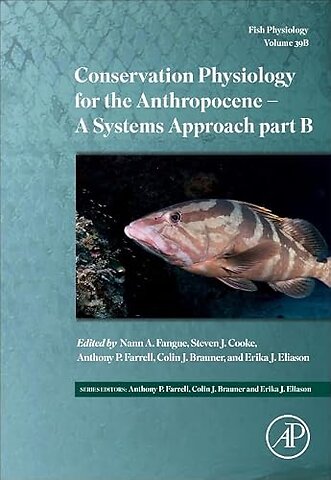
Conservation Physiology for the Anthropocene - Issues and Applications
Gebonden Engels 2022 9780128242681Samenvatting
Conservation Physiology for the Anthropocene – A Systems Approach, Volume 39B in the Fish Physiology series, is a comprehensive synthesis related to the physiology of fish in the Anthropocene. This volume helps solve knowledge gaps by considering the many ways in which different physiological systems (e.g., sensory physiology, endocrine, cardio-respiratory, bioenergetics, water and ionic balance and homeostasis, locomotion/biomechanics, gene function) and physiological diversity are relevant to the management and conservation of fish and fisheries. Chapters in this release include Using physiology for recovering imperiled species – the Delta smelt, Conservation hatcheries – the Sturgeon story, Aquatic pollutants and stressors, and more.
Other sections discuss Fisheries interactions in a multi-stressor world, Environmental change in riverine systems - Amazon basin stressors, Environmental change in lakes and wetlands – East African basin stressors, Coral reef fish in a multi-stressor world, Polar fish in a multi-stressor world, Physiology informs fisheries restoration and habitat management, A physiological perspective on fish passage and entrainment, Invasive species control and management – the sea lamprey story, and On the conservation physiology of fishes for tomorrow.
Specificaties
Lezersrecensies
Inhoudsopgave
Preface
Nann A. Fangue, Steven J. Cooke, Anthony P. Farrell, Colin J. Brauner and Erika J. Eliason
1. Using physiology to recover imperiled smelt species
Yuzo R. Yanagitsuru, Brittany E. Davis, Melinda R. Baerwald, Ted R. Sommer and Nann A. Fangue
2. Conservation aquaculture—A sturgeon story
W. Gary Anderson, Andrea Schreier and James A. Crossman
3. Using ecotoxicology for conservation: From biomarkers to modeling
Gudrun De Boeck, Essie Rodgers and Raewyn M. Town
4. Consequences for fisheries in a multi-stressor world
Shaun S. Killen, Jack Hollins, Barbara Koeck, Robert J. Lennox and Steven J. Cooke
5. Environmental stressors in Amazonian riverine systems
Adalberto Luis Val, Rafael Mendonça Duarte, Derek Campos and Vera Maria Fonseca de Almeida-Val
6. Fish response to environmental stressors in the Lake Victoria Basin ecoregion
Lauren J. Chapman, Elizabeth A. Nyboer and Vincent Fugère
7. Coral reef fishes in a multi-stressor world
Jodie L. Rummer and Björn Illing
8. Restoration physiology of fishes: Frontiers old and new for aquatic restoration
Katherine K. Strailey and Cory D. Suski
9. A conservation physiological perspective on dam passage by fishes
Scott G Hinch, Nolan N Bett and Anthony P. Farrell
10. Invasive species control and management: The sea lamprey story
Michael P. Wilkie, Nicholas S. Johnson and Margaret F. Docker
11. Conservation physiology of fishes for tomorrow: Successful conservation in a changing world and priority actions for the field
Lisa M. Komoroske and Kim Birnie-Gauvin
Rubrieken
- advisering
- algemeen management
- coaching en trainen
- communicatie en media
- economie
- financieel management
- inkoop en logistiek
- internet en social media
- it-management / ict
- juridisch
- leiderschap
- marketing
- mens en maatschappij
- non-profit
- ondernemen
- organisatiekunde
- personal finance
- personeelsmanagement
- persoonlijke effectiviteit
- projectmanagement
- psychologie
- reclame en verkoop
- strategisch management
- verandermanagement
- werk en loopbaan