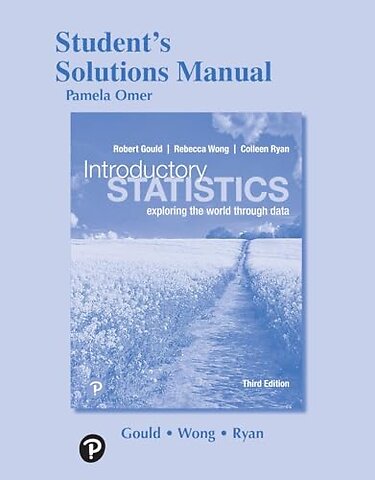
Colleen Ryan,
Robert Gould,
Robert N. Gould
Student Solutions Manual for Introductory Statistics
Exploring the World Through Data
Gebonden Engels 2019 3e druk 9780135189238Levertijd ongeveer 9 werkdagen
Gratis verzonden
Samenvatting
This manual provides detailed solutions to odd-numbered exercises in the text.
0135189233 / 9780135189238 STUDENT SOLUTIONS MANUAL FOR INTRODUCTORY STATISTICS, 3/e
Specificaties
ISBN13:9780135189238
Taal:Engels
Bindwijze:Gebonden
Aantal pagina's:128
Uitgever:Pearson Education
Druk:3
Lezersrecensies
Wees de eerste die een lezersrecensie schrijft!
Inhoudsopgave
1. Introduction to Data
- 1.1 What Are Data?
- 1.2 Classifying and Storing Data
- 1.3 Investigating Data
- 1.4 Organizing Categorical Data
- 1.5 Collecting Data to Understand Causality
2. Picturing Variation with Graphs
- 2.1 Visualizing Variation in Numerical Data
- 2.2 Summarizing Important Features of a Numerical Distribution
- 2.3 Visualizing Variation in Categorical Variables
- 2.4 Summarizing Categorical Distributions
- 2.5 Interpreting Graphs
3. Numerical Summaries of Center and Variation
- 3.1 Summaries for Symmetric Distributions
- 3.2 What's Unusual? The Empirical Rule and z-Scores
- 3.3 Summaries for Skewed Distributions
- 3.4 Comparing Measures of Center
- 3.5 Using Boxplots for Displaying Summaries<
4. Regression Analysis: Exploring Associations between Variables
- 4.1 Visualizing Variability with a Scatterplot
- 4.2 Measuring Strength of Association with Correlation
- 4.3 Modeling Linear Trends
- 4.4 Evaluating the Linear Model
5. Modeling Variation with Probability
- 5.1 What Is Randomness?
- 5.2 Finding Theoretical Probabilities
- 5.3 Associations in Categorical Variables
- 5.4 Finding Empirical Probabilities
6. Modeling Rando Events: The Normal and Binomial Models
- 6.1 Probability Distributions Are Models of Random Experiments
- 6.2 The Normal Model
- 6.3 The Binomial Model (Optional)
7. Survey Sampling and Inference
- 7.1 Learning about the World through Surveys
- 7.2 Measuring the Quality of a Survey
- 7.3 The Central Limit Theorem for Sample Proportions
- 7.4 Estimating the Population Proportion with Confidence Intervals
- 7.5 Comparing Two Population Proportions with Confidence
8. Hypothesis Testing for Population Proportions
- 8.1 The Essential Ingredients of Hypothesis Testing
- 8.2 Hypothesis Testing in Four Steps
- 8.3 Hypothesis Tests in Detail
- 8.4 Comparing Proportions from Two Populations
9. Inferring Population Means
- 9.1 Sample Means of Rando Samples
- 9.2 The Central Limit Theorem for Sample Means
- 9.3 Answering Questions about the Mean of a Population
- 9.4 Hypothesis Testing for Means
- 9.5 Comparing Two Population Means
- 9.6 Overview of Analyzing Means
10. Associations between Categorical Variables
- 10.1 The Basic Ingredients for Testing with Categorical Variables
- 10.2 The Chi-Square Test for Goodness of Fit
- 10.3 Chi-Square Tests for Associations between Categorical Variables
- 10.4 Hypothesis Tests When Sample Sizes Are Small
11. Multiple Comparisons and Analysis of Variance
- 11.1 Multiple Comparisons
- 11.2 The Analysis of Variance
- 11.3 The ANOVA Test
- 11.4 Post-Hoc Procedures
12. Experimental Design: Controlling Variation
- 12.1 Variation Out of Control
- 12.2 Controlling Variation in Surveys
- 12.3 Reading Research Papers
13. Inference without Normality
- 13.1 Transforming Data
- 13.2 The Sign Test for Paired Data
- 13.3 Mann-Whitney Test for Two Independent Groups
- 13.4 Randomization Tests
14. Inference for Regression
- 14.1 The Linear Regression Model
- 14.2 Using the Linear Model
- 14.3 Predicting Values and Estimating Means
Rubrieken
- advisering
- algemeen management
- coaching en trainen
- communicatie en media
- economie
- financieel management
- inkoop en logistiek
- internet en social media
- it-management / ict
- juridisch
- leiderschap
- marketing
- mens en maatschappij
- non-profit
- ondernemen
- organisatiekunde
- personal finance
- personeelsmanagement
- persoonlijke effectiviteit
- projectmanagement
- psychologie
- reclame en verkoop
- strategisch management
- verandermanagement
- werk en loopbaan