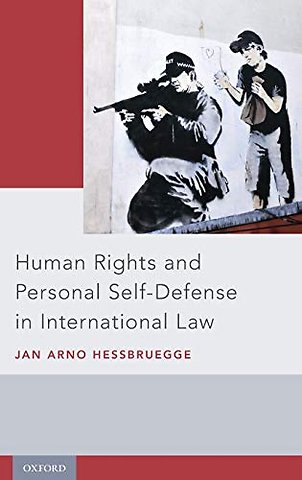
Human Rights and Personal Self-Defense in International Law
Gebonden Engels 2017 1e druk 9780190655020Samenvatting
While an abundance of literature covers the right of states to defend themselves against external aggression, this is the first book dedicated to the right to personal self-defense in international law. Drawing on his extensive experience as a human rights practitioner and scholar, Dr. Hessbruegge sets out in careful detail the strict requirements that human rights impose on defensive force by law enforcement authorities, especially police killings in self-defense. The book also discusses the exceptional application of the right to personal self-defense in military-led operations, notably to contain violent civilians who do not directly participate in hostilities.
Human rights also establish parameters on how broad or narrow the laws can be drawn on self-defense between private persons. Setting out the prevailing international standards, the book critically examines the ongoing trend to excessively broaden self-defense laws. It also refutes the claim that there is a human right to possess firearms for self-defense purposes.
In extraordinary circumstances, the right to personal self-defence sharpens human rights and allows people to defend themselves against the state. Here the author establishes that international law gives individuals the right to forcibly resist human rights violations that pose a serious risk of significant and irreparable harm. At the same time, he calls into question prevailing state practice, which fails to recognize any collective right to organized armed resistance even when it constitutes the last resort to defend against genocide or other mass atrocities.
Specificaties
Lezersrecensies
Inhoudsopgave
1: Introduction
A. Summary of the argument
B. Delineation of the topic: What is personal self-defense?
I. Distinction of self-defense from other concepts of self-help
II. Distinction between personal and interstate self-defense
C. Methodology and sources
I. Reliance on universal and regional jurisprudence
II. Transposition of jurisprudence from other disciplines of international law
III. Consideration of arguments from domestic jurisprudence
2: The right to personal self-defense as a general principle of law
A. No treaty provisions establishing a right to personal self-defense
B. No recognition under customary international law
C. General principles according to Article 38 (1) (c) ICJ Statute
I. Formation of general principles
II. Functions of general principles
D. The right to self-defense as a principle of natural law
I. Personal self-defense: a shared principle across cultural and religious traditions
II. Inherent moral justification of self-defense
E. The right to self-defense as a general principle derived from domestic law
I. Common classification as a right and justification
II. Comparable requirements of application
F. Transposition of the personal self-defense principle into international law
I. International humanitarian law
II. International criminal law
III. The law of the sea
IV. The law of diplomatic relations
G. Conclusion: A universally recognized right, but no unlimited license for violence
3: A human right to self-defense?
A. Positions in the academic literature
B. Lack of state recognition of a human right to self-defense
I. No recognition of a human right in international treaties or resolutions
II. Insufficient national legislative practice supporting a human right
C. Conceptual differences between the right to self-defense and human rights
I. Inalienable nature as a commonality
II. Auxiliary and relational nature of the right to self-defense
III. No specific aim of curbing state power and abuses
IV. Neutrality of the right to self-defense on the nature of the state
D. Conclusion: Right sui generis, not human right
4: Defensive force by law enforcement agents
A. Self-defense as a justified limitation of the rights to life and physical security
I. Recognition in universal and regional human rights law
II. Defensive force as a state obligation
III. Self-defense as the sole peacetime justification of deliberately lethal force
B. Formal requirement: Sufficient basis for the use of force in domestic law
I. Minimum specifications
II. Publicity
III. Parliamentary prerogative to regulate lethal force
C. Substantive requirements for self-defense as a ground of justification
I. Unlawful attack against protected individual interests
II. Immediacy of defensive action
III. Necessity of defensive action
IV. Proportionality of defensive action
V. Defensive Intent
D. Burden of Proof and evaluation of evidence
E. Post-action duties of care, accountability and remedy
II. Duty to investigate incidents involving use of firearms and other force
III. Duty to prosecute perpetrators of excessive force
IV. Duties to provide compensation and, exceptionally, to make amends
F. Conclusion: A deep, but narrow justification for the use of force in law enforcement
5: Personal self-defense in military-led operations
A. Exceptional relevance of the personal self-defense principle in armed conflict
I. Riots, violent demonstrations and opportunistic banditry
II. Violent prisoners of war and interned fighters
III. Enforcement of naval blockades and ceasefire lines
B. Military involvement in peacetime law enforcement
C. "Naked self-defense" - a conflation of personal and interstate self-defense
D. Conclusion: Exceptional relevance of personal self-defense in military-led operations
6: Human rights standards for self-defense between private persons
A. Applicability of human rights standards to self-defense between private persons
B. Duty to recognize a right to self-defense between private persons
C. Duty to regulate and reasonably circumscribe self-defense between private persons
I. Unlawful attack on a defensible interest
II. Immediate defense: An exception for victims of intra-family violence?
III. Necessity and proportionality
IV. Special requirements regarding private security companies
D. Duty to investigate and prosecute excessive or unwarranted self-defense
I. Immunities from prosecution
II. Burden of proof
E. No general right to possess firearms and other means of self-defense
I. Negative impact of gun proliferation on the protection of life and physical security
II. No enhancement of women's right to self-defense
III. No effective means to pre-empt tyranny or atrocities
IV. The right to self-defense of unarmed citizens
F. Conclusion: Human rights circumscribe the ambit of private self-defense
7: Self-defense against the state - resistance against human rights violations
A. Resistance against the state - a history of opposing views
I. Resistance as a legitimate defense against abusive governments
II. Unassailable authority based on divine mandate or constitutional supremacy
III. Rebellion as a threat to order and stability
IV. Balancing stability and vindication of the right to self-defense
B. Personal self-defense against unlawful individual acts of law enforcement officials
I. Resistance against extrajudicial killings, torture and other police brutality
II. No resistance against arbitrary arrest and detention if judicial remedies available
III. Force to escape inhumane conditions of detention
IV. General limits of the right to resist individual human rights violations
C. Collective self-defense below the threshold of direct participation in armed conflict
I. Limits based on the right to self-defense
II. Distinction between civilian defense groups and organized armed groups
D. Organized armed resistance against denials of the right to self-determination
I. Legal Basis for a right to organized armed resistance
II. Limits of the right to organized armed resistance
III. Legal implications of the right to resistance
IV. No right to rebel against undemocratic governments
E. Organized armed resistance against mass atrocities
I. No state recognition of a right of armed resistance against mass atrocities
II. The case for a right of armed struggle against mass atrocities
III. Limits of a right to resist mass atrocities
IV. Legal implications of a right to resist mass atrocities
V. No justification of unilateral humanitarian interventions
F. Conclusion: A right to resistance only in exceptional circumstances
8: The right to personal self-defense in a Rechtsstaat - final reflections
Bibliography
Index
Anderen kochten ook
 Chris O'Meara€ 165,54
 Lawrence Hill-Cawthorne€ 55,10
 Jens Ohlin€ 149,35
 Ezequiel Heffes€ 129,70
 Anne Quintin€ 234,77
 Stuart Casey-Maslen€ 152,17
Rubrieken
- advisering
- algemeen management
- coaching en trainen
- communicatie en media
- economie
- financieel management
- inkoop en logistiek
- internet en social media
- it-management / ict
- juridisch
- leiderschap
- marketing
- mens en maatschappij
- non-profit
- ondernemen
- organisatiekunde
- personal finance
- personeelsmanagement
- persoonlijke effectiviteit
- projectmanagement
- psychologie
- reclame en verkoop
- strategisch management
- verandermanagement
- werk en loopbaan