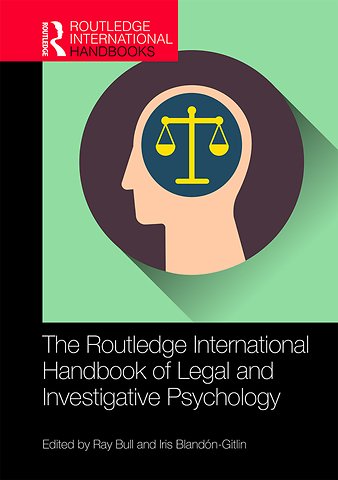
The Routledge International Handbook of Legal and Investigative Psychology
Gebonden Engels 2019 1e druk 9780367345570Samenvatting
The Routledge International Handbook of Legal and Investigative Psychology explores contemporary topics in psychological science, applying them to investigative and legal procedures. Written by recognized scholars from around the globe, this book brings together current research, emerging trends, and cutting-edge debates in a single comprehensive and authoritative volume.
Drawing from both research and practice, this handbook highlights many important issues such as: how to investigate and prosecute rape; the value of emotional affect in homicide investigations; and factors affecting jurors’ and suspects’ decision making. By considering current research, the authors inform both legal and investigative professionals of findings that are of direct relevance to them, and the steps that can be taken to improve efficiency.
This collection will inform investigative and legal professionals, advanced psychology students, academics, researchers, and policy makers. It will also be of great interest to researchers from other disciplines, including criminology, policing, and law.
Specificaties
Lezersrecensies
Inhoudsopgave
Introduction
Ray Bull and Iris Blandon-Gitlin
- The Right to Remain Silent: Realities and Illusions Saul M. Kassin, Kyle C. Scherr and Fabiana Alceste
- Roar or ‘PEACE’: Is it a ‘Tall Story’? Ray Bull
- True and False Memories in Forensic Contexts Iris Blandon-Gitlin and Elise Fenn
- Investigating and Prosecuting Rape: Victim and Criminal Justice Professionals’ Perspectives Emma Sleath
- The Probative Value of Emotional Affect in Homicide Investigations Emily V. Shaw, Jennifer Gongola, Jennifer Teitcher and Nicholas Scurich
- Investigative Decision Making Karl Ask and Ivar Fahsing
- Cognitive Fluency in the Courtroom Eryn Newman, Madeline Jalbert, and Neal Feigenson
- Interviewing and Interrogating Minority Suspects: Psychological Science Can Help Improve the Process and Outcomes Elise Fenn, Catherine Grosz and Iris Blandon-Gitlin
- Interpreters in Investigative Contexts Jacqueline Evans, Sarah Shaffer and Dave Walsh
- Impact of Alcohol and other Drugs on Eyewitness Memory Heather D. Flowe, Melissa F. Colloff, Lilian Kloft, Theodore Jores and Laura M. Stevens
- Lay Participation in Legal Decision Making Margaret Bull Kovera and Lora M. Levett
- Police Interviewing of Sexual Assault Victims: Current Organisational Responses and Recommendations for Improvement Nina J. Westera, Martine B. Powell, Rebecca Milne and Jane Goodman-Delahunty
- Reviewing the use of Crime Linkage Evidence within a Legal Context Kari Davies, Jessica Woodhams, Matthew Tonkin
- The Verifiability Approach: Advances, Challenges, and Future Prospects Galit Nahari and Aldert Vrij
- Emotion – Internal and External Consequences for Legal Authorities Annika Melinder, Chiara Mirandola, and Livia Gilstrap
- Stalking: How Perceptions differ from Reality and why these Differences matter by Adrian J. Scott
- Establishing cooperation and eliciting information: Semi-cooperative sources’ affective resistance and cognitive strategies Simon Oleszkiewicz and Pär Anders Granhag
- Evidence of Identification from Eyewitnesses Colin Tredoux and Jacques Py
- From the Ivory Tower to the Interrogation Room: Training and Field Evaluation Research on Suspect Interviewing Melissa B. Russano, Christopher E. Kelly, and Christian A. Meissner
- Introducing Psychology to the Justice System in Taiwan
Yee-San Teoh and Leon C. H. Huang
Index
Rubrieken
- advisering
- algemeen management
- coaching en trainen
- communicatie en media
- economie
- financieel management
- inkoop en logistiek
- internet en social media
- it-management / ict
- juridisch
- leiderschap
- marketing
- mens en maatschappij
- non-profit
- ondernemen
- organisatiekunde
- personal finance
- personeelsmanagement
- persoonlijke effectiviteit
- projectmanagement
- psychologie
- reclame en verkoop
- strategisch management
- verandermanagement
- werk en loopbaan