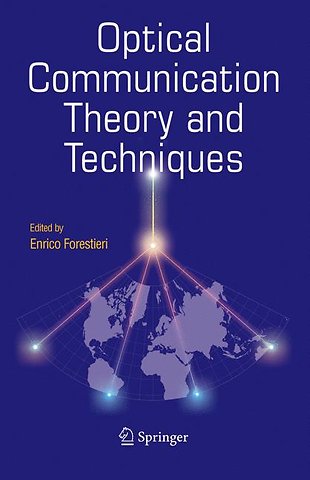
Optical Communication Theory and Techniques
Gebonden Engels 2004 2005e druk 9780387231327Samenvatting
Since the advent of optical communications, a greattechnological effort has been devoted to the exploitation of the huge bandwidth of optical fibers. Sta- ing from a few Mb/s single channel systems, a fast and constant technological development has led to the actual 10 Gb/s per channel dense wavelength - vision multiplexing (DWDM) systems, with dozens of channels on a single fiber. Transmitters and receivers are now ready for 40 Gb/s, whereas hundreds of channels can be simultaneously amplified by optical amplifiers. Nevertheless, despite such a pace in technological progress, optical c- munications are still in a primitive stage if compared, for instance, to radio communications: the widely spread on-off keying (OOK) modulation format is equivalent to the rough amplitude modulation (AM) format, whereas the DWDM technique is nothing more than the optical version of the frequency - vision multiplexing (FDM) technique. Moreover, adaptive equalization, ch- nel coding or maximum likelihood detection are still considered something “exotic” in the optical world. This is mainly due to the favourable char- teristics of the fiber optic channel (large bandwidth, low attenuation, channel stability, ...), which so far allowed us to use very simple transmission and detection techniques.
Specificaties
Lezersrecensies
Rubrieken
- advisering
- algemeen management
- coaching en trainen
- communicatie en media
- economie
- financieel management
- inkoop en logistiek
- internet en social media
- it-management / ict
- juridisch
- leiderschap
- marketing
- mens en maatschappij
- non-profit
- ondernemen
- organisatiekunde
- personal finance
- personeelsmanagement
- persoonlijke effectiviteit
- projectmanagement
- psychologie
- reclame en verkoop
- strategisch management
- verandermanagement
- werk en loopbaan