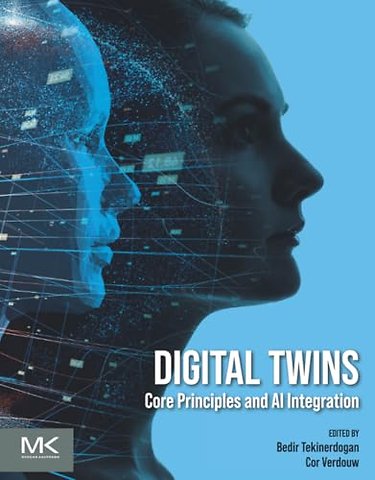
Digital Twins
Core Principles and AI Integration
Paperback Engels 2026 9780443455735Samenvatting
Digital Twins: Core Principles and AI Integration offers a structured and up-to-date overview of digital twin technology, combining foundational principles with the rapidly growing role of artificial intelligence (AI). This book introduces the core concepts, modeling approaches, and software and systems engineering foundations needed to design and implement digital twins effectively. It then explores architectural methods, lifecycle management, interoperability, and the alignment between physical systems and their digital representations. A central part of this book focuses on data science and AI-enabled digital twins, demonstrating how machine learning, deep learning, generative AI, and autonomous agents enhance predictive analytics, optimization, anomaly detection, and automated decision-making. Integration with Internet of Things (IoT), cloud–edge infrastructures, big data analytics, and XR technologies further shows how intelligent digital twins evolve into adaptive and interactive systems. Real-world applications from manufacturing, agriculture, food systems, energy, mobility, healthcare, and urban environments illustrate the practical value of AI-driven digital twins. This book concludes with key challenges and future directions, including trustworthy AI, security, data governance, and the scaling of digital twin ecosystems.
Specificaties
Lezersrecensies
Inhoudsopgave
1. Introduction
2. Modeling artificial intelligence integration in digital twins: a systematic survey
3. Autonomous digital twins: foundations, challenges, and future directions
PART II: AI integration in digital twins
4. System engineering and artificial intelligence integration principles of digital-twins for tactical edge environments
5. Artificial intelligence-augmented digital twins: a comparative study of machine learning and large language model integration in smart systems
6. Enhancing Internet of Things security through artificial intelligence and digital twins
7. Digital twins for artificial intelligencebased simulation of upcoming payment trends
8. Optimizing agricultural sustainability: integrating the power of digital twin and artificial intelligence for renewable energy management
9. Towards intelligent immersive systems: the convergence of digital twins, extended reality, and artificial intelligence
10. Cloud-native digital twins for enhanced autonomous vehicle safety
PART III: Software and systems engineering
11. Enhancing automation and manufacturing with digital twin systems
12. Exploring the concept and use of organizational digital twin
13. Data clumps as structural indicators in digital twin software: a static analysis perspective
14. Intent-based unmanned aerial vehicle control: enabling unmanned aerial vehicle autonomy through large language model-based digital twin control
15. DevOps for and by digital twins leveraging virtual replicas in continuous software engineering
PART IV: Application domains
16. Digital twin underwater game engine environment for generating deep learning fish detection datasets
17. Toward digital twins in the petroleum industry: opportunities and challenges
18. The digital twin revolution: optimizing healthcare built environments for safety, efficiency, and resiliency
19. Reducing errors in disaster management data with digital-twin architecture
20. Digital twins for disaster management: mitigating structural obstacles in the response pipeline
21. Digital twin-based reference architecture for smart greenhouses
Rubrieken
- advisering
- algemeen management
- coaching en trainen
- communicatie en media
- economie
- financieel management
- inkoop en logistiek
- internet en social media
- it-management / ict
- juridisch
- leiderschap
- marketing
- mens en maatschappij
- non-profit
- ondernemen
- organisatiekunde
- personal finance
- personeelsmanagement
- persoonlijke effectiviteit
- projectmanagement
- psychologie
- reclame en verkoop
- strategisch management
- verandermanagement
- werk en loopbaan