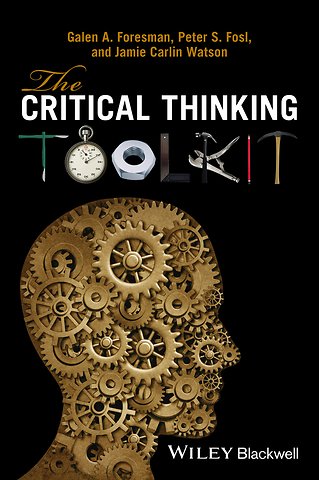
The Critical Thinking Toolkit
Paperback Engels 2016 1e druk 9780470658697Samenvatting
'The Critical Thinking Toolkit' is a comprehensive compendium that equips readers with the essential knowledge and methods for clear, analytical, logical thinking and critique in a range of scholarly contexts and everyday situations.
- Takes an expansive approach to critical thinking by exploring concepts from other disciplines, including evidence and justification from philosophy, cognitive biases and errors from psychology, race and gender from sociology and political science, and tropes and symbols from rhetoric
- Follows the proven format of 'The Philosopher's Toolkit' and 'The Ethics Toolkit' with concise, easily digestible entries, see also recommendations that connect topics, and recommended reading lists
- Allows readers to apply new critical thinking and reasoning skills with exercises and real life examples at the end of each chapter
- Written in an accessible way, it leads readers through terrain too often cluttered with jargon
- Ideal for beginning to advanced students, as well as general readers, looking for a sophisticated yet accessible introduction to critical thinking
Specificaties
Lezersrecensies
Inhoudsopgave
Introduction 1
The Very Idea of Critical Thinking 1
Critical thinking in the formal and empirical sciences 2
Critical thinking, critical theory, and critical politics 4
Critical thinking, finitude, and self–understanding 5
Using this book 5
1 Basic Tools for Critical Thinking about Arguments 7
1.1 Claims 7
1.2 Arguments 11
1.3 Premises 13
1.4 Conclusions 16
2 More Tools for Critical Thinking about Arguments 19
2.1 Deductive and Inductive Arguments 19
2.2 Conditional Claims 22
2.3 Classifying and Comparing Claims 26
2.4 Claims and Definitions 29
2.5 The Critical Thinker s Two Step : Validity and Soundness/Cogency and Strength 32
2.6 Showing Invalidity by Counterexample 35
3 Tools for Deductive Reasoning with Categories 39
3.1 Thinking Categorically 39
3.2 Categorical Logic 40
3.3 Translating English Claims to Standard Form 46
3.4 Formal Deduction with Categories: Immediate Inferences 50
3.5 Formal Deduction with Categories: Syllogisms 63
4 Tools for Deductive Reasoning with Claims 72
4.1 Propositional vs. Categorical Logics 72
4.2 Common Deductively Valid Forms 83
4.3 Equivalences 90
4.4 Formal Deduction with Forms and Equivalences 96
4.5 Common Formal Fallacies 101
5 Tools for Detecting Informal Fallacies 107
5.1 Critical Thinking, Critical Deceiving, and the Two Step 107
5.2 Subjectivist Fallacy 109
5.3 Genetic Fallacies 112
5.4 Ad Hominem Fallacies: Direct, Circumstantial, and Tu Quoque 113
5.5 Appeal to Emotions or Appeal to the Heart (argumentum ad passiones) 120
5.6 Appeal to Force (argumentum ad baculum) 124
5.7 Appeal to Ignorance (argumentum ad ignorantiam) 125
5.8 Appeal to Novelty (argumentum ad novitatem) 127
5.9 Appeal to the People (argumentum ad populum) 128
5.10 Appeal to Unqualified Authority (argumentum ad verecundiam) 132
5.11 Fallacy of Accident 135
5.12 False Dilemma 137
5.13 Semantic and Syntactic Fallacies 138
5.14 Begging the Question (petitio principii) 143
5.15 Question–Begging Sentences 144
5.16 Missing the Point (ignoratio elenchi) 145
5.17 Fallacy of Composition 146
5.18 Fallacy of Division 148
5.19 Is–Ought Fallacy 149
5.20 Appeal to Tradition 152
5.21 Quoting Out of Context 153
5.22 Red Herring 158
5.23 Straw Man and Fidelity 159
5.24 Hasty Fallacization 161
5.25 A Brief Argument Clinic 162
6.1 Inductive vs. Deductive Arguments Again 166
6.2 Analogies and Arguments from Analogy 167
6.3 Fallacies about Causation 170
6.4 Inductive Statistical Reasoning 177
6.5 Base Rate Fallacy 182
6.6 Slippery Slope and Reductio ad Absurdum 184
6.7 Hasty Generalization 188
6.8 Mill s Five Methods 189
7 Tools for Critical Thinking about Experience and Error 195
7.1 Error Theory 195
7.2 Cognitive Errors 197
7.3 Environment and Error 206
7.4 Background and Ignorance 209
7.5 Misleading Language 210
7.6 Standpoint and Disagreement 211
8 Tools for Critical Thinking about Justification 215
8.1 Knowledge: The Basics 215
8.2 Feelings as Evidence 219
8.3 Skepticism and Sensory Experience 223
8.4 Emotions and Evidence 229
8.5 Justifying Values 237
8.6 Justification: The Basics 242
8.7 Truth and Responsible Belief 246
8.8 How Does JustificationWork? 248
8.9 A Problem for Responsible Belief 251
8.10 Evidence:Weak and Strong 256
8.11 Justification: Conclusions 266
9 Tools for Critical Thinking about Science 271
9.1 Science and the Value of Scientific Reasoning 271
9.2 The Purview of Science 273
9.3 Varieties of Possibility and Impossibility 280
9.4 Scientific Method 283
9.5 Unfalsifiability and Falsification Resistance 289
9.6 Experiments and Other Tests 293
9.7 Six Criteria for Abduction 298
9.8 Bad Science 302
10 Tools from Rhetoric, Critical Theory, and Politics 305
10.1 Meta–Narratives 305
10.2 Governing Tropes 308
10.3 The Medium Is the Message 311
10.4 Voice 313
10.5 Semiotics: Critically Reading Signs 316
10.6 Deconstruction 319
10.7 Foucault s Critique of Power 322
10.8 The Frankfurt School: Culture Critique 326
10.9 Class Critiques 328
10.10 Feminist and Gender Critiques 332
10.11 Critiques of Race and Racism 338
10.12 Traditionalist and Historicist Critiques 341
10.13 Ecological Critiques 345
Appendix: RecommendedWeb Sites 349
Index 351
Rubrieken
- advisering
- algemeen management
- coaching en trainen
- communicatie en media
- economie
- financieel management
- inkoop en logistiek
- internet en social media
- it-management / ict
- juridisch
- leiderschap
- marketing
- mens en maatschappij
- non-profit
- ondernemen
- organisatiekunde
- personal finance
- personeelsmanagement
- persoonlijke effectiviteit
- projectmanagement
- psychologie
- reclame en verkoop
- strategisch management
- verandermanagement
- werk en loopbaan