, , , , , e.a.

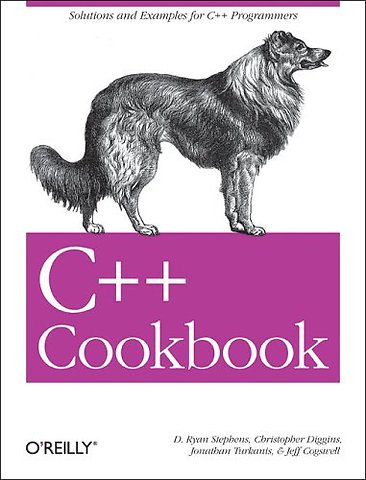
C++ Cookbook

Paperback Engels 2005 9780596007614
€ 58,43
Levertijd ± 16 werkdagen
Gratis verzonden

Samenvatting

Despite its highly adaptable and flexible nature, C++ is also one of the more complex programming languages to learn. Once mastered, however, it can help you organize and process information with amazing efficiency and quickness.
The C++ Cookbook will make your path to mastery much shorter. This practical, problem-solving guide is ideal if you're an engineer, programmer, or researcher writing an application for one of the legions of platforms on which C++ runs. The algorithms provided in C++ Cookbook will jump-start your development by giving you some basic building blocks that you don't have to develop on your own.
Less a tutorial than a problem-solver, the book addresses many of the most common problems you're likely encounter--whether you've been programming in C++ for years or you're relatively new to the language. Here are just some of the time-consuming tasks this book contains practical solutions for:

-Reading the contents of a directory
-Creating a singleton class
-Date and time parsing/arithmetic
-String and text manipulation
-Working with files
-Parsing XML
-Using the standard containers

Typical of O'Reilly's "Cookbook" series, C++ Cookbook is written in a straightforward format, featuring recipes that contain problem statements and code solutions, and apply not to hypothetical situations, but those that you're likely to encounter. A detailed explanation then follows each recipe in order to show you how and why the solution works. This question-solution-discussion format is a proven teaching method, as any fan of the "Cookbook" series can attest to. This book will move quickly to the top of your list of essential C++ references.

Specificaties

ISBN13:9780596007614
Taal:Engels
Bindwijze:paperback
Aantal pagina's:592
Verschijningsdatum:11-11-2005

Lezersrecensies

Wees de eerste die een lezersrecensie schrijft!

Over Ray Lischner

Ray Lischner has a bachelor's degree in computer science from Caltech and a master's in computer science from Oregon State University. He worked as a software developer for a dozen years, at big and small companies across the US, using PL/I, C, C++, Delphi, Smalltalk, and various assembly languages on both large and small systems. He has been self-employed as a consultant, trainer, and author for the last ten years. Ray taught computer science at Oregon State University for several years and specialized in teaching introductory computer programming. He taught courses in C and C++ and software engineering.

Andere boeken door Ray Lischner

Inhoudsopgave

Preface;
About the Examples;
Conventions Used in This Book;
Using Code Examples;
Comments and Questions;
Safari Enabled;
Acknowledgments;
Chapter 1: Building C++ Applications;
1.1 Introduction to Building;
1.1 Obtaining and Installing GCC;
1.2 Building a Simple "Hello, World" Application from the Command Line;
1.3 Building a Static Library from the Command Line;
1.4 Building a Dynamic Library from the Command Line;
1.5 Building a Complex Application from the Command Line;
1.6 Installing Boost.Build;
1.7 Building a Simple "Hello, World" Application Using Boost.Build;
1.8 Building a Static Library Using Boost.Build;
1.9 Building a Dynamic Library Using Boost.Build;
1.10 Building a Complex application Using Boost.Build;
1.11 Building a Static Library with an IDE;
1.12 Building a Dynamic Library with an IDE;
1.13 Building a Complex Application with an IDE;
1.14 Obtaining GNU make;
1.15 Building A Simple "Hello, World" Application with GNU make;
1.16 Building a Static Library with GNU Make;
1.17 Building a Dynamic Library with GNU Make;
1.18 Building a Complex Application with GNU make;
1.19 Defining a Macro;
1.20 Specifying a Command-Line Option from Your IDE;
1.21 Producing a Debug Build;
1.22 Producing a Release Build;
1.23 Specifying a Runtime Library Variant;
1.24 Enforcing Strict Conformance to the C++ Standard;
1.25 Causing a Source File to Be Linked Automatically Against a Specified Library;
1.26 Using Exported Templates;
Chapter 2: Code Organization;
2.1 Introduction;
2.1 Making Sure a Header File Gets Included Only Once;
2.2 Ensuring You Have Only One Instance of a Variable Across Multiple Source Files;
2.3 Reducing #includes with Forward Class Declarations;
2.4 Preventing Name Collisions with Namespaces;
2.5 Including an Inline File;
Chapter 3: Numbers;
3.1 Introduction;
3.1 Converting a String to a Numeric Type;
3.2 Converting Numbers to Strings;
3.3 Testing Whether a String Contains a Valid Number;
3.4 Comparing Floating-Point Numbers with Bounded Accuracy;
3.5 Parsing a String Containing a Number in Scientific Notation;
3.6 Converting Between Numeric Types;
3.7 Getting the Minimum and Maximum Values for a Numeric Type;
Chapter 4: Strings and Text;
4.1 Introduction;
4.1 Padding a String;
4.2 Trimming a String;
4.3 Storing Strings in a Sequence;
4.4 Getting the Length of a String;
4.5 Reversing a String;
4.6 Splitting a String;
4.7 Tokenizing a String;
Afgekapt op 60 regels

Managementboek Top 100

€ 58,43
Levertijd ongeveer 16 werkdagen
Gratis verzonden

Rubrieken

Producten

    Auteurs

      Trefwoorden

        Artikelen

          C++ Cookbook