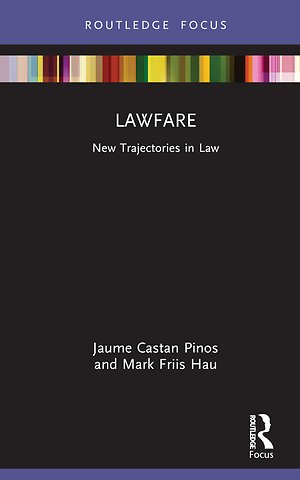
Lawfare
New Trajectories in Law
Gebonden Engels 2022 9781032267722Samenvatting
This book develops a new conceptualisation of lawfare that recognises the polysemantic nature of the term.
Drawing on theoretical developments from legal anthropology, international relations, and social theory, the book scrutinises the multiple dimensions of this phenomenon. It illustrates the multifaceted character of lawfare with a wide range of historical and contemporary cases from across the globe and analyses the implications of actors pursuing political objectives through legal means. This includes the use of lawfare by states as a legal instrument to accomplish geopolitical objectives, domestic lawfare, or the use of legal instruments to undermine internal opposition, and state lawfare used by governments to ‘protect’ the state from internal territorial-secessionist challenges. Finally, the book shows that lawfare is not exclusively a tool for hegemonic actors, as it can also be used by civil society actors that aim to uphold their rights through legal instruments in asymmetric lawfare.
This book contributes to new developments in lawfare without shying away from controversy, acknowledging its sometimes-brutal efficacy as well as its potential pitfalls. The book will appeal to scholars and students of law, international relations, political science, anthropology, and sociology.
Specificaties
Lezersrecensies
Inhoudsopgave
1 Introduction
2 Geopolitical lawfare: legal instruments as weapons of war
2.1 Introduction
2.2 Why is geopolitical lawfare a popular tool?
2.3 Great powers’ attitudes and strategies towards geopolitical lawfare
2.3.1 The US vis-à-vis geopolitical lawfare
2.3.2 Lawfare and the People’s Republic of China
2.3.3 The Russian Federation and lawfare
2.4 Geopolitical lawfare methods in the international arena
2.4.1 Sanctions
2.4.2 Lawfare through intergovernmental organisations
2.4.3 Discursive lawfare
2.5 Conclusion
3 Domestic lawfare
3.1 Introduction
3.2 Related concepts
3.2.1 Judicialisation of politics
3.2.2 Power, law, and the state of exception
3.3 The effects of domestic lawfare on liberal democratic regimes
3.4 Applications of domestic lawfare
3.4.1 Soft domestic lawfare in Hungary and Poland?
3.4.2 Domestic lawfare in Latin America
3.5 Conclusion
4 Lawfare and territorial conflicts
4.1 Introduction
4.2 Rule of law in territorial conflicts
4.3 The legal dispossession of Native Americans
4.3.1 Situation
4.3.2 Analysis
4.3.3 Implications
4.4 State lawfare in Northern Ireland
4.4.1 Situation
4.4.2 Analysis
4.4.3 Implications
4.5 State lawfare in the Basque Country
4.5.1 Situation
4.5.2 Analysis
4.5.3 Implications
4.6 State lawfare in Catalonia
4.6.1 Situation
4.6.2 Analysis
4.6.3 Implications
4.7 Conclusion
5 Asymmetric lawfare: a weapon of the weak
5.1 Introduction
5.2 Civil society lawfare
5.3 Civil society lawfare: cases
5.3.1 The Ogoni case
5.3.2 The Dakota Access Pipeline protests
5.4 Lawfare from ‘weak’ governmental actors
5.5 Conclusion
6 Conclusion
Bibliography
Index
Rubrieken
- advisering
- algemeen management
- coaching en trainen
- communicatie en media
- economie
- financieel management
- inkoop en logistiek
- internet en social media
- it-management / ict
- juridisch
- leiderschap
- marketing
- mens en maatschappij
- non-profit
- ondernemen
- organisatiekunde
- personal finance
- personeelsmanagement
- persoonlijke effectiviteit
- projectmanagement
- psychologie
- reclame en verkoop
- strategisch management
- verandermanagement
- werk en loopbaan