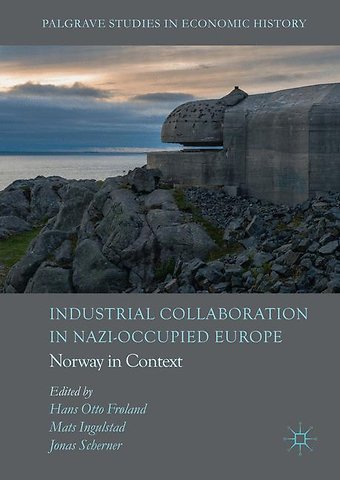
Industrial Collaboration in Nazi-Occupied Europe
Norway in Context
Gebonden Engels 2016 9781137534224Samenvatting
This book brings
together leading experts to assess how and whether the Nazis were successful in fostering collaboration to secure the resources they required during World War II. These studies of the occupation regimes in Norway and Western Europe reveal that the Nazis developed highly sophisticated instruments of exploitation beyond oppression and looting. The authors highlight that in comparison to the heavy manufacturing industries of Western Europe, Norway could provide many raw materials that the German war machine desperately needed, such as aluminium, nickel, molybdenum and fish. These chapters demonstrate that the Nazis provided incentives to foster economic collaboration, hoping that these would make every mine, factory and smelter produce at its highest level of capacity. All readers will learn about the unique part of Norwegian economic collaboration during this period and discover the rich context of economic collaboration across Europe during World War II.
Specificaties
Lezersrecensies
Inhoudsopgave
I. The German Demand for Norwegian Resources.- Chapter
1. Ideology and Business Strategy: Assessing Nazi Germany’s different
approaches to the supply of light metals for the Luftwaffe; Lutz Budrass.-
Chapter 2. Frozen
fillets from the far north: German demand for Norwegian fish; Ole Sparenberg.- Section II. The Western European context: Regulation and Responses.- Chapter 3. Financial and
monetary developments in the occupied Netherlands, 1940-45; Hein A.M. Klemann.-
Chapter 4. Doing business with the Hun: Dutch business during the German
occupation 1940-1945; Martijn Lak.- Chapter 5. Seizure
or Purchase? French deliveries for German purposes in World War II (1940-1944); Marcel
Boldorf.- Chapter
6. Shades of Collaboration: The French Automobile Industry under German
Occupation, 1940-1944; Talbot Imlay.- Chapter 7. A Faustian Bargain: Denmark's precarious deal with
the German war economy; Joachim
Lund.- Chapter 8. Corporatist
institutions and economic collaboration in occupiedBelgium; Dirk Luyten.-
Section III. Supply: Managing and extracting resources from the Norwegian
economy.- Chapter 9. Incentive structures and state regulations of the
Norwegian economy; Harald Espeli.- Chapter 10. Why Germany did not fully
exploit nickel industry in occupied Norway: IG Farben and the political economy
of nickel in the Third Reich; Pål Sandvik and Jonas Scherner.- Chapter 11. A quest for diversification?
Norsk Hydro, IG Farben and the German light metal program; Ketil Gjølme Andersen and Anette Storeide.- Chapter12. Facing
disincentives: Norwegian aluminium companies working for the German aircraft
industry; Hans Otto Frøland.- Chapter 13. Hitler’s Achilles Heel: The contest
for the Norwegian Molybdenum supply; Andreas Dugstad & Mats Ingulstad.-
Chapter 14. The Norwegian fishing sector during the German
occupation—continuity or change?; Bjørn Petter Finstad.
Rubrieken
- advisering
- algemeen management
- coaching en trainen
- communicatie en media
- economie
- financieel management
- inkoop en logistiek
- internet en social media
- it-management / ict
- juridisch
- leiderschap
- marketing
- mens en maatschappij
- non-profit
- ondernemen
- organisatiekunde
- personal finance
- personeelsmanagement
- persoonlijke effectiviteit
- projectmanagement
- psychologie
- reclame en verkoop
- strategisch management
- verandermanagement
- werk en loopbaan