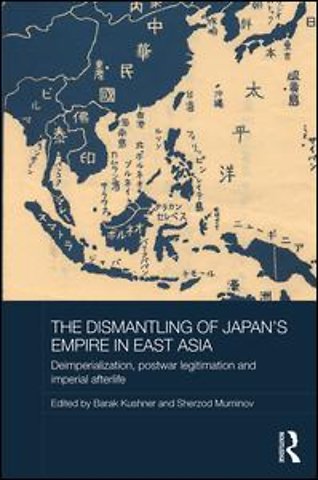
The Dismantling of Japan's Empire in East Asia
Deimperialization, Postwar Legitimation and Imperial Afterlife
Gebonden Engels 2016 9781138187641Samenvatting
The end of Japan’s empire appeared to happen very suddenly and cleanly – but, as this book shows, it was in fact very messy, with a long period of establishing or re-establishing the postwar order. Moreover, as the authors argue, empires have afterlives, which, in the case of Japan’s empire, is not much studied. This book considers the details of deimperialization, including the repatriation of Japanese personnel, the redrawing of boundaries, issues to do with prisoners of war and war criminals and new arrangements for democratic political institutions, for media and for the regulation of trade. It also discusses the continuing impact of empire on the countries ruled or occupied by Japan, where, as a result of Japanese management and administration, both formal and informal, patterns of behavior and attitudes were established that continued subsequently. This was true in Japan itself, where returning imperial personnel had to be absorbed and adjustments made to imperial thinking, and in present-day East Asia, where the shadow of Japan’s empire still lingers. This legacy of unresolved issues concerning the correct relationship of Japan, an important, energetic, outgoing nation and a potential regional "hub," with the rest of the region not comfortably settled in this era, remains a fulcrum of regional dispute.
Specificaties
Lezersrecensies
Inhoudsopgave
Part I: The New Postwar Order - Meaning and Significance
1. The Decline of the Japanese Empire and the Transformation of the Regional Order in East Asia
2. "De-imperialization" in Early Postwar Japan: Adjusting and Transforming Institutions of Empire
3. Imperial Loss and Japan’s Search for Postwar Legitimacy
4. Collapse of the Japanese Empire and the Great Migrations: Repatriation, Assimilation, and Remaining Behind
Part II: War Criminals, POWS, and the Imperial Breakdown
5. The Shifting Politics of Guilt: the Campaign for the Release of Japanese War Criminals
6. Allied POWs in Korea: Life and Death during the Pacific War
7. Carceral Geographies of Japan’s Vanishing Empire: War Criminals’ Prisons in Asia
8. Prejudice, Punishment and Propaganda: Post-Imperial Japan and the Soviet Versions of History and Justice in East Asia, 1945-1956
Part III: Diplomacy, Law, and the End of Empire
9. Sublimating the Empire: How Japanese Experts of International Law Translated "Greater East Asia" into the Postwar Period
10. The transformation of a Manchukuo imperial bureaucrat to postwar supporter of the Yoshida Doctrine: the case of Shiina Etsusaburō
11. North Korean Nation Building and Japanese Imperialism: People’s Nation, "People’s Diplomacy" and the Japanese Technicians
12. Humanitarian Hero or Communist Stooge? The Ambivalent Japanese Reception of Li Dequan in 1954
Part IV: Media and the Imperial Aftermath
13. The "Pacifist" Magazine Sekai: A Barometer of Postwar Thought
14. Post-imperial Broadcasting Networks in China and Manchuria
15. Parting the Bamboo Curtain: Japanese Cold War Film Exchange with China
Comparative Epilogue
16. Germany as a role model? Coming to terms with Nazi War deeds, 1945-2015
Rubrieken
- advisering
- algemeen management
- coaching en trainen
- communicatie en media
- economie
- financieel management
- inkoop en logistiek
- internet en social media
- it-management / ict
- juridisch
- leiderschap
- marketing
- mens en maatschappij
- non-profit
- ondernemen
- organisatiekunde
- personal finance
- personeelsmanagement
- persoonlijke effectiviteit
- projectmanagement
- psychologie
- reclame en verkoop
- strategisch management
- verandermanagement
- werk en loopbaan