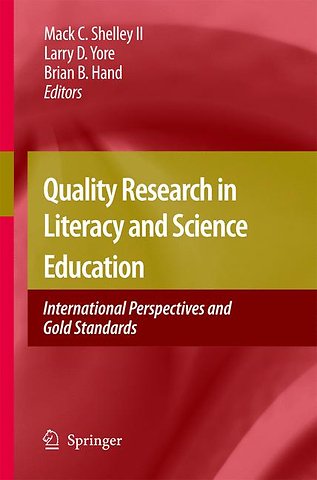
Quality Research in Literacy and Science Education
International Perspectives and Gold Standards
Gebonden Engels 2009 2009e druk 9781402084263Samenvatting
Statistical models attempt to describe and quantify relationships between variables. In the models presented in this chapter, there is a response variable (sometimes called dependent variable) and at least one predictor variable (sometimes called independent or explanatory variable). When investigating a possible cause-and-effect type of relationship, the response variable is the putative effect and the predictors are the hypothesized causes. Typically, there is a main predictor variable of interest; other predictors in the model are called covariates. Unknown covariates or other independent variables not controlled in an experiment or analysis can affect the dependent or outcome variable and mislead the conclusions made from the inquiry (Bock, Velleman, & De Veaux, 2009). A p value (p) measures the statistical significance of the observed relationship; given the model, p is the probability that a relationship is seen by mere chance. The smaller the p value, the more confident we can be that the pattern seen in the data 2 is not random. In the type of models examined here, the R measures the prop- tion of the variation in the response variable that is explained by the predictors 2 specified in the model; if R is close to 1, then almost all the variation in the response variable has been explained. This measure is also known as the multiple correlation coefficient. Statistical studies can be grouped into two types: experimental and observational.
Specificaties
Lezersrecensies
Rubrieken
- advisering
- algemeen management
- coaching en trainen
- communicatie en media
- economie
- financieel management
- inkoop en logistiek
- internet en social media
- it-management / ict
- juridisch
- leiderschap
- marketing
- mens en maatschappij
- non-profit
- ondernemen
- organisatiekunde
- personal finance
- personeelsmanagement
- persoonlijke effectiviteit
- projectmanagement
- psychologie
- reclame en verkoop
- strategisch management
- verandermanagement
- werk en loopbaan