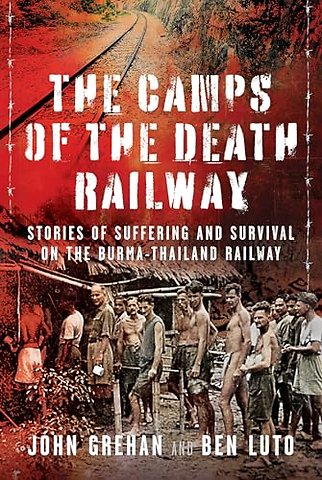
The Camps of the Death Railway
Stories of Suffering and Survival on the Burma-Thailand Railway
Gebonden EN 2025 9781526724762Samenvatting
As the terrible conditions experienced by the British, Australian, Dutch, and American PoWs in the building of railway linking Buma and Thailand became known, as well as the appalling atrocities the men suffered at the hands of the Japanese, it was clear that an investigation would have to be undertaken. Before war trials began, the Japanese submitted their account of the building of the railway, which is presented here. What is also presented are the stories from the prisoners themselves from each of the camps, telling in stark, unflinching detail what really happened to them.Drawn entirely from first-hand accounts, a picture emerges of men being driven to very heavy manual labour without boots to protect their feet from injuries which resulted in tropical ulcers and the amputation of untreatable limbs with nothing but a wood saw. Of men dying of cholera in their hundreds; of stinking, maggot-ridden open latrines and campgrounds covered in faeces from dysentery sufferers.With virtually no medical equipment or medicines, the Allied medical officers faced an unwinnable battle to save the lives of men so weakened from hunger and unremitting work at times for eighteen hours a day, they could not fight off the multiple diseases which were endemic in the depths of the Thai and Burmese jungles.As more and more prisoners became ill, the number available for work on the railway diminished. But with orders to finish the railway ahead of time, the Japanese forced prisoners from their hospital beds out to work, many of whom never returned.When Allied officers tried to intervene to protect their men, they were subjected beating from the Japanese and Korean guards. Other brutal punishments, sometimes fatal, were handed out to the prisoners, frequently for no accountable reason. Conditions were so intolerable, some prisoners tried to escape, only to die in the jungle or be recaptured and executed. Others simply gave up all hope and died, quite literally, of despair.There were, of course, lighter moments amid the misery. Elephants were used to pull heavy logs. When an extra load was added to that of one elephant, the animal refused to move. As the normal method adopted by the Japanese with uncooperative prisoners was to give them a beating, one of the guards hit the elephant. The elephant roared and charged after him, chasing the terrified guard into the River Kwai and squirted water at him through his trunk.Through sheer determination in some cases or mere good fortune, many men survived the horrors of the camps to tell the world of what was one of the most dreadful humanitarian disasters of the Second World War. This is their story.
Specificaties
Lezersrecensies
Rubrieken
- advisering
- algemeen management
- coaching en trainen
- communicatie en media
- economie
- financieel management
- inkoop en logistiek
- internet en social media
- it-management / ict
- juridisch
- leiderschap
- marketing
- mens en maatschappij
- non-profit
- ondernemen
- organisatiekunde
- personal finance
- personeelsmanagement
- persoonlijke effectiviteit
- projectmanagement
- psychologie
- reclame en verkoop
- strategisch management
- verandermanagement
- werk en loopbaan