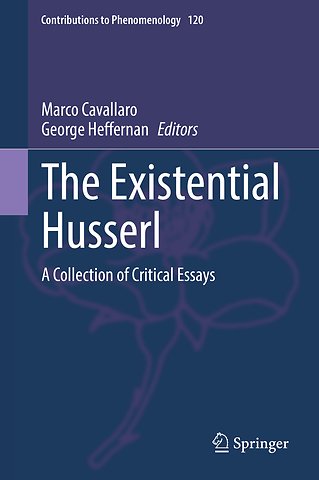
The Existential Husserl
A Collection of Critical Essays
Gebonden Engels 2022 9783031050947Samenvatting
This book examines Husserl’s approach to the question concerning meaning in life and demonstrates that his philosophy includes a phenomenology of existence. Given his critique of the fashionable “philosophy of existence” of the late 1920s and early 1930s, one might think that Husserl posited an opposition between transcendental phenomenology and existential philosophy, as well as that in this respect he differed from existential phenomenologists after him. But texts composed between 1908 and 1937 and recently published in Husserliana XLII, Grenzprobleme der Phänomenologie (2014), show that the existential Husserl was not opposed but open to the phenomenological investigation of several basic topics of a philosophy of existence. A collection of contributions from a team of internationally recognized scholars drawing on these and other sources, the present volume offers insights into the relationship between phenomenology and philosophy of existence. It does so by (1) delineating the basic outlines of Husserl’s phenomenology of existence, (2) reinterpreting the tension between Husserl’s transcendental phenomenology and Jaspers’s and Heidegger’s philosophy of existence as well as Kierkegaard’s and Sartre’s existentialism, and (3) investigating the existential aspects of Husserl’s phenomenological ethics. Thus focusing on neglected aspects of Husserl’s thought, the volume shows that there is a consensus between classical phenomenology and existential phenomenology on the urgency of addressing the existential questions that in The Crisis of the European Sciences and Transcendental Phenomenology (1936) Husserl calls “the questions concerning the meaning or meaninglessness of this entire human existence”. The Existential Husserl represents a major contribution to the clarification of the historical and philosophical developments from transcendental phenomenology to existential phenomenology. The book should appeal to a wide audience of many readers at all levels looking for phenomenological answers to existential questions.
Specificaties
Lezersrecensies
Inhoudsopgave
PART II: BASIC OUTLINES OF HUSSERL’S PHENOMENOLOGY OF EXISTENCEChapter 5. Essence and existence in HusserlChapter 6. The individual and the universal in HusserlChapter 7. The existential situatedness of the transcendental egoChapter 8. Birth, death, and sleep: Limit problems and the paradox of phenomenology
PART III: PHENOMENOLOGY, EXISTENTIALISM, AND EXISTENTIAL PHENOMENOLOGYChapter 9. Husserl’s phenomenology of existence in Limit Problems of PhenomenologyChapter 10. Husserl’s transcendental phenomenology of ego, existence, and praxisChapter 11. Phenomenology, existence, and personhoodChapter 12. Transcendental anthropology and existential phenomenology of happinessChapter 13. Existential dimensions of Husserl’s late ethicsChapter 14. Individualism and cosmopolitanism in Husserl’s late ethicsChapter 15. Husserl’s “existentialist” ethicsChapter 16. Husserlian ethics, embodied ethics, and feminist ethics
LITERATUREINDEXNOTES ON CONTRIBUTORS
Rubrieken
- advisering
- algemeen management
- coaching en trainen
- communicatie en media
- economie
- financieel management
- inkoop en logistiek
- internet en social media
- it-management / ict
- juridisch
- leiderschap
- marketing
- mens en maatschappij
- non-profit
- ondernemen
- organisatiekunde
- personal finance
- personeelsmanagement
- persoonlijke effectiviteit
- projectmanagement
- psychologie
- reclame en verkoop
- strategisch management
- verandermanagement
- werk en loopbaan