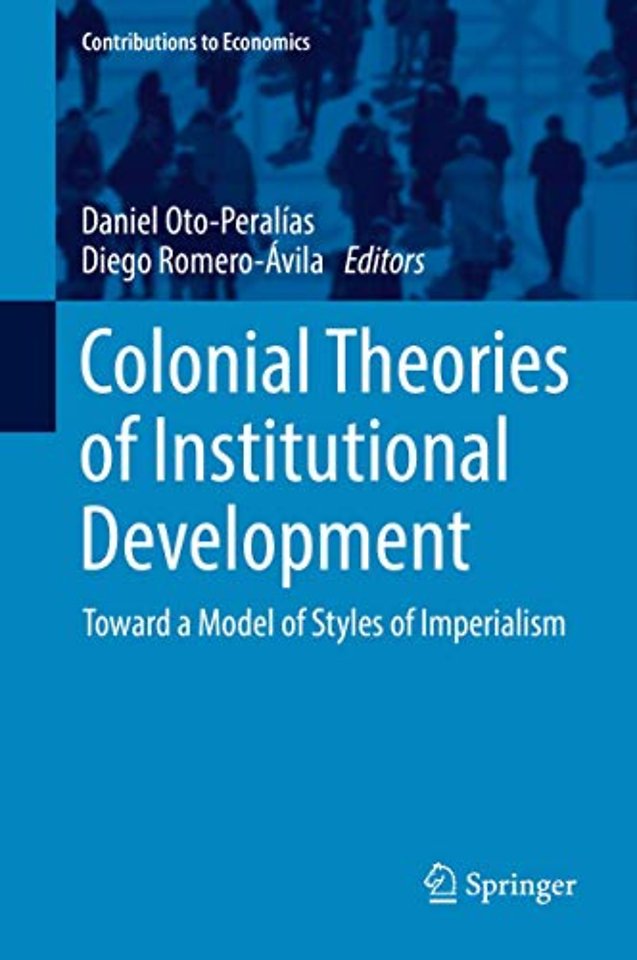
Colonial Theories of Institutional Development
Toward a Model of Styles of Imperialism
Gebonden Engels 2017 9783319541266Samenvatting
This book analyzes the role played by initial endowments and colonizer identity in seeking to explain institutional development in former colonies. It presents a model of two styles of imperialism that integrates the colonial origin and endowment views explaining current institutions. The authors argue that Great Britain and Portugal adopted an ‘economically-oriented’ style, which was pragmatic and sensitive to initial conditions. For this style of imperialism the endowment view is applicable. In contrast, France employed a ‘politically-oriented’ style of imperialism, in which ideological and political motivations were more present. This led to a uniform colonial policy that largely disregarded initial endowments. In turn, the case of Spain represents a hybrid of the two models. The empirical analysis presented here reveals a remarkable degree of heterogeneity in the relationship of endowments and colonizer identity with current institutions.
Specificaties
Lezersrecensies
Inhoudsopgave
<p>1.1 On the importance of institutions</p>
<p>1.2 Determinants of institutional quality: The key role of European colonialism</p>
<p><1.3 Toward a model of styles of imperialism</p>
<p>1.4 Preliminary empirical evidence</p>
<p>1.5 Structure of the study</p>
<p>Chapter 2. Views Linking Colonialism with Institutions</p>
<p>2.1. The Colonial Origin View</p>
<p>2.2. The Endowment View</p>
<p>2.3. The Eclectic View</p>
2.4 Other Related Literature<p></p>
<p> 2.4.1 Additional studies on colonialism</p>
<p> 2.4.2 Studies about the importance of precolonial institutions</p>
<p> 2.4.3 Other work on the historical roots of comparative development</p>
<p>Chapter 3. A Model of Two Styles of Imperialism 3.1. The Theoretical Framework</p> <p>3.2. An Application to European Colonial Empires</p>
<p> 3.2.1. The British Empire</p>
<p> 3.2.2. The French Empire</p>
<p> 3.2.3. The Spanish Empire</p>
<p> 3.2.4. The Portuguese Empire</p>
<p> 3.2.5. The Remainder Empires</p>
<p>3.3. Some General Observations between Domestic Conditions and the Style of Imperialism</p>
<p>Chapter 4. Empirical Methodology and Baseline Regression Results</p>
<p>4.1. Empirical Strategy and Data Description</p>
<p>4.2. Initial Results: Additive Model versus Interaction Model</p>
<p>Chapter 5. Sensitivity to Alternative Theories</p>
<p>5.1 Timing and Duration of Colonization</p>
5.2 Sociological and Anthropological Factors<p></p>
<p>5.3 Geographic and Climatic Factors</p>
<p>Chapter 6. Further Sensitivity Analyses</p>
<p>6.1. Robustness to Sample Selection and Outliers</p>
<p>6.2 Robustness to Institutional Indicators</p>
<p>6.3 Robustness to Endowment Indicators</p>
6.4. Limiting the Range in the Distribution of Endowments to French Range<p></p>
<p>Chapter 7. Exploring the Mechanism of Colonial Rule</p>
<p>Chapter 8. The Legacy of European Colonialism on Relevant Determinants of Institutional Development</p>
<p>Chapter 9.Conclusions</p>
<p>References</p>
<p>Appendix </p><p><br></p>
Rubrieken
- advisering
- algemeen management
- coaching en trainen
- communicatie en media
- economie
- financieel management
- inkoop en logistiek
- internet en social media
- it-management / ict
- juridisch
- leiderschap
- marketing
- mens en maatschappij
- non-profit
- ondernemen
- organisatiekunde
- personal finance
- personeelsmanagement
- persoonlijke effectiviteit
- projectmanagement
- psychologie
- reclame en verkoop
- strategisch management
- verandermanagement
- werk en loopbaan