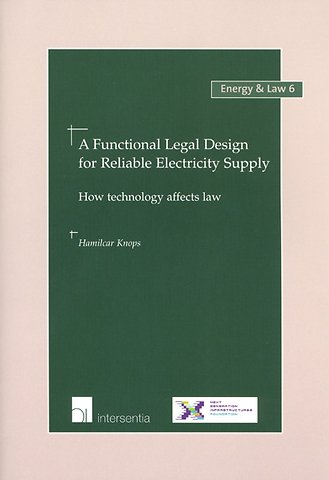
A Functional Legal Design for Reliable Electricity Supply

How technology affects law

Ingenaaid Engels 2008 1e druk 9789050957809
€ 153,50
Levertijd ± 11 werkdagen
Gratis verzonden

Samenvatting

De privatisering en de internationale integratie van de elektriciteitsmarkt heeft ervoor gezorgd dat de sector een stuk complexer is geworden. Het is vooral het juridische raamwerk – de regels van het spel – die het gedrag van de spelers, zoals leveranciers, netbeheerders en opwekkers bepalen. Maar de ongebruikelijke technische en economische eigenschappen van de elektriciteitsmarkt zorgen ervoor dat dit juridische raamwerk nog steeds niet vastligt. Dit boek geeft hiertoe een aanzet.

Dit boek geeft een ontwerpmethode voor het analyseren en het ontwerpen van de juridische organisatie van een technisch complexe sector zoals de elektriciteitsindustrie. Deze methode houdt rekening met de doelstellingen van de politiek, juridische beperkingen en de technische eigenschappen. Alhoewel deze methode is ontwikkeld voor de elektriciteitsmarkt, is deze ook geschikt van andere technische complexe industrieën.

De voorgestelde methode is toegepast op diverse kritieke situaties. Deze case studies geven veel informatie over de keuzes die de politiek moet maken bij het hervormen van de energiemarkt.

Specificaties

ISBN13:9789050957809
Taal:Engels
Bindwijze:ingenaaid
Aantal pagina's:565
Uitgever:Intersentia
Druk:1
Hoofdrubriek:Juridisch

Lezersrecensies

Wees de eerste die een lezersrecensie schrijft!

Over Hamilcar Knops

Hamilcar Knops heeft zowel natuurkunde als recht gestudeerd. Hij is onderzoeker aan de TU Delft en de Universiteit van Leiden.

Andere boeken door Hamilcar Knops

Inhoudsopgave

Preface
Table of Contents
List of Tables
List of Figures

1. Electricity supply: from monopoly to complexity
1.1 Introduction
1.2 A paradigm shift for network industries
1.3 What does it mean for electricity?
1.4 Main research question
1.5 Relevance
1.6 Reading guide

2. Research framework
2.1 Research goal
2.2 Research question
2.3 A design problem: the meta model
2.4 The meta model as applied to this research question
2.5 Research method

3. System description
3.1 Introduction: the electricity system
3.2 The technical subsystem
3.3 The economic subsystem
3.4 The subsystems integrated

4. Legal organisation
4.1 Introduction
4.2 Hohfeld's fundamental legal conceptions
4.3 Policy instruments
4.4 Legal organisation: the issues
4.5 Allocation of responsibility
4.6 Permissions: who is allowed to perform which tasks?
4.7 Rules: how to perform responsibilities and permissions?
4.8 Government control
4.9 Design variables

5. Public policy goals
5.1 Introduction
5.2 Triple A: the main primary goals
5.3 Availability: secure supply for all
5.4 Affordability: the quest for economic efficiency
5.5 Acceptability: socially responsible electricity supply
5.6 Secondary goals
5.7 The main goals in our design problem

6. Legal constraints
6.1 Introduction: restriction to the EU
6.2 Development of a European electricity framework
6.3 Free movement of goods
6.4 Free movement of services and capital and the right of establishment
6.5 Competition law: rules for undertakings
6.6 State aid
6.7 Public service obligations
6.8 Directives: main structure of the industry
6.9 Conclusion: legal constraints in our design problem
7. Design method
7.1 A 'method' to integrate the model and selection stages
7.2 Outline of the method
7.3 Step I: Analysis of the function
7.4 Step II: Analysis of each function within its context
7.5 Step III: Design decisions for the legal organisation
Afgekapt op 62 regels

Managementboek Top 100

€ 153,50
Levertijd ongeveer 11 werkdagen
Gratis verzonden

Rubrieken

Producten

    Auteurs

      Trefwoorden

        Artikelen

          A Functional Legal Design for Reliable Electricity Supply