
Over Iacopo Senatori
Iacopo Senatori, Researcher of Labour Law at the Marco Biagi Foundation, University of Modena and Reggio Emilia.
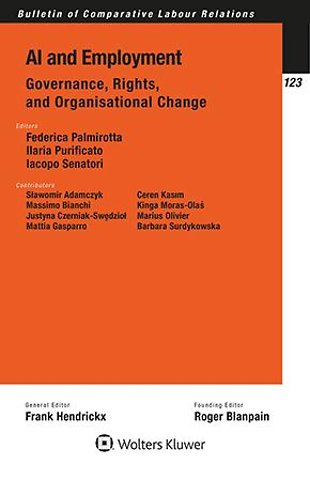
AI and Employment is an urgently needed book that gathers contributions from eight notable labour scholars addressing technological transformation as an ongoing disruptive process steadily reshaping the established categories, institutions, and protective guarantees of labour law, organization, and human resources management. The intensification and reconfiguration of employer power through artificial intelligence (AI) reinforce the need for new forms of employee protection.
What’s in this book:
Relying on an interdisciplinary analysis of AI’s impact on the employment relationship, the authors clarify such issues as the following:
The contributors emphasise the human-centred digital corporate responsibility model embodied in the European regulatory framework that encompasses the AI Act, the GDPR, the Corporate Sustainability Due Diligence Directive, and the Platform Work Directive. The insistence throughout is that no algorithm can replace the human capacities for judgment, responsibility, and solidarity on which labour law is ultimately built, and that AI cannot supersede human accountability, social dialogue, and sustainable leadership.
The book represents a selection of contributions originally presented at the annual international conference in commemoration of Marco Biagi held at the Marco Biagi Foundation in Modena on 19–20 March 2025, entitled ‘Employment in the Era of AI and Digital Platforms: Understanding and Regulating Transitions’.
How this will help you:
In its systematic assessment of risks to workers’ rights, equality, privacy, job security, and working conditions posed by AI – along with in-depth discussion of policy debates and collective responses to workplace AI – this book will help practitioners, policymakers, and businesses to identify risks of discrimination, opacity, and dehumanisation in algorithmic systems. In practical terms, it will assist in the development of design strategies for the ethical and fair use of AI at work, anticipate legal and organisational implications of AI and shape balanced responses.


