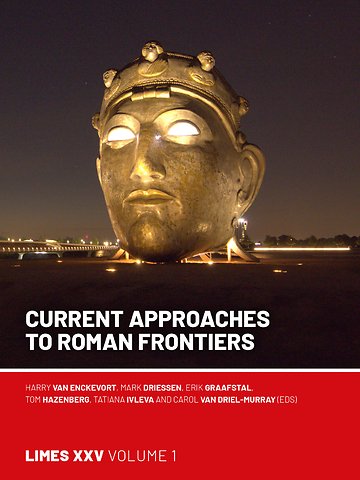

Current Approaches to Roman Frontiers
Proceedings of the 25th International Congress of Roman Frontier Studies 1
Paperback Engels 2024 1e druk 9789464262759Samenvatting
This publication – Current Approaches to Roman Frontiers – is the first volume of the LIMES XXV’s congress proceedings arranged around the original sessions, in order to form coherent thematical collections that make the vast output more accessible to generalists and specialists alike. This volume starts with a recap of the congress. Regarding the themes it deals with a contemporary feminist approach; new digital methodologies and computational modelling; three themes on archaeological heritage management dealing inter alia with preservation, protection, citizen science and World Heritage aspects, and a comparison between the Roman Limes and the Great Wall of China. It ends with an overview of the sessions and lectures of the congress in Nijmegen.
Frontiers are zones, or lines, of contact and coercion, of exchange and exclusion. As such they often express some of the most typical elements of the socio-political spaces that are defined by them. Spanning some 6,000 km along rivers, mountain ranges, artificial barriers and fringes of semi-desert, the frontiers of the Roman empire offer a wide variety of avenues and topics for a very diverse community of scholars.
They are the central subject of the International Congress of Roman Frontier Studies (or just Limes Congress after the Latin word for ‘border’), organised every three years since 1949. This four-volume publication contains most of the papers presented at the 25th edition which was hosted by the municipality of Nijmegen in August 2022.
Specificaties
Lezersrecensies
Inhoudsopgave
Part 1. Reports from the congress and field trips
The 25th Congress of Roman Frontier Studies in Nijmegen
Rebecca H. Jones & Andreas Thiel
A record of the 25th Congress of Roman Frontier Studies
Harry van Enckevort, Mark Driessen, Erik Graafstal, Tom Hazenberg, Tatiana Ivleva and Carol van Driel-Murray
The excursions
Mark Driessen, Erik Graafstal, Tom Hazenberg, Tatiana Ivleva and Carol van Driel-Murray
Part 2. Feminists at the gates. Frontier research by female academics
Feminists at the gates. Feminist approaches to Roman frontiers
Anna H. Walas and Rebecca H. Jones
The (In)visibility of women in stone-cut personal inscriptions from fortresses in Roman Britain. Epigraphic absence, or earlier scholarship bias?
Joanne E. Ball
Fathers and daughters, mothers and sons. The presence of women on the Dacian Limes
Ştefania Dogărel
Britannia Romana. Ambiguous image of a province Kseniya
S. Danilochkina
A snapshot of two pioneering female archaeologists in Switzerland. Elisabeth Ettlinger and Victorine von Gonzenbach in Vindonissa around 1950
Regine Fellmann Brogli and Christine Meyer-Freuler
Female archaeologists and Roman military research in Croatia
Iva Kaić and Mima Cvetko
Women and Roman religion in provinces. Case study Dalmatia
Anna Mech
Walls don’t stop women. An urban approach to frontier sites
Catherine Teitz
Part 3. Digital Limes. The use of modern methods and advanced techniques for a better understanding of the frontier development
Digital Limes. Introduction to the session and a discussion of temporary camps in the Netherlands to illustrate the use of modern methods and advanced techniques for a better understanding of the Roman Frontier development
Wouter K. Vos, Roeland Emaus, Jeroen Oosterbaan and Maarten Sepers
Tactics or topography? Interdisciplinary studies on the course of the Upper German Limes. A preliminary report
Peter Henrich, Matthias Lang and Jennifer Schamper
Supplying the Limes Britannicus. An approach from network science and archaeology
Arnau Lario Devesa and Jordi Pérez González
Research on the effects of relative sea-level change on the River Exe estuary in the mid-1st century AD (South-West Britain)
Stephen J. Kaye and John Pamment Salvatore
Roman camps of Villamontán de la Valduerna.Camp complex close to Via XVII. Item a Bracara Astvricam
Esperanza Martín Hernández, Florian Hermann and Felix Teichner
Part 4. Simulating the limes. Challenges to computational modelling in Roman Studies
Lost and found on the frontier. Predictive modelling and Late Roman forts in Scythia Minor (4th-7th centuries AD)
Nathaniel F. Durant
Dealing with changes in qualitative and quantitative aspects of the imported Roman metal objects within the Marcomannic settlement zone in the era of metal detecting
Balázs Komoróczy, Marek Vlach and Michaela Kmošková
Investigating Roman strata to the core. The use of well core data in the interpolation of Vindobona’s archaeological layers
Kira Lappé
Following Baradez’s tracks. The GIS approach integrating photographic and satellite sources near Biskra (Algeria)
Andrea Meleri and Paola Zanovello
Roman connectivity, networking and mobility along the Lower Danube frontier. A GIS approach
Ioana A. Oltean and D. Ciprian Lungescu
Part 5. ‘Managing the Romans?’ Preservation, protection and community management of frontiers. Opportunities, challenges, and use of ‘citizen science’
Imagining Hadrian’s Wall. Developing and assessing explanations behind its construction
Paul J. Kitching
Engaging disadvantaged communities in heritage-led regeneration. Rediscovering the Antonine Wall Project
Ríona McMorrow
Frontier Voices. A creative exploration
Nigel Mills and Karen MacDougall
Hadrian’s Wall. Managing 1900 years of a cultural resource for the future generation
Community involvement in the World Heritage Sites of Pécs (Sopianae)
Dániel Poulet
Limes in the forest. Threats and chances
Andreas A. Schaflitzl
Citizen science on Hadrian’s Wall. A case study of the WallCAP Project
Kerry Shaw
Identity though art. How Weißenburg is strengthening its role as a Roman city in modern Bavaria
Simon Sulk
Part 6. Reconstructing the limes. Roman archaeology as national and transnational heritage
Reception of the limes in cities along the Rhine and the Danube (16th and 17th centuries)
Konrad A. Ottenheym
Cologne praetorium, new findings. The bath of the Governor and news about phases of the late antique and early medieval times
Sebastian Ristow
The Romantic Limes
Catherine Visser
Part 7. Frontiers of the Roman Empire. World Heritage across three continents
Frontiers of the Roman Empire. World Heritage across three continents
Marinus Polak, Stéphanie Guédon and René Ployer
Le système de défense romain en Maurétanie tingitane
Aomar Akerraz
An Interpretation Framework methodology for the Roman frontiers in Tunisia
Christof Flügel and Nigel T.W. Mills
Frontiers of the Roman Empire. UNESCO World Heritage and frontier perspectives
Stéphanie Guédon
Developing a management system for the Frontiers of the Roman Empire World Heritage
Rebecca H. Jones
Living Danube Limes Interreg project
Ivana Ožanić Roguljić, Mislav Fileš and Nemanja Mrđić
The Eastern Limes. Observations towards a sustainable nomination strategy for the Anatolian Frontier
Özge Deniz Toköz and Zeynep Aktüre
Part 8. Wall to Wall
Wall to Wall. A collaborative initiative between Hadrian’s Wall and the Great Wall of China
David Brough
Vulnerability assessment of the natural disasters of the Great Wall in Ningxia Hui Autonomous Region, China
Fei Cheng and Dong Xiao
Comparison of the military system of the China’s Great Wall and the ancient Roman frontier
Li Yan, Zhai Yujie, Yao Wang and Li Zhe
Archaeology of Qingping fort site. Practicing the purpose and idea of archaeology
Yu Chunlei
A Large granary found along the Great Wall of Western Han Dynasty in Hetao Region
Zhang Wenping and Zhao Fei
Part 9. Overview of sessions and papers
Anderen kochten ook
 Rodney Van Der Ree€ 153,08
 Mark De Berg€ 60,99
 Harry van Enckevort€ 65,–
 Harry van Enckevort€ 65,–
 Roderick Geerts€ 35,–
 Jan Neefjes€ 30,–
Rubrieken
- advisering
- algemeen management
- coaching en trainen
- communicatie en media
- economie
- financieel management
- inkoop en logistiek
- internet en social media
- it-management / ict
- juridisch
- leiderschap
- marketing
- mens en maatschappij
- non-profit
- ondernemen
- organisatiekunde
- personal finance
- personeelsmanagement
- persoonlijke effectiviteit
- projectmanagement
- psychologie
- reclame en verkoop
- strategisch management
- verandermanagement
- werk en loopbaan