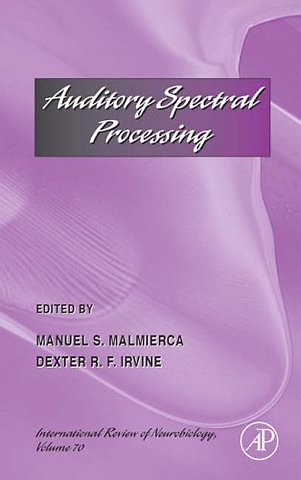
Auditory Spectral Processing
Gebonden Engels 2005 9780123668714Samenvatting
All natural auditory signals, including human speech and animal communication signals, are spectrally and temporally complex, that is, they contain multiple frequencies and their frequency composition, or spectrum, varies over time. The ability of hearers to identify and localize these signals depends on analysis of their spectral composition. For the overwhelming majority of human listeners spoken language is the major means of social communication, and this communication therefore depends on spectral analysis. Spectral analysis begins in the cochlea, but is then elaborated at various stages along the auditory pathways in the brain that lead from the cochlea to the cerebral cortex. The broad purpose of Auditory Spectral Processing is to provide a comprehensive account of the way in which spectral information is processed in the brain and the way in which this information is used by listeners to identify and localize sounds.
Specificaties
Lezersrecensies
Inhoudsopgave
Spectral processing by the peripheral auditory system: Facts and models
Basic psychophysics of human spectral processing
Across-channel spectral processing
Speech and music have different requirements for spectral resolution
Nonlinearities and the representation of auditory spectra
Spectral processing in the inferior colliculus
Neural mechanisms for spectral analysis in the auditory midbrain, thalamus, and cortex
Spectral processing in the auditory cortex
Dynamic spectral processing
Representations of spectral coding in the human brain
Spectral processing and sound source determination
Spectral information in sound localization
Plasticity of spectral processing
Spectral processing in cochlear implants
Rubrieken
- advisering
- algemeen management
- coaching en trainen
- communicatie en media
- economie
- financieel management
- inkoop en logistiek
- internet en social media
- it-management / ict
- juridisch
- leiderschap
- marketing
- mens en maatschappij
- non-profit
- ondernemen
- organisatiekunde
- personal finance
- personeelsmanagement
- persoonlijke effectiviteit
- projectmanagement
- psychologie
- reclame en verkoop
- strategisch management
- verandermanagement
- werk en loopbaan