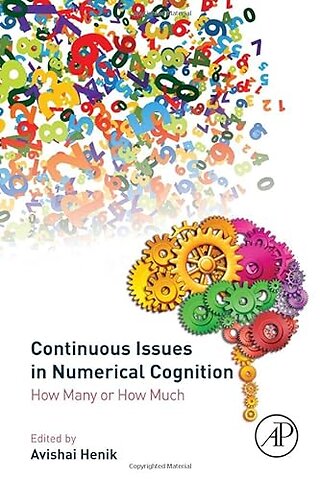
Continuous Issues in Numerical Cognition
How Many or How Much
Gebonden Engels 2016 9780128016374Samenvatting
Continuous Issues in Numerical Cognition: How Many or How Much re-examines the widely accepted view that there exists a core numerical system within human beings and an innate ability to perceive and count discrete quantities. This core knowledge involves the brain’s intraparietal sulcus, and a deficiency in this region has traditionally been thought to be the basis for arithmetic disability. However, new research findings suggest this wide agreement needs to be examined carefully and that perception of sizes and other non-countable amounts may be the true precursors of numerical ability. This cutting-edge book examines the possibility that perception and evaluation of non-countable dimensions may be involved in the development of numerical cognition. Discussions of the above and related issues are important for the achievement of a comprehensive understanding of numerical cognition, its brain basis, development, breakdown in brain-injured individuals, and failures to master mathematical skills.
Specificaties
Lezersrecensies
Inhoudsopgave
1. Development of quantitative thinking across correlated dimensions
Kelly S. Mix, Susan C. Levine and Nora S. Newcombe
2. Link between numbers and spatial extent from birth to adulthood
Maria Dolores de Hevia
3. Catching math problems early: Findings from the number sense intervention project
Nancy C. Jordan and Nancy Dyson
4. Contextual sensitivity and the large number word bias: When is bigger really more?
Michèle M. Mazzocco, Jenny Yun-Chen Chan and Maria Sera
5. Learning, ageing, and the number brain
Marinella Cappelletti
6. The development of counting ability - An evolutionary computation point of view
Gali Katz, Amit Benbassat and Moshe Sipper
SECTION II. ANIMAL STUDIES
7. Number vs. continuous quantities in lower vertebrates
Christian Agrillo, Maria Elena Miletto Petrazzini and Angelo Bisazza
8. Going for more: Discrete and continuous quantity judgments by nonhuman animals
Michael J. Beran and Audrey E. Parrish
SECTION III. PROCESSES AND MECHANISMS
9. Number sense: What's in a name and why should we bother?
Bert Reynvoet, Karolien Smets and Delphine Sasanguie
10. The distribution game: evidence for discrete numerosity coding in preschool children
Alain Content and Julie Nys
11. Magnitudes in the coding of visual multitudes: Evidence from adaptation
Frank H. Durgin
12. The ordinal instinct: A neurocognitive perspective and methodological issues
Orly Rubinstein
13. Discrete and continuous presentation of quantities in science and mathematics education
Ruth Stavy and Reuven Babai
14. The interaction of numerical and non-numerical parameters in magnitude comparison tasks with children and their relation to arithmetic performance
Swiya Nath and Denes Szucs
SECTION IV. MODELS
15. Symbolic and nonsymbolic representation of number in the human parietal cortex
Moriah Sokolowski and Daniel Ansari
16. What do we measure when we measure magnitudes?
Tali Leibovich, Arava Y. Kallai and Shai Itamar
17. How do humans represent numerical and non-numerical magnitudes? Evidence for an integrated system of magnitude representation across development
Stella F. Lourenco
18. The sensory integration theory: An alternative to the approximate number system
Wim Gevers, Roi Cohen Kadosh and Titia Gebuis
Rubrieken
- advisering
- algemeen management
- coaching en trainen
- communicatie en media
- economie
- financieel management
- inkoop en logistiek
- internet en social media
- it-management / ict
- juridisch
- leiderschap
- marketing
- mens en maatschappij
- non-profit
- ondernemen
- organisatiekunde
- personal finance
- personeelsmanagement
- persoonlijke effectiviteit
- projectmanagement
- psychologie
- reclame en verkoop
- strategisch management
- verandermanagement
- werk en loopbaan