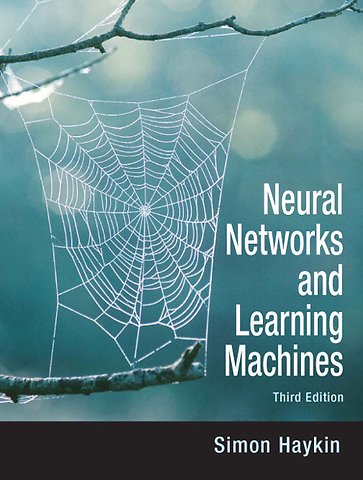
Neural Networks and Learning Machines
Gebonden Engels 2008 2e druk 9780131471399Samenvatting
Neural Networks and Learning Machines
Third Edition
Simon Haykin
McMaster University, Canada
This third edition of a classic book presents a comprehensive treatment of neural networks and learning machines. These two pillars that are closely related. The book has been revised extensively to provide an up-to-date treatment of a subject that is continually growing in importance. Distinctive features of the book include:
• On-line learning algorithms rooted in stochastic gradient descent; small-scale and large-scale learning problems.
• Kernel methods, including support vector machines, and the representer theorem.
• Information-theoretic learning models, including copulas, independent components analysis (ICA), coherent ICA, and information bottleneck.
• Stochastic dynamic programming, including approximate and neurodynamic procedures.
• Sequential state-estimation algorithms, including Kalman and particle filters.
• Recurrent neural networks trained using sequential-state estimation algorithms.
• Insightful computer-oriented experiments.
Just as importantly, the book is written in a readable style that is Simon Haykin’s hallmark.
Specificaties
Lezersrecensies
Inhoudsopgave
Introduction 1
1. What is a Neural Network? 1
2. The Human Brain 6
3. Models of a Neuron 10
4. Neural Networks Viewed As Directed Graphs 15
5. Feedback 18
6. Network Architectures 21
7. Knowledge Representation 24
8. Learning Processes 34
9. Learning Tasks 38
10. Concluding Remarks 45
Notes and References 46
Chapter 1 Rosenblatt’s Perceptron 47
1.1 Introduction 47
1.2. Perceptron 48
1.3. The Perceptron Convergence Theorem 50
1.4. Relation Between the Perceptron and Bayes Classifier for a Gaussian Environment 55
1.5. Computer Experiment: Pattern Classification 60
1.6. The Batch Perceptron Algorithm 62
1.7. Summary and Discussion 65
Notes and References 66
Problems 66
Chapter 2 Model Building through Regression 68
2.1 Introduction 68
2.2 Linear Regression Model: Preliminary Considerations 69
2.3 Maximum a Posteriori Estimation of the Parameter Vector 71
2.4 Relationship Between Regularized Least-Squares Estimation and MAP Estimation 76
2.5 Computer Experiment: Pattern Classification 77
2.6 The Minimum-Description-Length Principle 79
2.7 Finite Sample-Size Considerations 82
2.8 The Instrumental-Variables Method 86
2.9 Summary and Discussion 88
Notes and References 89
Problems 89
Chapter 3 The Least-Mean-Square Algorithm 91
3.1 Introduction 91
3.2 Filtering Structure of the LMS Algorithm 92
3.3 Unconstrained Optimization: a Review 94
3.4 The Wiener Filter 100
3.5 The Least-Mean-Square Algorithm 102
3.6 Markov Model Portraying the Deviation of the LMS Algorithm from the Wiener Filter 104
3.7 The Langevin Equation: Characterization of Brownian Motion 106
3.8 Kushner’s Direct-Averaging Method 107
3.9 Statistical LMS Learning Theory for Small Learning-Rate Parameter 108
3.10 Computer Experiment I: Linear Prediction 110
3.11 Computer Experiment II: Pattern Classification 112
3.12 Virtues and Limitations of the LMS Algorithm 113
3.13 Learning-Rate Annealing Schedules 115
3.14 Summary and Discussion 117
Notes and References 118
Problems 119
Chapter 4 Multilayer Perceptrons 122
4.1 Introduction 123
4.2 Some Preliminaries 124
4.3 Batch Learning and On-Line Learning 126
4.4 The Back-Propagation Algorithm 129
4.5 XOR Problem 141
4.6 Heuristics for Making the Back-Propagation Algorithm Perform Better 144
4.7 Computer Experiment: Pattern Classification 150
4.9 The Hessian and Its Role in On-Line Learning 155
4.10 Optimal Annealing and Adaptive Control of the Learning Rate 157
4.11 Generalization 164
4.12 Approximations of Functions 166
4.13 Cross-Validation 171
4.14 Complexity Regularization and Network Pruning 175
4.15 Virtues and Limitations of Back-Propagation Learning 180
4.16 Supervised Learning Viewed as an Optimization Problem 186
4.17 Convolutional Networks 201
4.18 Nonlinear Filtering 203
4.19 Small-Scale Versus Large-Scale Learning Problems 209
4.20 Summary and Discussion 217
Notes and References 219
Problems 221
Chapter 5 Kernel Methods and Radial-Basis Function Networks 230
5.1 Introduction 230
5.2 Cover’s Theorem on the Separability of Patterns 231
5.3 The Interpolation Problem 236
5.4 Radial-Basis-Function Networks 239
5.5 K-Means Clustering 242
5.6 Recursive Least-Squares Estimation of the Weight Vector 245
5.7 Hybrid Learning Procedure for RBF Networks 249
5.8 Computer Experiment: Pattern Classification 250
5.9 Interpretations of the Gaussian Hidden Units 252
5.10 Kernel Regression and Its Relation to RBF Networks 255
5.11 Summary and Discussion 259
Notes and References 261
Problems 263
Chapter 6 Support Vector Machines 268
6.1 Introduction 268
6.2 Optimal Hyperplane for Linearly Separable Patterns 269
6.3 Optimal Hyperplane for Nonseparable Patterns 276
6.4 The Support Vector Machine Viewed as a Kernel Machine 281
6.5 Design of Support Vector Machines 284
6.6 XOR Problem 286
6.7 Computer Experiment: Pattern Classification 289
6.8 Regression: Robustness Considerations 289
6.9 Optimal Solution of the Linear Regression Problem 293
6.10 The Representer Theorem and Related Issues 296
6.11 Summary and Discussion 302
Notes and References 304
Problems 307
Chapter 7 Regularization Theory 313
7.1 Introduction 313
7.2 Hadamard’s Conditions for Well-Posedness 314
7.3 Tikhonov’s Regularization Theory 315
7.4 Regularization Networks 326
7.5 Generalized Radial-Basis-Function Networks 327
7.6 The Regularized Least-Squares Estimator: Revisited 331
7.7 Additional Notes of Interest on Regularization 335
7.8 Estimation of the Regularization Parameter 336
7.9 Semisupervised Learning 342
7.10 Manifold Regularization: Preliminary Considerations 343
7.11 Differentiable Manifolds 345
7.12 Generalized Regularization Theory 348
7.13 Spectral Graph Theory 350
7.14 Generalized Representer Theorem 352
7.15 Laplacian Regularized Least-Squares Algorithm 354
7.16 Experiments on Pattern Classification Using Semisupervised Learning 356
7.17 Summary and Discussion 359
Notes and References 361
Problems 363
Chapter 8 Principal-Components Analysis 367
8.1 Introduction 367
8.2 Principles of Self-Organization 368
8.3 Self-Organized Feature Analysis 372
8.4 Principal-Components Analysis: Perturbation Theory 373
8.5 Hebbian-Based Maximum Eigenfilter 383
8.6 Hebbian-Based Principal-Components Analysis 392
8.7 Case Study: Image Coding 398
8.8 Kernel Principal-Components Analysis 401
8.9 Basic Issues Involved in the Coding of Natural Images 406
8.10 Kernel Hebbian Algorithm 407
8.11 Summary and Discussion 412
Notes and References 415
Problems 418
Chapter 9 Self-Organizing Maps 425
9.1 Introduction 425
9.2 Two Basic Feature-Mapping Models 426
9.3 Self-Organizing Map 428
9.4 Properties of the Feature Map 437
9.5 Computer Experiments I: Disentangling Lattice Dynamics Using SOM 445
9.6 Contextual Maps 447
9.7 Hierarchical Vector Quantization 450
9.8 Kernel Self-Organizing Map 454
9.9 Computer Experiment II: Disentangling Lattice Dynamics Using Kernel SOM 462
9.10 Relationship Between Kernel SOM and Kullback—Leibler Divergence 464
9.11 Summary and Discussion 466
Notes and References 468
Problems 470
Chapter 10 Information-Theoretic Learning Models 475
10.1 Introduction 476
10.2 Entropy 477
10.3 Maximum-Entropy Principle 481
10.4 Mutual Information 484
10.5 Kullback—Leibler Divergence 486
10.6 Copulas 489
10.7 Mutual Information as an Objective Function to be Optimized 493
10.8 Maximum Mutual Information Principle 494
10.9 Infomax and Redundancy Reduction 499
10.10 Spatially Coherent Features 501
10.11 Spatially Incoherent Features 504
10.12 Independent-Components Analysis 508
10.13 Sparse Coding of Natural Images and Comparison with ICA Coding 514
10.14 Natural-Gradient Learning for Independent-Components Analysis 516
10.15 Maximum-Likelihood Estimation for Independent-Components Analysis 526
10.16 Maximum-Entropy Learning for Blind Source Separation 529
10.17 Maximization of Negentropy for Independent-Components Analysis 534
10.18 Coherent Independent-Components Analysis 541
10.19 Rate Distortion Theory and Information Bottleneck 549
10.20 Optimal Manifold Representation of Data 553
10.21 Computer Experiment: Pattern Classification 560
10.22 Summary and Discussion 561
Notes and References 564
Problems 572
Chapter 11 Stochastic Methods Rooted in Statistical Mechanics 579
11.1 Introduction 580
11.2 Statistical Mechanics 580
11.3 Markov Chains 582
11.4 Metropolis Algorithm 591
11.5 Simulated Annealing 594
11.6 Gibbs Sampling 596
11.7 Boltzmann Machine 598
11.8 Logistic Belief Nets 604
11.9 Deep Belief Nets 606
11.10 Deterministic Annealing 610
11.11 Analogy of Deterministic Annealing with Expectation-Maximization Algorithm 616
11.12 Summary and Discussion 617
Notes and References 619
Problems 621
Chapter 12 Dynamic Programming 627
12.1 Introduction 627
12.2 Markov Decision Process 629
12.3 Bellman’s Optimality Criterion 631
12.4 Policy Iteration 635
12.5 Value Iteration 637
12.6 Approximate Dynamic Programming: Direct Methods 642
12.7 Temporal-Difference Learning 643
12.8 Q-Learning 648
12.9 Approximate Dynamic Programming: Indirect Methods 652
12.10 Least-Squares Policy Evaluation 655
12.11 Approximate Policy Iteration 660
12.12 Summary and Discussion 663
Notes and References 665
Problems 668
Chapter 13 Neurodynamics 672
13.1 Introduction 672
13.2 Dynamic Systems 674
13.3 Stability of Equilibrium States 678
13.4 Attractors 684
13.5 Neurodynamic Models 686
13.6 Manipulation of Attractors as a Recurrent Network Paradigm 689
13.7 Hopfield Model 690
13.8 The Cohen—Grossberg Theorem 703
13.9 Brain-State-In-A-Box Model 705
13.10 Strange Attractors and Chaos 711
13.11 Dynamic Reconstruction of a Chaotic Process 716
13.12 Summary and Discussion 722
Notes and References 724
Problems 727
Chapter 14 Bayseian Filtering for State Estimation of Dynamic Systems 731
14.1 Introduction 731
14.2 State-Space Models 732
14.3 Kalman Filters 736
14.4 The Divergence-Phenomenon and Square-Root Filtering 744
14.5 The Extended Kalman Filter 750
14.6 The Bayesian Filter 755
14.7 Cubature Kalman Filter: Building on the Kalman Filter 759
14.8 Particle Filters 765
14.9 Computer Experiment: Comparative Evaluation of Extended Kalman and Particle Filters 775
14.10 Kalman Filtering in Modeling of Brain Functions 777
14.11 Summary and Discussion 780
Notes and References 782
Problems 784
Chapter 15 Dynamically Driven Recurrent Networks 790
15.1 Introduction 790
15.2 Recurrent Network Architectures 791
15.3 Universal Approximation Theorem 797
15.4 Controllability and Observability 799
15.5 Computational Power of Recurrent Networks 804
15.6 Learning Algorithms 806
15.7 Back Propagation Through Time 808
15.8 Real-Time Recurrent Learning 812
15.9 Vanishing Gradients in Recurrent Networks 818
15.10 Supervised Training Framework for Recurrent Networks Using Nonlinear Sequential State Estimators 822
15.11 Computer Experiment: Dynamic Reconstruction of Mackay—Glass Attractor 829
15.12 Adaptivity Considerations 831
15.13 Case Study: Model Reference Applied to Neurocontrol 833
15.14 Summary and Discussion 835
Notes and References 839
Problems 842
Bibliography 845
Index 889
 
Rubrieken
- advisering
- algemeen management
- coaching en trainen
- communicatie en media
- economie
- financieel management
- inkoop en logistiek
- internet en social media
- it-management / ict
- juridisch
- leiderschap
- marketing
- mens en maatschappij
- non-profit
- ondernemen
- organisatiekunde
- personal finance
- personeelsmanagement
- persoonlijke effectiviteit
- projectmanagement
- psychologie
- reclame en verkoop
- strategisch management
- verandermanagement
- werk en loopbaan