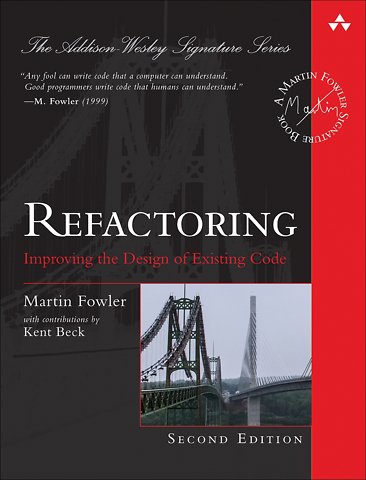
Refactoring
Improving the Design of Existing Code
Gebonden Engels 2018 2e druk 9780134757599Samenvatting
Fully Revised and Updated–Includes New Refactorings and Code Examples
“Any fool can write code that a computer can understand. Good programmers write code that humans can understand.” - M. Fowler (1999)
For more than twenty years, experienced programmers worldwide have relied on Martin Fowler’s Refactoring to improve the design of existing code and to enhance software maintainability, as well as to make existing code easier to understand.
This eagerly awaited new edition has been fully updated to reflect crucial changes in the programming landscape. 'Refactoring, Second Edition', features an updated catalog of refactorings and includes JavaScript code examples, as well as new functional examples that demonstrate refactoring without classes.
Like the original, this edition explains what refactoring is; why you should refactor; how to recognize code that needs refactoring; and how to actually do it successfully, no matter what language you use.
- Understand the process and general principles of refactoring
- Quickly apply useful refactorings to make a program easier to comprehend and change
- Recognize “bad smells” in code that signal opportunities to refactor
- Explore the refactorings, each with explanations, motivation, mechanics, and simple examples
- Build solid tests for your refactorings
- Recognize tradeoffs and obstacles to refactoring
Specificaties
Lezersrecensies
Inhoudsopgave
Preface xiii
Chapter 1: Refactoring: A First Example 1
The Starting Point 1
Comments on the Starting Program 3
The First Step in Refactoring 5
Decomposing the statement Function 6
Status: Lots of Nested Functions 22
Splitting the Phases of Calculation and Formatting 24
Status: Separated into Two Files (and Phases) 31
Reorganizing the Calculations by Type 34
Status: Creating the Data with the Polymorphic Calculator 41
Final Thoughts 43
Chapter 2: Principles in Refactoring 45
Defining Refactoring 45
The Two Hats 46
Why Should We Refactor? 47
When Should We Refactor? 50
Problems with Refactoring 55
Refactoring, Architecture, and Yagni 62
Refactoring and the Wider Software Development Process 63
Refactoring and Performance 64
Where Did Refactoring Come From? 67
Automated Refactorings 68
Going Further 70
Chapter 3: Bad Smells in Code 71
Mysterious Name 72
Duplicated Code 72
Long Function 73
Long Parameter List 74
Global Data 74
Mutable Data 75
Divergent Change 76
Shotgun Surgery 76
Feature Envy 77
Data Clumps 78
Primitive Obsession 78
Repeated Switches 79
Loops 79
Lazy Element 80
Speculative Generality 80
Temporary Field 80
Message Chains 81
Middle Man 81
Insider Trading 82
Large Class 82
Alternative Classes with Different Interfaces 83
Data Class 83
Refused Bequest 83
Comments 84
Chapter 4: Building Tests 85
The Value of Self-Testing Code 85
Sample Code to Test 87
A First Test 90
Add Another Test 93
Modifying the Fixture 95
Probing the Boundaries 96
Much More Than This 99
Format of the Refactorings 101
The Choice of Refactorings 102
Chapter 6: A First Set of Refactorings 105
Extract Function 106
Inline Function 115
Extract Variable 119
Inline Variable 123
Change Function Declaration 124
Encapsulate Variable 132
Rename Variable 137
Introduce Parameter Object 140
Combine Functions into Class 144
Combine Functions into Transform 149
Split Phase 154
Chapter 7: Encapsulation 161
Encapsulate Record 162
Encapsulate Collection 170
Replace Primitive with Object 174
Replace Temp with Query 178
Extract Class 182
Inline Class 186
Hide Delegate 189
Remove Middle Man 192
Substitute Algorithm 195
Chapter 8: Moving Features 197
Move Function 198
Move Field 207
Move Statements into Function 213
Move Statements to Callers 217
Replace Inline Code with Function Call 222
Slide Statements 223
Split Loop 227
Replace Loop with Pipeline 231
Remove Dead Code 237
Chapter 9: Organizing Data 239
Split Variable 240
Rename Field 244
Replace Derived Variable with Query 248
Change Reference to Value 252
Change Value to Reference 256
Chapter 10: Simplifying Conditional Logic 259
Decompose Conditional 260
Consolidate Conditional Expression 263
Replace Nested Conditional with Guard Clauses 266
Replace Conditional with Polymorphism 272
Introduce Special Case 289
Introduce Assertion 302
Chapter 11: Refactoring APIs 305
Separate Query from Modifier 306
Parameterize Function 310
Remove Flag Argument 314
Preserve Whole Object 319
Replace Parameter with Query 324
Replace Query with Parameter 327
Remove Setting Method 331
Replace Constructor with Factory Function 334
Replace Function with Command 337
Replace Command with Function 344
Chapter 12: Dealing with Inheritance 349
Pull Up Method 350
Pull Up Field 353
Pull Up Constructor Body 355
Push Down Method 359
Push Down Field 361
Replace Type Code with Subclasses 362
Remove Subclass 369
Extract Superclass 375
Collapse Hierarchy 380
Replace Subclass with Delegate 381
Replace Superclass with Delegate 399
Bibliography 405
Index 409
Anderen kochten ook
 Mark Richards€ 93,51
 Santiago Fernández Muñoz€ 57,87
 Francesco Esposito€ 52,18
 Mel Robbins€ 23,99
 Tim Masselink€ 27,50
 Marianne Heemskerk€ 29,95
Rubrieken
- advisering
- algemeen management
- coaching en trainen
- communicatie en media
- economie
- financieel management
- inkoop en logistiek
- internet en social media
- it-management / ict
- juridisch
- leiderschap
- marketing
- mens en maatschappij
- non-profit
- ondernemen
- organisatiekunde
- personal finance
- personeelsmanagement
- persoonlijke effectiviteit
- projectmanagement
- psychologie
- reclame en verkoop
- strategisch management
- verandermanagement
- werk en loopbaan