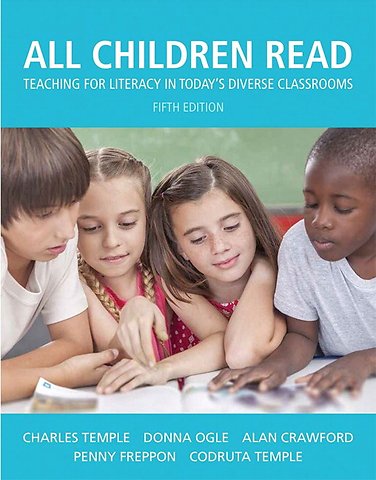
All Children Read
Teaching for Literacy in Today's Diverse Classrooms
Paperback Engels 2021 5e druk 9780134894652Samenvatting
A practical and applied K-8 reading methods book with a focus on new literacies and developmental, cultural, and linguistic diversities.
Written by one of the most dynamic author teams in the field of reading and literacy, All Children Read, Fifth Edition, continues to offer K-8 teachers the best practices for developing reading and writing in all students. As with earlier editions, six critical themes are interwoven throughout: the struggling reader; family/community literacy; new literacies; writing and reading connections; developmental, cultural, and linguistic diversity; and phonics/phonological awareness. The fifth edition further integrates Common Core State Standards and Response to Intervention (RTI), includes separate chapters on teaching reading fluency and vocabulary, emphasizes the teaching of English Learners, and equips teachers-in-training with the foundational knowledge they will need for their professional qualifying examinations. This focus on contemporary and critical learning prepares future teachers for the demands of helping all students succeed in the classroom.
Also available with Revel
Revel™ is Pearson’s newest way of delivering our respected content. Fully digital and highly engaging, Revel replaces the textbook and gives students everything they need for the course. Informed by extensive research on how people read, think, and learn, Revel is an interactive learning environment that enables students to read, practice, and study in one continuous experience—for less than the cost of a traditional textbook.
Note: You are purchasing a standalone product; Revel does not come packaged with this content. Students, if interested in purchasing this title with Revel, ask your instructor to confirm the correct package ISBN and Course ID. Instructors, contact your Pearson representative for more information.
If you would like to purchase both the physical text and Revel, search for:
0134995147 / 9780134995144 All Children Read: Teaching for Literacy in Today's Diverse Classrooms, with Revel -- Access Card Package
Package consists of:
0134894650 / 9780134894652 All Children Read: Teaching for Literacy in Today's Diverse Classrooms
0134515978 / 9780134515977 Revel All Children Read: Teaching for Literacy in Today's Diverse Classrooms -- Access Card
Specificaties
Lezersrecensies
Inhoudsopgave
Brief Table of Contents
- Approaches to Teaching Reading
- The Social and Cultural Contexts for Teaching All Children to Read
- What Reading Teachers Need to Know About Language
- Emergent Literacy
- Phonics and Word Knowledge
- Helping Readers Build Fluency
- The Importance of Vocabulary Development
- Reading Comprehension, Part I: Making Sense of Literature
- Reading Comprehension, Part II: Understanding and Learning with Informational Texts
- Critical Thinking and Critical Literacy
- Teaching Children to Spell and Write
- Assessing Literacy
- Integrating Language and Literacy Instruction Across the Grades
- Models and Strategies for Teaching ESL and for Teaching Reading in the Mother Tongue
Appendix A: Addressing the Common Core Standards
Appendix B: Teach It! Instructional Activities
References
Glossary
Name Index
Subject Index
Detailed Table of Contents
- Approaches to Teaching Reading
- Why Does Literacy Matter?
- How Well Do Children in the United States Read?
- Components of Reading Ability
- Phases of Reading Development
- The Recent History of Reading Instruction: How WeGot Where We Are
- The Social and Cultural Contexts for Teaching All Children to Read
- The Social Contexts of Literacy
- Planning for a Literate Classroom
- Meeting the Literacy Needs of All Children
- Response to Intervention (RTI)
- Finding the Books and Materials TheyWant to Read
- What Reading Teachers Need to Know About Language
- Phonology: The Sounds of English
- Morphology: How English Words Are Built
- Vocabulary: Words and Their Meanings
- Syntax: Ordering and Inflecting Classes of Words
- Text Structure
- Emergent Literacy
- What Is Emergent Literacy?
- Language-Based Learning and Emergent Literacy
- Print-Based Learning and Emergent Literacy
- Comprehensive Strategies to Nurture Emergent Literacy
- Teaching Specific Skills
- Environmental Strategies to Support
- Emergent Literacy
- Involving Families in Emergent Literacy
- Phonics and Word Knowledge
- What Is Phonics? What Is Word Knowledge?
- Words as Wholes: The Logographic Phase
- Letter-by-Letter Reading: The Alphabetic Phase
- Chunking: The Orthographic Phase
- Meaningful Word Parts: The Morphological Phase
- Word Histories and Families: The Derivational Phase
- Helping Students Read Words in Context
- Helping Readers Build Fluency
- Fluency in Reading
- Modeling Fluent Oral Reading
- Supporting Children’s Reading for Fluency
- Practicing Fluency With and Without the Teacher’s Guidance
- Embedding Repeated Reading in Performance
- The Importance of Vocabulary Development
- What Is Vocabulary?
- What Does the Research Say About Vocabulary?
- Teaching Vocabulary
- Teaching Strategies for Independent Word Learning
- Reading Comprehension, Part 1: Making Sense of Literature
- How Students Understand Literature
- Teaching for Comprehension: General Strategies
- Teaching for Comprehension: Specific Skills
- Close Reading
- Assessing Comprehension
- Reading Comprehension, Part II: Understanding and Learning with Informational Texts
- Characteristics of Informational Texts
- Understanding How Readers Comprehend Informational Texts
- Teaching Students to Use Features of Informational Texts
- Teaching with Informational Texts
- Classrooms That Develop Independent Learners
- Critical Thinking and Critical Literacy
- Critical Thinking and Critical Literacy
- Looking Critically at Works of Literature
- Thinking Critically About Texts Other Than Stories
- Teaching Strategies for Critical Thinking
- Teaching Children to Spell and Write
- Spelling Development and Assessment
- Teaching Children to Spell
- A Writing Process in Five Parts
Writing in Different Genres - Assessment of Writing
- Writing to Learn
- Assessing Literacy
- What Is Assessment and Why Do We Assess?
- Approaches to Assessment
- Terms Used in Testing
- Assessing Emergent Readers
- Assessing Beginning Readers and Beyond
- Other Uses of Assessment
- Integrating Language and Literacy Instruction Across the Grades
- Teaching Print Concepts and Phonological Awareness in Context
- Teaching Phonics in Context
- Teaching Morphology in Context
- Teaching Grammar in Context
- Teaching Text Structure
- Models and Strategies for Teaching ESL and for Teaching Reading in the Mother Tongue
- Options for Teaching the English Language Learner
- Major Principles of Second-Language Acquisition
- Instructional Strategies for Second-Language Acquisition
- Options for Teaching the English Language Learnerto Read
- Mother Tongue Support in the Bilingual Classroom
Appendix A: Addressing the Common Core Standards
Appendix B: Teach It! Instructional Activities
References
Glossary
Name Index
Subject Index
Rubrieken
- advisering
- algemeen management
- coaching en trainen
- communicatie en media
- economie
- financieel management
- inkoop en logistiek
- internet en social media
- it-management / ict
- juridisch
- leiderschap
- marketing
- mens en maatschappij
- non-profit
- ondernemen
- organisatiekunde
- personal finance
- personeelsmanagement
- persoonlijke effectiviteit
- projectmanagement
- psychologie
- reclame en verkoop
- strategisch management
- verandermanagement
- werk en loopbaan