, ,

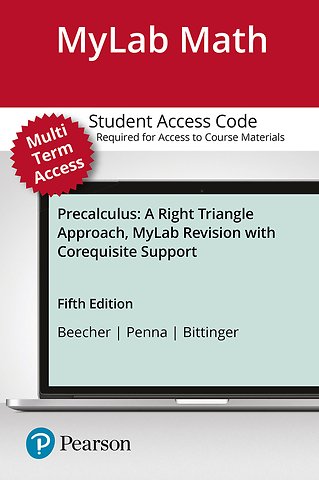
MyLab Math with Pearson eText Access Code (24 Months) for Precalculus

A Right Triangle Approach MyLab Revision with Corequisite Support

Onbekend Engels 2019 9780135263815
€ 172,54
Levertijd ongeveer 9 werkdagen
Gratis verzonden

Samenvatting

For courses in Precalculus.

Includes MyLab Math.

Prepare. Visualize. Succeed.

Precalculus: A Right Triangle Approach by Beecher, Penna, and Bittinger is known for helping students “see the math” through a focus on visualization and early introduction to functions. The author team has expanded and enhanced the instruction on review topics needed for today’s corequisite courses, or simply for students who come to the course underprepared. 

The Precalculus MyLab Revision with Corequisite Support offers a complete precalculus MyLab™ Math course with review of key topics from developmental algebra. The authors have built tools specifically for underprepared students — resources that can be used by students independently via videos and notebook, or by instructors through integrating activities and interactive media into the classroom. Ideal either for standard course needs or for courses with students requiring additional preparation, this robust, just-in-time approach to corequisites gives instructors complete flexibility in implementation — no matter how their courses are set up.

Reach every student with MyLab Math 

MyLab™ Math is the teaching and learning platform that empowers you to reach every student. By combining trusted author content with digital tools and a flexible platform, MyLab Math personalizes the learning experience and improves results for each student. Learn more about MyLab Math.

Specificaties

ISBN13:9780135263815
Taal:Engels
Bindwijze:onbekend

Lezersrecensies

Wees de eerste die een lezersrecensie schrijft!

Inhoudsopgave

<h2>Table of Contents</h2> <div class="c-non-traditional-number-list_container"> <ol> <li><strong>Graphs, Functions, and Models</strong> <ul> <li>1.1 Introduction to Graphing</li> <li>1.2 Functions and Graphs</li> <li>1.3 Linear Functions, Slope, and Applications</li> <li>1.4 Equations of Lines and Modeling</li> <li>1.5 Linear Equations, Functions, Zeros, and Applications</li> <li>1.6 Solving Linear Inequalities</li> </ul> </li> <li><strong>More on Functions</strong> <ul> <li>2.1 Increasing, Decreasing, and Piecewise Functions; Applications</li> <li>2.2 The Algebra of Functions</li> <li>2.3 The Composition of Functions</li> <li>2.4 Symmetry</li> <li>2.5 Transformations</li> <li>2.6 Variation and Applications</li> </ul> </li> <li><strong>Quadratic Functions and Equations; Inequalities</strong> <ul> <li>3.1 The Complex Numbers</li> <li>3.2 Quadratic Equations, Functions, Zeros, and Models</li> <li>3.3 Analyzing Graphs of Quadratic Functions</li> <li>3.4 Solving Rational Equations and Radical Equations</li> <li>3.5 Solving Equations and Inequalities with Absolute Value</li> </ul></li> <li><strong>Polynomial Functions and Rational Functions</strong> <ul> <li>4.1 Polynomial Functions and Models</li> <li>4.2 Graphing Polynomial Functions</li> <li>4.3 Polynomial Division; The Remainder Theorem and the Factor Theorem</li> <li>4.4 Theorems about Zeros of Polynomial Functions</li> <li>4.5 Rational Functions</li> <li>4.6 Polynomial Inequalities and Rational Inequalities</li> </ul></li> <li><strong>Exponential Functions and Logarithmic Functions</strong> <ul> <li>5.1 Inverse Functions</li> <li>5.2 Exponential Functions and Graphs</li> <li>5.3 Logarithmic Functions and Graphs</li> <li>5.4 Properties of Logarithmic Functions</li> <li>5.5 Solving Exponential Equations and Logarithmic Equations</li> <li>5.6 Applications and Models: Growth and Decay; Compound Interest</li> </ul></li> <li><strong>The Trigonometric Functions</strong> <ul> <li>6.1 Trigonometric Functions of Acute Angles</li> <li>6.2 Applications of Right Triangles</li> <li>6.3 Trigonometric Functions of Any Angle</li> <li>6.4 Radians, Arc Length, and Angular Speed</li> <li>6.5 Circular Functions: Graphs and Properties</li> <li>6.6 Graphs of Transformed Sine and Cosine Functions</li> </ul></li> <li><strong>Trigonometric Identities, Inverse Functions, and Equations</strong> <ul> <li>7.1 Identities: Pythagorean and Sum and Difference</li> <li>7.2 Identities: Cofunction, Double-Angle, and Half-Angle</li> <li>7.3 Proving Trigonometric Identities</li> <li>7.4 Inverses of the Trigonometric Functions</li> <li>7.5 Solving Trigonometric Equations</li> </ul></li> <li><strong>Applications of Trigonometry</strong> <ul> <li>8.1 The Law of Sines</li> <li>8.2 The Law of Cosines</li> <li>8.3 Complex Numbers: Trigonometric Notation</li> <li>8.4 Polar Coordinates and Graphs</li> <li>8.5 Vectors and Applications</li> <li>8.6 Vector Operations</li> </ul></li> <li><strong>Systems of Equations and Matrices</strong> <ul> <li>9.1 Systems of Equations in Two Variables</li> <li>9.2 Systems of Equations in Three Variables</li> <li>9.3 Matrices and Systems of Equations</li> <li>9.4 Matrix Operations</li> <li>9.5 Inverses of Matrices</li> <li>9.6 Determinants and Cramer’s Rule</li> <li>9.7 Systems of Inequalities and Linear Programming</li> <li>9.8 Partial Fractions</li> </ul></li> <li><strong>Conic Sections</strong> <ul> <li>10.1 The Parabola</li> <li>10.2 The Circle and the Ellipse</li> <li>10.3 The Hyperbola</li> <li>10.4 Nonlinear Systems of Equations and Inequalities</li> <li>10.5 Rotation of Axes</li> <li>10.6 Polar Equations of Conics</li> <li>10.7 Parametric Equations</li> </ul></li> <li><strong>Sequences, Series, and Combinatorics</strong> <ul> <li>11.1 Sequences and Series</li> <li>11.2 Arithmetic Sequences and Series</li> <li>11.3 Geometric Sequences and Series</li> <li>11.4 Mathematical Induction</li> <li>11.5 Combinatorics: Permutations</li> <li>11.6 Combinatorics: Combinations</li> <li>11.7 The Binomial Theorem</li> <li>11.8 Probability</li> </ul> </li> </ol> </div>

Managementboek Top 100

€ 172,54
Levertijd ongeveer 9 werkdagen
Gratis verzonden

Rubrieken

    Personen

      Trefwoorden

        MyLab Math with Pearson eText Access Code (24 Months) for Precalculus