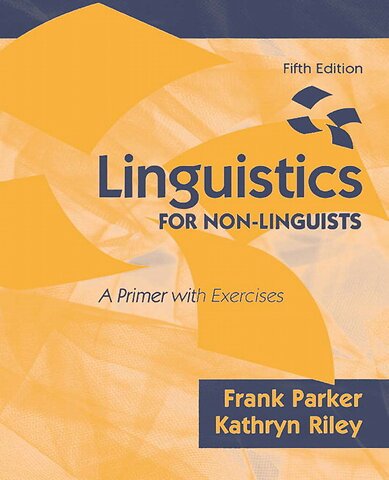
Linguistics for Non-Linguists
A Primer with Exercises
Paperback Engels 2009 5e druk 9780137152049Samenvatting
Linguistics for Non-Linguists is a highly readable introductory text that presents students with the basic elements of linguistics in a clear and concise style that any beginner will understand.
This newly revised edition continues to expand on the success of earlier editions, taking a subject that is generally considered quite complicated and making it accessible to virtually anyone who requires a basic understanding of linguistics. The authors illustrate major concepts in an easy-to-read style, giving students and specialists in language-related fields an introduction to the essential principles and methods of linguistic theory. Non-linguistics majors will also find this book user-friendly, with a wealth of exercises and references interspersed throughout to help reinforce concepts.
Specialists in language-related fields, including Speech-Language Pathology, Experimental Phonetics, Communication, Education, Psychology, and English as a Second Language, will find this text a must-have reference for all courses.
Specificaties
Lezersrecensies
Inhoudsopgave
NOTE: Each chapter concludes with Summary, Supplementary Readings, Supplementary Exercises, and Exploratory Exercises.
1. Introduction
2. Pragmatics
- Implicature
- Conversational Maxims
- Speech Acts
- A Taxonomy of Illocutionary Acts
- Felicity Conditions
- Explicit Versus Nonexplicit Illocutionary Acts
- Direct Versus Indirect Illocutionary Acts
- Expressed Versus Implied Locutionary Acts
- Literal Versus Nonliteral Locutionary Acts
- Overview of Speech Act Theory
3. Semantics
- Background
- Sense
- Reference
- Truth
4. Syntax
- Categories
- Left-to-Right Ordering
- Constituent Structure
- X-Bar Syntax
- Transformations
- Movement
- Constraints on Movement
5. Morphology
- Morphemes
- Lexical and Grammatical Morphemes
- Free and Bound Morphemes
- Inflectional and Derivational Morphemes
- Inflectional Affixes
- Derivational Affixes
- Differences Between Types of Affixes
- Word-Formation Processes
6. Phonology
- Vocal Tract
- Segments
- Phonemic Alphabet
- Vowels
- Consonants
- Levels of Representation
- Phonological Rules
- Aspiration
- Vowel Lengthening
- Vowel Nasalization
- Flapping
- Rule Ordering
7. Language Processing
- Sentence-Level Phenomena in Language Processing
- Resolving Syntactic Ambiguity
- Resolving Ambiguous Pronoun Reference
- Understanding Negative Sentences
- Processing Passive Sentences
- Processing Complex Sentences
- Processing Heavy NPs
- Discourse-Level Phenomena in Language Processing
- Readability
- Schemata and Scripts
- Cohesion
- Thematic Roles
- The Given-New Contract
- Reading Between the Lines
8. Language Variation
- Language Universals, Languages, Dialects, and Idiolects
- Regional Variation
- Regional Lexical Variation
- Regional Phonological Variation
- Social Variation
- Nonstandard Phonological Variation
- Nonstandard Morphological Variation
- Nonstandard Syntactic Variation
- Language and Gender
- Gender as a Social Variable
- Gender Patterns Within Standard English
- Stylistic Variation
- Stylistic Lexical Variation
- Stylistic Phonological Variation
- Stylistic Morphological Variation
- Stylistic Syntactic Variation
9. Language Change
- Background
- Semantic Change
- Syntactic Change
- Word Order Typology
- Rule Change
- Morphological Change
- Phonological Change
- Causes of Change
10. First-Language Acquisition
- Prelinguistic Stages
- Linguistic Stages
- Acquisition of Phonology
- Acquisition of Morphology
- Acquisition of Syntax
- Acquisition of Semantics
- Issues in Language Acquisition
- Nativism and Empiricism
- Language-Specific and General Cognitive Capacities
- Chomsky’s Position
11. Second-Language Acquisition
- Issues in Second-Language Acquisition
- Interlanguage Theory
- Language Transfer
- Other Linguistic Factors
- Patterns in Second-Language Acquisition
- Phonology
- Morphology
- Syntax
- Semantics
- Nonlinguistic Influences on Second-Language Acquisition
12. Written Language
- Writing Systems
- The English Spelling System
- Reasons for Inconsistency in English Spelling
- English Spelling and Morphophonemics
- Analyzing Errors in Written English
- Phonology and Spelling
- Morphology and Writing
13. The Neurology of Language
- Anatomy of the Nervous System
- Lobes
- Convolutions and Fissures
- Broca’s Area
- Wernicke’s Area
- Supplementary Motor Cortex
- Hemispherical Specialization
- Left-Hemisphere Dominance for Language
- Left Brain Versus Right Brain
- Handedness
- Aphasia
References
Glossary
Answers to Selected Exercises
Author Index
Subject Index
Rubrieken
- advisering
- algemeen management
- coaching en trainen
- communicatie en media
- economie
- financieel management
- inkoop en logistiek
- internet en social media
- it-management / ict
- juridisch
- leiderschap
- marketing
- mens en maatschappij
- non-profit
- ondernemen
- organisatiekunde
- personal finance
- personeelsmanagement
- persoonlijke effectiviteit
- projectmanagement
- psychologie
- reclame en verkoop
- strategisch management
- verandermanagement
- werk en loopbaan