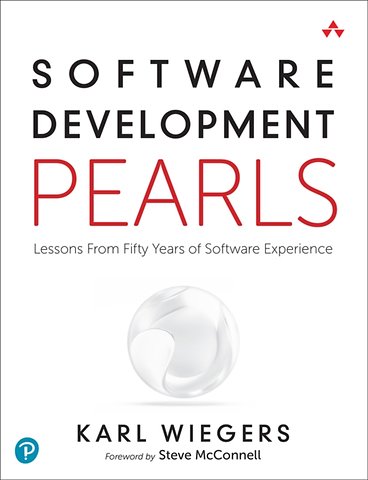
Software Development Pearls
Lessons from Fifty Years of Software Experience
Paperback Engels 2021 1e druk 9780137487776Samenvatting
Accelerate Your Pursuit of Software Excellence by Learning from Others' Hard-Won Experience "Karl is one of the most thoughtful software people I know. He has reflected deeply on the software development irritants he has encountered over his career, and this book contains 60 of his most valuable responses." -- From the Foreword by Steve McConnell, Construx Software and author of Code Complete "Wouldn't it be great to gain a lifetime's experience without having to pay for the inevitable errors of your own experience? Karl Wiegers is well versed in the best techniques of business analysis, software engineering, and project management. You'll gain concise but important insights into how to recover from setbacks as well as how to avoid them in the first place." --Meilir Page-Jones, Senior Business Analyst, Wayland Systems Inc.
Experience is a powerful teacher, but it's also slow and painful. You can't afford to make every mistake yourself! Software Development Pearls helps you improve faster and bypass much of the pain by learning from others who already climbed the learning curves. Drawing on 25+ years helping software teams succeed, Karl Wiegers has crystallized 60 concise, practical lessons for all your projects, regardless of your role, industry, technology, or methodology.
Wiegers's insights and specific recommendations cover six crucial elements of success: requirements, design, project management, culture and teamwork, quality, and process improvement. For each, Wiegers offers First Steps for reflecting on your own experiences before you start; detailed Lessons with core insights, real case studies, and actionable solutions; and Next Steps for planning adoption in your project, team, or organization. This is knowledge you weren't taught in college or boot camp.
It can boost your performance as a developer, business analyst, quality professional, or manager. Clarify requirements to gain a shared vision and understanding of your real problemCreate robust designs that implement the right functionality and quality attributes and can evolveAnticipate and avoid ubiquitous project management pitfallsGrow a culture in which behaviors actually align with what people claim to valuePlan realistically for quality and build it in from the outsetUse process improvement to achieve desired business results, not as an end in itselfChoose your next steps to get full value from all these lessons Register your book for convenient access to downloads, updates, and/or corrections as they become available. See inside book for details.
Specificaties
Lezersrecensies
Inhoudsopgave
Acknowledgments xxi
About the Author xxiii
Chapter 1: Learning from Painful Experience 1
My Perspective 1
About the Book 2
A Note on Terminology 4
Your Opportunity 5
Chapter 2: Lessons About Requirements 7
Introduction to Requirements 7
First Steps: Requirements 11
Lesson 1: Get the requirements right or the project will fail 12
Lesson 2: Requirements development delivers shared understanding 15
Lesson 3: Stakeholder interests intersect at the requirements 17
Lesson 4: Favor a usage-centric approach to requirements 21
Lesson 5: Requirements development demands iteration 25
Lesson 6: Agile requirements aren't different from other requirements 28
Lesson 7: Recording knowledge is cheaper than acquiring it 33
Lesson 8: Requirements are about clear communication 37
Lesson 9: Requirements quality is in the eye of the beholder 41
Lesson 10: Requirements must be good enough to reduce risk 44
Lesson 11: People don't simply gather requirements 46
Lesson 12: Elicitation brings the customer's voice to the developer 51
Lesson 13: Telepathy and clairvoyance don't work 55
Lesson 14: Large groups have difficulty agreeing on requirements 57
Lesson 15: Avoid decibel prioritization 61
Lesson 16: Define scope to know whether your scope is creeping 64
Next Steps: Requirements 69
Chapter 3: Lessons About Design 71
Introduction to Design 71
First Steps: Design 75
Lesson 17: Design demands iteration 76
Lesson 18: It's cheaper to iterate at higher levels of abstraction 79
Lesson 19: Make products easy to use correctly, hard to use incorrectly 84
Lesson 20: You can't optimize all desirable quality attributes 87
Lesson 21: An ounce of design is worth a pound of recoding 92
Lesson 22: Many system problems take place at interfaces 94
Next Steps: Design 100
Chapter 4: Lessons About Project Management 103
Introduction to Project Management 103
First Steps: Project Management 108
Lesson 23: Work plans must account for friction 109
Lesson 24: Don't give anyone an estimate off the top of your head 114
Lesson 25: Icebergs are always larger than they first appear 116
Lesson 26: Data strengthens your negotiating position 121
Lesson 27: Use historical data to improve estimates 124
Lesson 28: Don't change an estimate just to make someone happy 127
Lesson 29: Stay off the critical path 129
Lesson 30: Incomplete tasks get no partial credit 132
Lesson 31: A project team needs flexibility to adapt to change 136
Lesson 32: Uncontrolled project risks will control you 140
Lesson 33: The customer is not always right 145
Lesson 34: We do too much pretending in software 149
Next Steps: Project Management 151
Chapter 5: Lessons About Culture and Teamwork 153
First Steps: Culture and Teamwork 158
Lesson 35: Knowledge is not zero-sum 159
Lesson 36: Don't make commitments you know you can't fulfill 163
Lesson 37: Higher productivity requires training and better practices 166
Lesson 38: The flip side of every right is a responsibility 171
Lesson 39: Surprisingly little separation can inhibit communication 173
Lesson 40: Small-team approaches don't scale to large projects 177
Lesson 41: Address culture change during a change initiative 180
Lesson 42: Engineering techniques don't work with unreasonable people 185
Next Steps: Culture and Teamwork 187
Chapter 6: Lessons About Quality 189
Introduction to Quality 189
First Steps: Quality 194
Lesson 43: Pay for quality now or pay more later 195
Lesson 44: High quality naturally leads to higher productivity 200
Lesson 45: Organizations somehow find time to fix bad software 205
Lesson 46: Beware the crap gap 207
Lesson 47: Never let anyone talk you into doing a bad job 209
Lesson 48: Strive to have peers find defects 213
Lesson 49: A fool with a tool is an amplified fool 217
Lesson 50: Rushed development leads to maintenance nightmares 221
Next Steps: Quality 224
Chapter 7: Lessons About Process Improvement 225
Introduction to Process Improvement 225
First Steps: Software Process Improvement 228
Lesson 51: Watch out for "Management by Businessweek" 229
Lesson 52: Ask not, "What's in it for me?" Ask, "What's in it for us?" 233
Lesson 53: The best motivation for changing how people work is pain 236
Lesson 54: Steer change with gentle pressure, relentlessly applied 238
Lesson 55: Don't make all the mistakes other people already have 241
Lesson 56: Good judgment and experience can trump a process 244
Lesson 57: Shrink templates to fit your project 247
Lesson 58: Learn and improve so the next project goes better 252
Lesson 59: Don't do ineffective things repeatedly 256
Next Steps: Software Process Improvement 259
Chapter 8: What to Do Next 261
Lesson 60: You can't change everything at once 262
Action Planning 266
Your Own Lessons 267
Appendix: Summary of Lessons 269
References 273
Index 285
Rubrieken
- advisering
- algemeen management
- coaching en trainen
- communicatie en media
- economie
- financieel management
- inkoop en logistiek
- internet en social media
- it-management / ict
- juridisch
- leiderschap
- marketing
- mens en maatschappij
- non-profit
- ondernemen
- organisatiekunde
- personal finance
- personeelsmanagement
- persoonlijke effectiviteit
- projectmanagement
- psychologie
- reclame en verkoop
- strategisch management
- verandermanagement
- werk en loopbaan