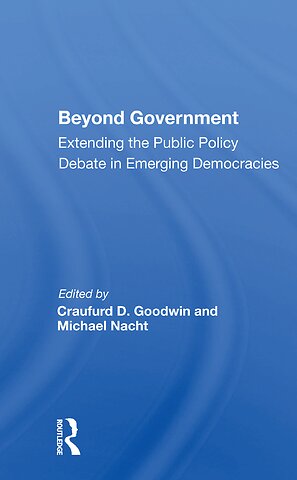
Craufurd D. Goodwin,
Michael Nacht
Beyond Government
Extending The Public Policy Debate In Emerging Democracies
Paperback Engels 2020 9780367166762Levertijd ± 11 werkdagen
Gratis verzonden
Samenvatting
Beyond Government examines how vigorous and truly pluralistic policy debate has evolved in both mature and emerging democracies and then suggests how it may be encouraged from within and sustained by outside assistance.
Specificaties
ISBN13:9780367166762
Taal:Engels
Bindwijze:Paperback
Aantal pagina's:462
Uitgever:Taylor & Francis Ltd
Thema:
1D Europa
Lezersrecensies
Wees de eerste die een lezersrecensie schrijft!
Inhoudsopgave
Introduction: Public Debate in a Free Society Part One: Models from a Mature Democracy 1. The Fifth Estate: Institutions for Extending Public Policy Debate in Emerging Democracies—Lessons from the American Experience 2. The American National Security Debate: Its Relevance for Emerging Democracies 3. Two Decades in the Front Office: Reflections on How the Carnegie Endowment for International Peace Operated in Cold War Washington Part Two: Debate during Transitions to Democracy 4. Democratic Citizens in Wild Markets: Menem's Neoliberal Experiment in Argentina 5. PARTICIPA "Lobbies" for Democracy 6. Hope and Anguish: Prospects for Political Pluralism in Post-Ceausescu Romania 7. The Opening of Public Debate on Economic Policy in Bulgaria Part Three: Areas of Public Policy Debate 8. The Czechoslovakian Divorce: "Velvet" Settlement or Muted Coexistence? 9. Public Debate on Poverty in Hungary since the 1960s 10. Economic Policy in Public Debate: A Romanian Perspective 11. Decentralization as a Tool for Democratic Consolidation: The Brazilian Challenge 12. Environmental Politics and Policy in Bulgaria: Challenges and Constraints to Democratization Part Four: Institutions That Foster Debate 13. Democracy and Institution Building in Mexico: A Case Study 14. The Role of the Press in the Democratization of Poland 15. Academies of Science in Emerging Democracies 16. The Role of the Intelligentsia as a Political Elite in Czechoslovakia 17. Strengthening Democracy, Accelerating Economic Growth, and Promoting Equality: The Changing Role of Brazilian Scholars 18. Nongovernmental Think Tanks in Poland Part Five: Contributions from Abroad 19. Spring into Summer: The Role of Private Foundations in Extending Public Debate in Central and Eastern Europe 20. The Role of Overseas Foundations in Emerging Democracies: The Ford Foundation's Office for the Andes and Southern Cone 21. International Business and Public Policy Debate in Latin America 22. Conclusion: Public Debate in a Free Society
Rubrieken
- advisering
- algemeen management
- coaching en trainen
- communicatie en media
- economie
- financieel management
- inkoop en logistiek
- internet en social media
- it-management / ict
- juridisch
- leiderschap
- marketing
- mens en maatschappij
- non-profit
- ondernemen
- organisatiekunde
- personal finance
- personeelsmanagement
- persoonlijke effectiviteit
- projectmanagement
- psychologie
- reclame en verkoop
- strategisch management
- verandermanagement
- werk en loopbaan