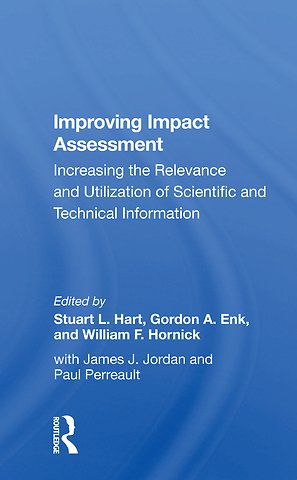
Stuart L Hart,
Stuart L. Hart,
Gordon A. Enk,
William F. Hornick,
James J. Jordan,
Paul Perreault
e.a.
Improving Impact Assessment
Increasing The Relevance And Utilization Of Scientific And Technical Information
Paperback Engels 2020 9780367169824Levertijd ± 11 werkdagen
Gratis verzonden
Samenvatting
This book considers ways in which the development of scientific and technical information for Environmental Impact Statements can be improved. It addresses legal, social, political, and ecological issues and explores ways to facilitate communication between researchers and policymakers.
Specificaties
ISBN13:9780367169824
Taal:Engels
Bindwijze:Paperback
Aantal pagina's:440
Uitgever:Taylor & Francis Ltd
Thema:
Lezersrecensies
Wees de eerste die een lezersrecensie schrijft!
Inhoudsopgave
Introduction: Problem Statement and Project Context Part 1: Redefining the Scope of Environmental Assessment 1. A Process-oriented Approach to Human Concerns in Environmental Decision Making 2. Assessing Human Concerns for Environmental Decision Making 3. EIA Scoping for Aesthetics: Hindsight from the Greene County Nuclear Power Plant EIS 4. Socioeconomic Impact Assessment and Nuclear Power Plant Licensing: Greene County, New York 5. The Role of Human Values, Attitudes, and Beliefs in Environmental Assessment Part 2: Applying Assessment Techniques 6. Improving Predictive Performance and Usefulness of Biological Environmental Impact Assessment: Experimental Impact Studies and Adaptive Impact Assessment 7. Preliminary Environmental Assessment Techniques for Soils 8. Land-capability Analysis As a Planning and Regulatory Tool 9. The Application of Image-Based Information Systems for Environmental Assessment 10. Toward a Participant Value Method for the Presentation of Environmental Impact Data 11. Comparisons of Methods for Evaluating Multi-attributed Alternatives in Environmental Assessments: Results of the BNL-NRC Siting Methods Project 12. The Scoping Concept and Citizen Involvement: An Opportunity for Rejuvenating NEPA Part 3: Keying Analysis to Decision Makers 13. How to Write a Socially Useful EIS 14. The EIS and the Decision Maker: Closing the Gap 15. The Impact Judgment: A Technical Impasse? 16. Organizational Environmental Management: The Los Alamos National Laboratory and Tennessee Valley Authority Experience Part 4: Analysis and Case Study 17. The Costs of Environmental Review: Assessment Methods and Trends 18. The Fate of EIS Projects: A Retrospective Study 19. Improving the EIS Process: A Case Study of Spruce Budworm Control 20. The Interface Between Federal and State EIS Requirements: An Overview 21. The Uses of Scoping: The Massachusetts Experience 22. Changing the Environmental Review Procedure in Minnesota Part 5: Recent Changes and Conclusions 23. The 1979 CEQ NEPA Regulations 24. Concluding Observations and Future Directions
Rubrieken
- advisering
- algemeen management
- coaching en trainen
- communicatie en media
- economie
- financieel management
- inkoop en logistiek
- internet en social media
- it-management / ict
- juridisch
- leiderschap
- marketing
- mens en maatschappij
- non-profit
- ondernemen
- organisatiekunde
- personal finance
- personeelsmanagement
- persoonlijke effectiviteit
- projectmanagement
- psychologie
- reclame en verkoop
- strategisch management
- verandermanagement
- werk en loopbaan