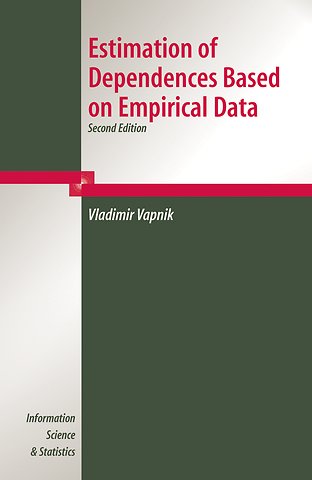
Estimation of Dependences Based on Empirical Data
Gebonden Engels 2006 1e druk 9780387308654Samenvatting
Twenty-?ve years have passed since the publication of the Russian version of the book Estimation of Dependencies Based on Empirical Data (EDBED for short). Twen- ?ve years is a long period of time. During these years many things have happened. Looking back, one can see how rapidly life and technology have changed, and how slow and dif?cult it is to change the theoretical foundation of the technology and its philosophy. I pursued two goals writing this Afterword: to update the technical results presented in EDBED (the easy goal) and to describe a general picture of how the new ideas developed over these years (a much more dif?cult goal). The picture which I would like to present is a very personal (and therefore very biased) account of the development of one particular branch of science, Empirical - ference Science. Such accounts usually are not included in the content of technical publications. I have followed this rule in all of my previous books. But this time I would like to violate it for the following reasons. First of all, for me EDBED is the important milestone in the development of empirical inference theory and I would like to explain why. S- ond, during these years, there were a lot of discussions between supporters of the new 1 paradigm (now it is called the VC theory ) and the old one (classical statistics).
Specificaties
Lezersrecensies
Inhoudsopgave
Rubrieken
- advisering
- algemeen management
- coaching en trainen
- communicatie en media
- economie
- financieel management
- inkoop en logistiek
- internet en social media
- it-management / ict
- juridisch
- leiderschap
- marketing
- mens en maatschappij
- non-profit
- ondernemen
- organisatiekunde
- personal finance
- personeelsmanagement
- persoonlijke effectiviteit
- projectmanagement
- psychologie
- reclame en verkoop
- strategisch management
- verandermanagement
- werk en loopbaan