,

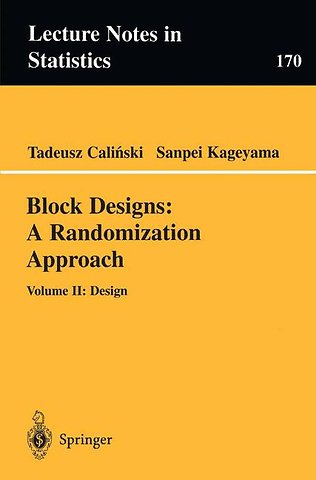
Block Designs: A Randomization Approach

Volume II: Design

Paperback Engels 2002 2003e druk 9780387954707
€ 120,99
Levertijd ongeveer 9 werkdagen
Gratis verzonden

Samenvatting

The book is composed of two volumes, each consisting of five chapters. In Vol­ ume I, following some statistical motivation based on a randomization model, a general theory of the analysis of experiments in block designs has been de­ veloped. In the present Volume II, the primary aim is to present methods of that satisfy the statistical requirements described in constructing block designs Volume I, particularly those considered in Chapters 3 and 4, and also to give some catalogues of plans of the designs. Thus, the constructional aspects are of predominant interest in Volume II, with a general consideration given in Chapter 6. The main design investigations are systematized by separating the material into two contents, depending on whether the designs provide unit efficiency fac­ tors for some contrasts of treatment parameters (Chapter 7) or not (Chapter 8). This distinction in classifying block designs may be essential from a prac­ tical point of view. In general, classification of block designs, whether proper or not, is based here on efficiency balance (EB) in the sense of the new termi­ nology proposed in Section 4. 4 (see, in particular, Definition 4. 4. 2). Most of the attention is given to connected proper designs because of their statistical advantages as described in Volume I, particularly in Chapter 3. When all con­ trasts are of equal importance, either the class of (v - 1; 0; O)-EB designs, i. e.

Specificaties

ISBN13:9780387954707
Taal:Engels
Bindwijze:paperback
Aantal pagina's:357
Uitgever:Springer New York
Druk:2003

Lezersrecensies

Wees de eerste die een lezersrecensie schrijft!

Inhoudsopgave

6 Constructional Approaches and Methods.- 6.0 Basic designs.- 6.0.1 BIB designs.- 6.0.2 PBIB designs.- 6.0.3 Resolvability.- 6.1 Dualization.- 6.2 Complementation.- 6.3 Supplementation.- 6.4 Juxtaposition.- 6.5 Merging.- 6.6 Patterned method.- 6.7 Methods of differences.- 6.8 Hadamard matrix.- 6.9 Finite geometry.- 6.10 Orthogonal Latin squares.- 7 Designs with Full Efficiency for Some Contrasts.- 7.1 General consideration.- 7.2 Orthogonal designs.- 7.3 Designs with two efficiency factors.- 7.3.1 Proper designs that are equireplicate.- 7.3.1.1 PBIB designs.- 7.3.1.2 Other than PBIB designs.- 7.3.2 Proper designs that are nonequireplicate.- 7.3.3 Nonproper designs that are equireplicate.- 7.3.4 Nonproper designs that are nonequireplicate.- 7.3.5 Illustration.- 7.4 Designs with three efficiency factors.- 7.4.1 Proper designs that are equireplicate.- 7.4.1.1 PBIB designs.- 7.4.1.2 Other than PBIB designs.- 7.4.2 Proper designs that are nonequireplicate.- 7.4.3 Nonproper designs that are equireplicate.- 7.4.4 Nonproper designs that are nonequireplicate.- 7.5 Designs with more efficiency factors.- 7.5.1 Proper designs that are equireplicate.- 7.5.2 Proper designs that are nonequireplicate.- 7.5.3 Nonproper designs that are equireplicate.- 7.5.4 Nonproper designs that are nonequireplicate.- 8 Designs with No Full Efficiency.- 8.1 General consideration.- 8.2 Designs with one efficiency factor.- 8.2.1 Proper designs.- 8.2.2 Nonproper designs.- 8.2.2.1 Equireplication.- 8.2.2.2 Nonequireplication.- 8.2.3 Illustration.- 8.3 Designs with two efficiency factors.- 8.3.1 Proper designs that are equireplicate.- 8.3.2 Proper designs that are nonequireplicate.- 8.3.3 Nonproper designs that are equireplicate.- 8.3.4 Nonproper designs that are nonequireplicate.- 8.4 Designs with three efficiency factors.- 8.4.1 Proper designs that are equireplicate.- 8.4.1.1 PBIB designs.- 8.4.1.2 Other than PBIB designs.- 8.4.2 Proper designs that are nonequireplicate.- 8.4.3 Nonproper designs that are equireplicate.- 8.4.4 Nonproper designs that are nonequireplicate.- 8.5 Designs with more efficiency factors.- 8.5.1 Proper designs that are equireplicate.- 8.5.2 Proper designs that are nonequireplicate.- 8.5.3 Nonproper designs that are equireplicate.- 8.5.4 Nonproper designs that are nonequireplicate.- 8.6 Tables.- Table 8.2.- Table 8.3.- Table 8.4.- 9 Resolvable Designs.- 9.1 General consideration.- 9.2 Designs with one efficiency factor.- 9.2.1 Proper designs.- 9.2.2 Nonproper designs.- 9.2.3 Illustration.- 9.3 Designs with two efficiency factors.- 9.3.1 Proper designs.- 9.3.2 Nonproper designs.- 9.4 Designs with three efficiency factors.- 9.4.1 Proper designs.- 9.4.2 Nonproper designs.- 9.5 Designs with more efficiency factors.- 9.5.1 Proper designs.- 9.5.2 Nonproper designs.- 9.6 Lattice designs.- 9.7 Tables.- Table 9.1.- Table 9.2, Table 9.3.- Table 9.4.- Table 9.5, Table 9.6.- Table 9.7.- 10 Special Designs.- 10.1 Variance-balanced designs.- 10.2 Resistant/Robust designs.- 10.3 Nonbinary designs.- 10.3.1 Merging.- 10.3.2 Patterned method.- 10.3.3 Supplementation.- 10.3.4 Supplementation and juxtaposition.- 10.4 Disconnected designs.- Appendix B. Finite Fields.- Appendix C. Finite Geometries.- C.1 Finite projective geometry.- C.2 Finite affine geometry.- C.3 Illustration.- Appendix D. Orthogonal Latin Squares.- References.- Author Index.

Managementboek Top 100

€ 120,99
Levertijd ongeveer 9 werkdagen
Gratis verzonden

Rubrieken

    Personen

      Trefwoorden

        Block Designs: A Randomization Approach