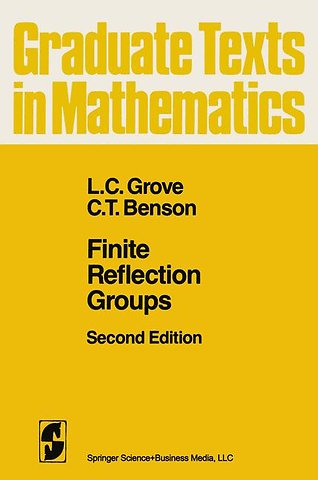
Finite Reflection Groups
Gebonden Engels 1996 2e druk 9780387960821Samenvatting
Chapter 1 introduces some of the terminology and notation used later and indicates prerequisites. Chapter 2 gives a reasonably thorough account of all finite subgroups of the orthogonal groups in two and three dimensions. The presentation is somewhat less formal than in succeeding chapters. For instance, the existence of the icosahedron is accepted as an empirical fact, and no formal proof of existence is included. Throughout most of Chapter 2 we do not distinguish between groups that are "geo metrically indistinguishable," that is, conjugate in the orthogonal group. Very little of the material in Chapter 2 is actually required for the sub sequent chapters, but it serves two important purposes: It aids in the development of geometrical insight, and it serves as a source of illustrative examples. There is a discussion offundamental regions in Chapter 3. Chapter 4 provides a correspondence between fundamental reflections and funda mental regions via a discussion of root systems. The actual classification and construction of finite reflection groups takes place in Chapter 5. where we have in part followed the methods of E. Witt and B. L. van der Waerden. Generators and relations for finite reflection groups are discussed in Chapter 6. There are historical remarks and suggestions for further reading in a Post lude.
Specificaties
Lezersrecensies
Rubrieken
- advisering
- algemeen management
- coaching en trainen
- communicatie en media
- economie
- financieel management
- inkoop en logistiek
- internet en social media
- it-management / ict
- juridisch
- leiderschap
- marketing
- mens en maatschappij
- non-profit
- ondernemen
- organisatiekunde
- personal finance
- personeelsmanagement
- persoonlijke effectiviteit
- projectmanagement
- psychologie
- reclame en verkoop
- strategisch management
- verandermanagement
- werk en loopbaan