,

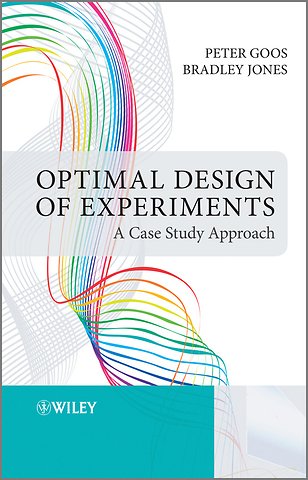
Optimal Design of Experiments

A Case Study Approach

Gebonden Engels 2011 9780470744611
€ 101,46
Levertijd ± 8 werkdagen
Gratis verzonden

Samenvatting

"This is an engaging and informative book on the modern practice of experimental design. The authors′ writing style is entertaining, the consulting dialogs are extremely enjoyable, and the technical material is presented brilliantly but not overwhelmingly. The book is a joy to read. Everyone who practices or teaches DOE should read this book." –

Douglas C. Montgomery,

Regents Professor, Department of Industrial Engineering, Arizona State University
"It′s been said: ′Design for the experiment, don′t experiment for the design.′ This book ably demonstrates this notion by showing how tailor–made, optimal designs can be effectively employed to meet a client′s actual needs. It should be required reading for anyone interested in using the design of experiments in industrial settings."
Christopher J. Nachtsheim, Frank A Donaldson Chair in Operations Management, Carlson School of Management, University of Minnesota
This book demonstrates the utility of the computer–aided optimal design approach using real industrial examples. These examples address questions such as the following:

-How can I do screening inexpensively if I have dozens of factors to investigate?

-What can I do if I have day–to–day variability and I can only perform 3 runs a day?

-How can I do RSM cost effectively if I have categorical factors?

-How can I design and analyze experiments when there is a factor that can only be changed a few times over the study?

-How can I include both ingredients in a mixture and processing factors in the same study?

-How can I design an experiment if there are many factor combinations that are impossible to run?

-How can I make sure that a time trend due to warming up of equipment does not affect the conclusions from a study?

-How can I take into account batch information in when designing experiments involving multiple batches?

-How can I add runs to a botched experiment to resolve ambiguities?

While answering these questions the book also shows how to evaluate and compare designs. This allows researchers to make sensible trade–offs between the cost of experimentation and the amount of information they obtain.

Specificaties

ISBN13:9780470744611
Taal:Engels
Bindwijze:gebonden
Aantal pagina's:304
Verschijningsdatum:1-7-2011

Lezersrecensies

Wees de eerste die een lezersrecensie schrijft!

Over Peter Goos

Peter Goos is a full professor at the Faculty of Bio-Science Engineering of the University of Leuven and at the Faculty of Business and Economics of the University of Antwerp, where he teaches introductory and advanced courses on statistics and probability. 

Andere boeken door Peter Goos

Over Bradley Jones

Bradley L. Jones, co-author of Sams Teach Yourself C in 21 Days, is the site manager for a number of high profile developer sites, including CodeGuru.com, Developer.com, and Javascripts.com. He is an Executive Editor of internet.com's EarthWeb channel.

Andere boeken door Bradley Jones

Inhoudsopgave

Preface.

Acknowledgments.

1 A simple comparative experiment.
1.1 Key concepts.
1.2 The setup of a comparative experiment.
1.3 Summary.

2 An optimal screening experiment.
2.1 Key concepts.
2.2 Case: an extraction experiment.
2.2.1 Problem and design.
2.2.2 Data analysis.
2.3 Peek into the black box.
2.3.1 Main–effects models.
2.3.2 Models with two–factor interaction effects.
2.3.3 Factor scaling.
2.3.4 Ordinary least squares estimation.
2.3.5 Significance tests and statistical power calculations.
2.3.6 Variance inflation.
2.3.7 Aliasing.
2.3.8 Optimal design.
2.3.9 Generating optimal experimental designs.
2.3.10 The extraction experiment revisited.
2.3.11 Principles of successful screening: sparsity, hierarchy, and heredity.
2.4 Background reading.
2.4.1 Screening.
2.4.2 Algorithms for finding optimal designs.
2.5 Summary.

3 Adding runs to a screening experiment.
3.1 Key concepts.
3.2 Case: an augmented extraction experiment.
3.2.1 Problem and design.
3.2.2 Data analysis.
3.3 Peek into the black box.
3.3.1 Optimal selection of a follow–up design.
3.3.2 Design construction algorithm.
3.3.3 Foldover designs.
3.4 Background reading.
3.5 Summary.

4 A response surface design with a categorical factor.
4.1 Key concepts.
4.2 Case: a robust and optimal process experiment.
4.2.1 Problem and design.
4.2.2 Data analysis.
4.3 Peek into the black box.
4.3.1 Quadratic effects.
4.3.2 Dummy variables for multilevel categorical factors.
4.3.3 Computing D–efficiencies.
4.3.4 Constructing Fraction of Design Space plots.
4.3.5 Calculating the average relative variance of prediction.
4.3.6 Computing I–efficiencies.
4.3.7 Ensuring the validity of inference based on ordinary least squares.
4.3.8 Design regions.
4.4 Background reading.
4.5 Summary.
Afgekapt op 59 regels

Managementboek Top 100

€ 101,46
Levertijd ongeveer 8 werkdagen
Gratis verzonden

Rubrieken

Producten

    Auteurs

      Trefwoorden

        Artikelen

          Optimal Design of Experiments