Sg Villas–Boas,
Silas Limited) Villas-Boas,
Jens For Microbial Biotechnology) Nielsen,
Jorn For Microbial Biotechnology) Smedsgaard,
Michael For Microbial Biotechnology) Hansen,
Ute Centre For Plant Functional Genomies) Roessner-Tunali
e.a.
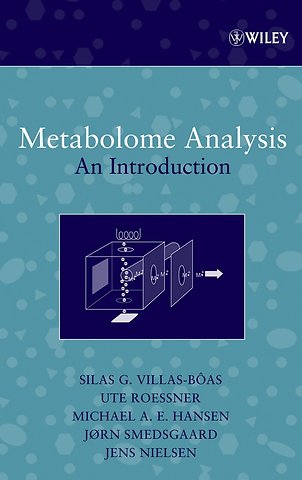
Metabolome Analysis – An Introduction
An Introduction
Gebonden Engels 2007 9780471743446In herdruk, verwacht op 15-01-2027
Samenvatting
Providing information on the main approaches for the analysis of metabolites, this textbook:
-Covers basic methodologies in sample preparation and separation techniques, as well as the most recent techniques of mass spectrometry.
-Differentiates between primary and secondary metabolites.
-Includes four chapters discussing successful metabolome studies of different organisms.
-Highlights the analytical challenges of studying metabolites.
-Illustrates applications of metabolome analysis through the use of case studies.
Specificaties
ISBN13:9780471743446
Taal:Engels
Bindwijze:gebonden
Aantal pagina's:330
Uitgever:John Wiley & Sons
Verschijningsdatum:6-3-2007
Hoofdrubriek:Wetenschap en techniek
Herdrukdatum:30-12-2026
Lezersrecensies
Wees de eerste die een lezersrecensie schrijft!
Inhoudsopgave
PREFACE.
LIST OF CONTRIBUTORS.
PART I: CONCEPTS AND METHODOLOGY.
1 Metabolomics in Functional Genomics and Systems Biology.
1.1 From genomic sequencing to functional genomics.
1.2 Systems biology and metabolic models.
1.3 Metabolomics.
1.4 Future perspectives.
2 The Chemical Challenge of the Metabolome.
2.1 Metabolites and metabolism.
2.2 The structural diversity of metabolites.
2.2.1 The chemical and physical properties.
2.2.2 Metabolite abundance.
2.2.3 Primary and secondary metabolism.
2.3 The number of metabolites in a biological system.
2.4 Controlling rates and levels.
2.4.1 Control by substrate level.
2.4.2 Feedback and feedforward control.
2.4.3 Control by pathway independent regulatory molecules.
2.4.4 Allosteric control.
2.4.5 Control by compartmentalization.
2.4.6 The dynamics of the metabolism the mass fl ow.
2.4.7 Control by hormones.
2.5 Metabolic channeling or metabolons.
2.6 Metabolites are arranged in networks that are part of a cellular interactome.
3 Sampling and Sample Preparation.
3.1 Introduction.
3.2 Quenching the fi rst step.
3.2.1 Overview on metabolite turnover.
3.2.2 Different methods for quenching.
3.2.3 Quenching microbial and cell cultures.
3.2.4 Quenching plant and animal tissues.
3.3 Obtaining metabolites from biological samples.
3.3.1 Release of intracellular metabolites.
3.3.2 Structure of the cell envelopes the main barrier to be broken.
3.3.3 Cell disruption methods.
3.3.4 Nonmechanical disruption of cell envelopes.
3.3.5 Mechanical disruption of cell envelopes.
3.4 Metabolites in the extracellular medium.
3.4.1 Metabolites in solution.
3.4.2 Metabolites in the gas phase.
3.5 Improving detection via sample concentration.
4 Analytical Tools.
4.1 Introduction.
4.2 Choosing a methodology.
4.3 Starting point samples.
4.4 Principles of chromatography.
4.4.1 Basics of chromatography.
4.4.2 The chromatogram and terms in chromatography.
4.5 Chromatographic systems.
4.5.1 Gas chromatography.
4.5.2 HPLC systems.
4.6 Mass spectrometry.
4.6.1 The mass spectrometer an overview.
4.6.2 GC–MS the EI ion source.
4.6.3 LC–MS the ESI ion source.
4.6.4 Mass analyzer the quadrupole.
4.6.5 Mass analyzer the ion–trap.
4.6.6 Mass analyzer the time–of–fl ight.
4.6.7 Detection and computing in MS.
4.7 The analytical work–fl ow.
4.7.1 Separation by chromatography.
4.7.2 Mass spectrometry.
4.7.3 General analytical considerations.
4.8 Data evaluation.
4.8.1 Structure of data.
4.8.2 The chromatographic separation.
4.8.3 Mass spectral data.
4.8.4 Exporting data for processing.
4.9 Beyond the core methods.
4.9.1 Developments in chromatography.
4.9.2 Capillary electrophoresis.
4.9.3 Tandem MS and advanced scanning techniques.
4.9.4 NMR spectrometry.
4.10 Further reading.
5 Data Analysis.
5.1 Organizing the data.
5.2 Scales of measurement.
5.2.1 Qualitative data.
5.2.2 Quantitative data.
5.3 Data structures.
5.4 Preprocessing of data.
5.4.1 Calibration of data.
5.4.2 Combining profi le scans.
5.4.3 Filtering.
5.4.4 Centroid calculation.
5.4.5 Internal mass scale correction.
5.4.6 Binning.
5.4.7 Baseline correction.
5.4.8 Chromatographic profi le matching.
5.5 Deconvolution of spectroscopic data.
5.6 Data standardization (normalization).
5.7 Data transformations.
5.7.1 Principal component analysis.
5.7.2 Fisher discriminant analysis.
5.8 Similarities and distances between data.
5.8.1 Continuous functions.
5.8.2 Binary functions.
5.9 Clustering techniques.
5.9.1 Hierarchical clustering.
5.9.2 k–means clustering.
5.10 Classifi cation techniques.
5.10.1 Decision theory.
5.10.2 k–nearest neighbor.
5.10.3 Tree–based classifi cation.
5.11 Integrated tools for automation, libraries, and data evaluation.
PART II: CASE STUDIES AND REVIEWS.
6 Yeast Metabolomics: The Discovery of New Metabolic Pathways in Saccharomyces cerevisiae.
6.1 Introduction.
6.2 Brief description of the methodology used.
6.2.1 Sample preparation.
6.2.2 The analysis.
6.3 Early discoveries.
6.4 Yeast stress response gives evidence of alternative pathway for glyoxylate biosynthesis in S. cerevisiae.
6.5 Biosynthesis of glyoxylate from glycine in S. cerevisiae.
6.5.1 Stable isotope labeling experiment to investigate glycine catabolism in S. cerevisiae.
6.5.2 Data leveraged for speculation.
7 Microbial Metabolomics: Rapid Sampling Techniques to Investigate Intracellular Metabolite Dynamics An Overview.
7.1 Introduction.
7.2 Starting with a simple sampling device proposed by Theobald et al. (1993).
7.3 An improved device reported by Lange et al. (2001).
7.4 Sampling tube device by Weuster–Botz (1997).
7.5 Fully automated device by Schaefer et al. (1999).
7.6 The stopped–fl ow technique by Buziol et al. (2002).
7.7 The BioScope: a system for continuous–pulse experiments.
7.8 Conclusions and perspectives.
8 Plant Metabolomics.
8.1 Introduction.
8.2 History of plant metabolomics.
8.3 Plants, their metabolism and metabolomics.
8.3.1 Plant structures.
8.3.2 Plant metabolism.
8.4 Specifi c challenges in plant metabolomics.
8.4.1 Light dependency of plant metabolism.
8.4.2 Extraction of plant metabolites.
8.4.3 Many cell types in one tissue.
8.4.4 The dynamical range of plant metabolites.
8.4.5 Complexity of the plant metabolome.
8.4.6 Development of databases for metabolomics–derived data in plant science.
8.5 Applications of metabolomics approaches in plant research.
8.5.1 Phenotyping.
8.5.2 Functional genomics.
8.5.3 Fluxomics.
8.5.4 Metabolic trait analysis.
8.5.5 Systems biology.
8.6 Future perspectives.
9 Mass Profi ling of Fungal Extract from Penicillium Species.
9.1 Introduction.
9.2 Methodology for screening of fungi by DiMS.
9.2.1 Cultures.
9.2.2 Extraction.
9.2.3 Analysis by direct infusion mass spectrometry.
9.3 Discussion.
9.3.1 Initial data processing.
9.3.2 Metabolite prediction.
9.3.3 Chemical diversity and similarity.
9.4 Conclusion.
10 Metabolomics in Humans and Other Mammals.
10.1 Introduction.
10.2 A brief history of mammalian metabolomics.
10.3 Sample preparation for mammalian metabolomics studies.
10.3.1 Working with blood.
10.3.2 Working with urine.
10.3.3 Working with cerebrospinal fl uid.
10.3.4 Working with cells and tissues.
10.4 Sample analysis.
10.4.1 GC–MS analysis of urine, plasma, and CSF.
10.4.2 LC–MS analysis of urine, blood, and CFS.
10.4.3 NMR analysis of CSF, urine, and blood.
10.5 Applications.
10.5.1 Identifi cation and classifi cation of metabolic disorders.
10.6 Future outlook.
INDEX.
Afgekapt op 60 regels
Anderen kochten ook
 Ted Kwartler€ 79,75
 Alessandra Sussulini€ 198,99
 Laura Cole€ 183,99
 James McCullagh€ 53,43
 Nessar Ahmed€ 73,83
 M.A. Hayat€ 130,60
Rubrieken
- advisering
- algemeen management
- coaching en trainen
- communicatie en media
- economie
- financieel management
- inkoop en logistiek
- internet en social media
- it-management / ict
- juridisch
- leiderschap
- marketing
- mens en maatschappij
- non-profit
- ondernemen
- organisatiekunde
- personal finance
- personeelsmanagement
- persoonlijke effectiviteit
- projectmanagement
- psychologie
- reclame en verkoop
- strategisch management
- verandermanagement
- werk en loopbaan