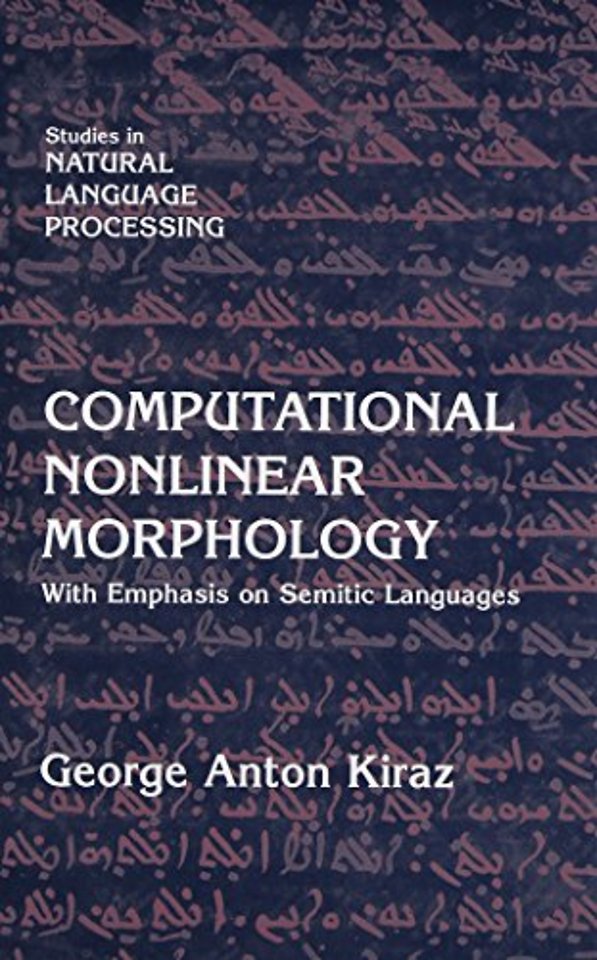
Computational Nonlinear Morphology
With Emphasis on Semitic Languages
Gebonden Engels 2001 9780521631969Samenvatting
By the late 1970s phonologists, and later morphologists, had departed from a linear approach for describing morphophonological operations to a non-linear one. Computational models, however, remain faithful to the linear model, making it very difficult, if not impossible, to implement the morphology of languages whose morphology is non-concatenative. Computational Nonlinear Morphology aims at presenting a computational system that counters the development in linguistics. It provides a detailed computational analysis of the complex morphophonological phenomena found in Semitic languages based on linguistically motivated models. The book outlines a generalized regular rewrite rule system that employs multi-tape finite-state automata to cater for root-and-pattern morphology, infixation, circumfixation and other complex operations such as the broken plural derivation problem found in Arabic and Ethiopic.
Specificaties
Lezersrecensies
Inhoudsopgave
Rubrieken
- advisering
- algemeen management
- coaching en trainen
- communicatie en media
- economie
- financieel management
- inkoop en logistiek
- internet en social media
- it-management / ict
- juridisch
- leiderschap
- marketing
- mens en maatschappij
- non-profit
- ondernemen
- organisatiekunde
- personal finance
- personeelsmanagement
- persoonlijke effectiviteit
- projectmanagement
- psychologie
- reclame en verkoop
- strategisch management
- verandermanagement
- werk en loopbaan