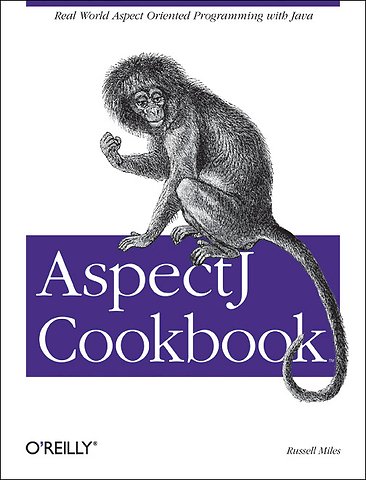
AspectJ Cookbook

Real-World Aspect-Oriented Programming with Java

Paperback Engels 2005 1e druk 9780596006549
€ 51,95
Levertijd ± 16 werkdagen
Gratis verzonden

Samenvatting

When Object Oriented programming (OO) first appeared, it was a revelation. OO gave developers the ability to create software that was more flexible and robust, but as time went on and applications became more sophisticated, too, certain areas of "traditional" OO architectures were found wanting. Aspect-oriented programming (AOP) addresses those issues by extending the OO approach even further.

Many developers are interested in AOP-especially in AspectJ, the open source extension of the Java programming language that explicitly supports the AOP approach. Yet, although AspectJ is included with Eclipse, the increasingly popular open source IDE for Java, finding a practical and non-theoretical way to learn this language and other AOP tools and techniques has been a real problem.

Until now. The 'AspectJ Cookbook' offers a hands-on solution--in fact, several--with a wide variety of code recipes for solving day-to-day design and coding problems using AOP's unique approach.

AOP allows the global properties of a program to determine how it's compiled into an executable program. Before AOP, important program design decisions were difficult to capture in actual code. Instead, the implementation of those design decisions--known as "aspects"--were scattered throughout, resulting in "tangled" code that was hard to develop and maintain. AOP has been compared to the manufacturing of cloth, in which threads are automatically interwoven. Without AOP, programmers must stitch the threads by hand.

The 'AspectJ Cookbook' shows readers why, and how, common Java development problems can be solved by using AOP techniques. With our popular problem-solution-discussion format, the book presents real world examples to demonstrate that AOP is more than just a concept; it's a development process that will benefit users in an immediate and visible manner.

If you're interested in how AOP is changing the way software is developed, and how you can use AspectJ to make code more modular, easier to develop, maintain, evolve and deploy, this is the book that really delivers.

Specificaties

ISBN13:9780596006549
Taal:Engels
Bindwijze:paperback
Aantal pagina's:331
Uitgever:O'Reilly
Druk:1
Hoofdrubriek:IT-management / ICT

Lezersrecensies

Wees de eerste die een lezersrecensie schrijft!

Over Russell Miles

Russell Miles works as a software engineer for General Dynamics UK where he works with Java and Distributed Systems, although his passion at the moment is Aspect Orientation and in particular AspectJ. To ensure he has as little spare time as possible Russ contributes to various open source projects whilst working on books for O'Reilly and is currently studying at Oxford University in England for an MSc in Software Engineering.

Andere boeken door Russell Miles

Inhoudsopgave

Preface

1. Aspect Orientation Overview
1.1 AspectJ
1.2 A Definition Of Aspect Orientation
1.3 Where To Go For More Information
2. Getting Started With AspectJ
2.1 Installing AspectJ
2.2 Developing A Simple Aspect
2.3 Compiling an Aspect and Multiple Java Files
2.4 Weaving Aspects into Jars
2.5 Weaving Aspects at Load-Time
2.6 Generating Javadoc Documentation
2.7 Compiling an AspectJ Project using Eclipse
2.8 Selecting the Aspects that are Woven in a Build within Eclipse
2.9 Building an AspectJ Project using Ant
3. Deploying AspectJ Applications
3.1 Deploying a Command Line AspectJ Application
3.2 Deploying an AspectJ Application as a fully contained Executable .Jar file
3.3 Deploying a Java Servlet that uses AspectJ
3.4 Deploying a JSP that uses AspectJ
3.5 Deploying an Axis Web Service that uses AspectJ
4. Capturing Join Points on Methods
4.1 Capturing a Method Call
4.2 Capturing the Parameter Values passed on a Method Call
4.3 Capturing the Target of a Method Call
4.4 Capturing a Method when it is Executing
4.5 Capturing the Value of the "this" Reference when a Method is Executing
5. Capturing Join Points on Exception Handling
5.1 Capturing when an Exception is Caught
5.2 Capturing the Thrown Exception
5.3 Capturing the Object Handling the Exception
6. Capturing Join Points on Advice
6.1 Capturing when Advice is Executing
6.2 Excluding Join Points that are a Result of Advice Execution
6.3 Exposing the original Join Point when Advice is being Advised
7. Capturing Join Points on Class and Object Construction
7.1 Capturing a Call to a Constructor
7.2 Capturing a Constructor when it is Executing
7.3 Capturing when an Object is Initialized
7.4 Capturing when an Object is about to be Initialized
7.5 Capturing when a Class is Initialized
8. Capturing Join Points on Attributes
8.1 Capturing when an Object's Attribute is Accessed
8.2 Capturing the Value of the Field being Accessed
8.3 Capturing when an Object's Field is Modified
8.4 Capturing the Value of a Field when it is Modified
9. Capturing Join Points within Programmatic Scope
9.1 Capturing all Join Points within a particular Class
9.2 Capturing all Join Points within a particular Package
9.3 Capturing all Join Points within a particular Method
10. Capturing Join Points based on Control Flow
10.1 Capturing all Join Points within a Program's Control Flow initiated by an Initial Join Point
10.2 Capturing all Join Points within a Program's Control Flow, Excluding the Initial Join Point
11. Capturing Join Points based on Object Type
11.1 Capturing when the "this" reference is a specific Type
11.2 Capturing when a Join Point's Target Object is a specific Type
11.3 Capturing when the Arguments to a Join Point are a certain Number, Type and Ordering
12. Capturing Join Points based on a Boolean or Combined Expression
12.1 Capturing when a Runtime Condition evaluates to True on a Join Point
Afgekapt op 60 regels

Managementboek Top 100

€ 51,95
Levertijd ongeveer 16 werkdagen
Gratis verzonden

Rubrieken

Producten

    Auteurs

      Trefwoorden

        Artikelen

          AspectJ Cookbook