,

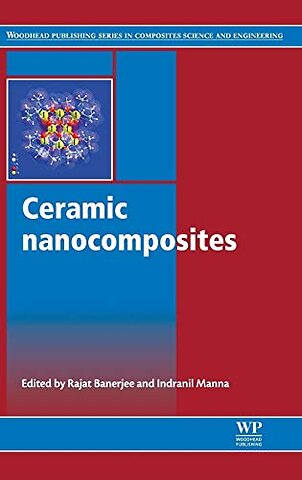
Ceramic Nanocomposites

Gebonden Engels 2013 9780857093387
€ 265,00
Levertijd ongeveer 9 werkdagen
Gratis verzonden

Samenvatting

Ceramic nanocomposites have been found to have improved hardness, strength, toughness and creep resistance compared to conventional ceramic matrix composites. Ceramic nanocomposites reviews the structure and properties of these nanocomposites as well as manufacturing and applications.

Part one looks at the properties of different ceramic nanocomposites, including thermal shock resistance, flame retardancy, magnetic and optical properties as well as failure mechanisms. Part two deals with the different types of ceramic nanocomposites, including the use of ceramic particles in metal matrix composites, carbon nanotube-reinforced glass-ceramic matrix composites, high temperature superconducting ceramic nanocomposites and ceramic particle nanofluids. Part three details the processing of nanocomposites, including the mechanochemical synthesis of metallic–ceramic composite powders, sintering of ultrafine and nanosized ceramic and metallic particles and the surface treatment of carbon nanotubes using plasma technology. Part four explores the applications of ceramic nanocomposites in such areas as energy production and the biomedical field.

With its distinguished editors and international team of expert contributors, Ceramic nanocomposites is a technical guide for professionals requiring knowledge of ceramic nanocomposites, and will also offer a deeper understanding of the subject for researchers and engineers within any field dealing with these materials.

Specificaties

ISBN13:9780857093387
Taal:Engels
Bindwijze:Gebonden

Lezersrecensies

Wees de eerste die een lezersrecensie schrijft!

Inhoudsopgave

<p>Contributor contact details</p> <p>Woodhead Publishing Series in Composites Science and Engineering</p> <p>Part I: Properties</p> <p>Chapter 1: Thermal shock resistant and flame retardant ceramic nanocomposites</p> <p>Abstract:</p> <p>1.1 Introduction</p> <p>1.2 Design of thermal shock resistant and flame retardant ceramic nanocomposites</p> <p>1.3 Types and processing of thermally stable ceramic nanocomposites</p> <p>1.4 Thermal properties of particular ceramic nanocomposites</p> <p>1.5 Interface characteristics of ceramic nanocomposites</p> <p>1.6 Superplasticity characteristics of thermal shock resistant ceramic nanocomposites</p> <p>1.7 Densification for the fabrication of thermal shock resistant ceramic nanocomposites</p> <p>1.8 Test Methods for the characterization and evaluation of thermal shock resistant ceramic nanocomposites</p> <p>1.9 Conclusions</p> <p>1.10 Future trends</p> <p>1.11 Sources of further information and advice</p> <p>Chapter 2: Magnetic properties of ceramic nanocomposites</p> <p>Abstract:</p> <p>2.1 Introduction</p> <p>2.2 Magnetic nanocomposites</p> <p>2.3 Size-dependent magnetic properties</p> <p>2.4 Colossal magnetoresistance (CMR)</p> <p>2.5 Electrical transport/resistivity</p> <p>2.6 Spin-dependent single-electron tunneling phenomena</p> <p>2.7 Applications: cobalt-doped nickel nanofibers as magnetic materials</p> <p>2.8 Applications: amorphous soft magnetic materials</p> <p>2.9 Applications: assembly of magnetic nanostructures</p> <p>Chapter 3: Optical properties of ceramic nanocomposites</p> <p>Abstract:</p> <p>3.1 Introduction</p> <p>3.2 Optical properties of ceramic nanocomposites</p> <p>3.3 Transmittance and absorption</p> <p>3.4 Non-linearity</p> <p>3.5 Luminescence</p> <p>3.6 Optical properties of glass–carbon nanotube (CNT) composites</p> <p>Chapter 4: Failure mechanisms of ceramic nanocomposites</p> <p>Abstract:</p> <p>4.1 Introduction</p> <p>4.2 Rupture strength</p> <p>4.3 Fracture origins</p> <p>4.4 Crack propagation, toughening mechanisms</p> <p>4.5 Preventing failures</p> <p>4.6 Wear of ceramic nanocomposites</p> <p>4.7 Future trends</p> <p>Chapter 5: Multiscale modeling of the structure and properties of ceramic nanocomposites</p> <p>Abstract:</p> <p>5.1 Introduction</p> <p>5.2 Multiscale modeling and material design</p> <p>5.3 Multiscale modeling approach</p> <p>5.4 The cohesive finite element method (CFEM)</p> <p>5.5 Molecular dynamics (MD) modeling</p> <p>5.6 Dynamic fracture analyses</p> <p>5.7 Conclusions</p> <p>Part II: Types</p> <p>Chapter 6: Ceramic nanoparticles in metal matrix composites</p> <p>Abstract:</p> <p>6.1 Introduction</p> <p>6.2 Material selection</p> <p>6.3 Physical and mechanical properties of metal matrix nanocomposites (MMNCs)</p> <p>6.4 Different manufacturing methods for MMNCs</p> <p>6.5 Future trends</p> <p>Chapter 7: Carbon nanotube (CNT) reinforced glass and glass-ceramic matrix composites</p> <p>Abstract:</p> <p>7.1 Introduction</p> <p>7.2 Carbon nanotubes</p> <p>7.3 Glass and glass-ceramic matrix composites</p> <p>7.4 Glass/glass-ceramic matrix composites containing carbon nanotubes: manufacturing process</p> <p>7.5 Microstructural characterization</p> <p>7.6 Properties</p> <p>7.7 Applications</p> <p>7.8 Conclusions and scope</p> <p>Chapter 8: Ceramic ultra-thin coatings using atomic layer deposition</p> <p>Abstract:</p> <p>8.1 Introduction</p> <p>8.2 Ultra-thin ceramic films coated on ceramic particles by atomic layer deposition (ALD)</p> <p>8.3 Using ultra-thin ceramic films as a protective layer</p> <p>8.4 Enhanced lithium-ion batteries using ultra-thin ceramic films</p> <p>8.5 Using ultra-thin ceramic films in tissue engineering</p> <p>8.6 Conclusions and future trends</p> <p>Chapter 9: High-temperature superconducting ceramic nanocomposites</p> <p>Abstract:</p> <p>9.1 Introduction</p> <p>9.2 Material preparation, characterization and testing</p> <p>9.3 Superconducting (SC) properties of polymer–ceramic nanocomposites manufactured by hot pressing</p> <p>9.4 Mechanical properties of SC polymer–ceramic nanocomposites</p> <p>9.5 Interphase phenomena in SC polymer–ceramic nanocomposites</p> <p>9.6 Influences on the magnetic properties of SC polymer–ceramic nanocomposites</p> <p>9.7 The use of metal-complex polymer binders to enhance the SC properties of polymer–ceramic nanocomposites</p> <p>9.8 Aging of SC polymer–ceramic nanocomposites</p> <p>9.9 Conclusions</p> <p>Chapter 10: Nanofluids including ceramic and other nanoparticles: applications and rheological properties</p> <p>Abstract:</p> <p>10.1 Introduction</p> <p>10.2 The development of nanofluids</p> <p>10.3 Potential benefits of nanofluids</p> <p>10.4 Applications of nanofluids</p> <p>10.5 The rheology of nanofluids</p> <p>10.6 Modeling the viscosity of nanofluids</p> <p>10.7 Summary and future trends</p> <p>Chapter 11: Nanofluids including ceramic and other nanoparticles: synthesis and thermal properties</p> <p>Abstract:</p> <p>11.1 Introduction</p> <p>11.2 Synthesis of nanofluids</p> <p>11.3 The thermal conductivity of nanofluids</p> <p>11.4 Modeling of thermal conductivity</p> <p>11.5 Summary and future trends</p> <p>11.7 Appendix: thermal conductivity details of nanofluids prepared by two-step process</p> <p>Part III: Processing</p> <p>Chapter 12: Mechanochemical synthesis of metallic–ceramic composite powders</p> <p>Abstract:</p> <p>12.1 Introduction</p> <p>12.2 Composite powder formation: bottom-up and top-down techniques</p> <p>12.3 Monitoring mechanochemical processes</p> <p>12.4 Examples of applied high-energy milling in the synthesis of selected metallic–ceramic composite powders</p> <p>12.5 Copper-based composite powders with Al2O3</p> <p>12.6 Nickel-based composite powders with Al2O3</p> <p>12.7 Other possible variants of the synthesis of metal matrix–ceramic composites in Cu–Al–O and Ni–Al–O elemental systems using mechanical treatment ex situ and in situ</p> <p>12.8 Conclusions</p> <p>12.9 Acknowledgements</p> <p>Chapter 13: Sintering of ultrafine and nanosized ceramic and metallic particles</p> <p>Abstract:</p> <p>13.1 Introduction</p> <p>13.2 Thermodynamic driving force for the sintering of nanosized particles</p> <p>13.3 Kinetics of the sintering of nanosized particles</p> <p>13.4 Grain growth during sintering of nano particles</p> <p>13.5 Techniques for controlling grain growth while achieving full densification</p> <p>13.6 Conclusion</p> <p>Chapter 14: Surface treatment of carbon nanotubes using plasma technology</p> <p>Abstract:</p> <p>14.1 Introduction</p> <p>14.2 Carbon nanotube surface chemistry and solution-based functionalization</p> <p>14.3 Plasma treatment of carbon nanotubes</p> <p>14.4 Summary</p> <p>Part IV: Applications</p> <p>Chapter 15: Ceramic nanocomposites for energy storage and power generation</p> <p>Abstract:</p> <p>15.1 Introduction</p> <p>15.2 Electrical properties</p> <p>15.3 Ionic nanocomposites</p> <p>15.4 Energy storage and power generation devices</p> <p>15.5 Future trends</p> <p>Chapter 16: Biomedical applications of ceramic nanocomposites</p> <p>Abstract:</p> <p>16.1 Introduction</p> <p>16.2 Why ceramic nanocomposites are used in biomedical applications</p> <p>16.3 Orthopaedic and dental implants</p> <p>16.4 Tissue engineering</p> <p>16.5 Future trends</p> <p>Chapter 17: Synthetic biopolymer/layered silicate nanocomposites for tissue engineering scaffolds</p> <p>Abstract:</p> <p>17.1 Introduction</p> <p>17.2 Tissue engineering applications</p> <p>17.3 Synthetic biopolymers and their nanocomposites for tissue engineering</p> <p>17.4 Three-dimensional porous scaffolds</p> <p>17.5 In-vitro degradation</p> <p>17.6 Stem cell–scaffold interactions</p> <p>17.7 Conclusions</p> <p>Index</p>

Managementboek Top 100

€ 265,00
Levertijd ongeveer 9 werkdagen
Gratis verzonden

Rubrieken

    Personen

      Trefwoorden

        Ceramic Nanocomposites