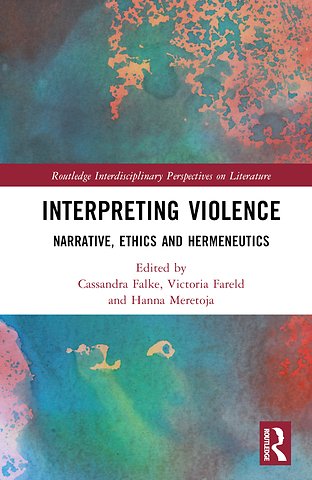
Interpreting Violence
Narrative, Ethics and Hermeneutics
Gebonden Engels 2023 9781032035727Samenvatting
Representations of violence surround us in everyday life – in news reports, films and novels – inviting interpretation and raising questions about the ethics of viewing or reading about harm done to others. How can we understand the processes of meaning-making involved in interpreting violent events and experiences? And can these acts of interpretation themselves be violent by reproducing the violence that they represent? This book examines the ethics of engaging with violent stories from a broad hermeneutic perspective. It offers multidisciplinary perspectives on the sense-making involved in interpreting violence in its various forms, from blatant physical violence to less visible forms that may inhere in words or in the social and political order of our societies. By focusing on different ways of narrating violence and on the cultural and paradigmatic forms that govern such narrations, Interpreting Violence explores the ethical potential of literature, art and philosophy to expose mechanisms of violence while also recognizing their implication in structures that contribute to or benefit from practices of violence.
Specificaties
Lezersrecensies
Inhoudsopgave
Interpreting Violence, Violent Interpretations: Introduction
Cassandra Falke, Victoria Fareld and Hanna Meretoja
Part I. Representing Violence, Violent Representations
-
- Witnessing Violence in Literature and Humanitarian Discourse
- Cassandra Falke (UiT - The Arctic University of Norway)
- Memory, Encore! Popular Music, Power and Postwar Memory
- Avril Tynan (Turku Institute for Advanced Studies)
- Rethinking Planetarity in the Specter of (Neo)colonial Violence: The Strangler Vine and ‘Thugs’ in America
- Amrita Ghosh (Linneaus University)
- Variants and Consequences of Violence in Iris Murdoch’s The Sacred and Profane Love Machine
- Jakob Lothe (University of Oslo)
- Violent Appetites: Distaste and the Aesthetics of Violence
- Tero Eljas Vanhanen (University of Helsinki)
Part II. Understanding the Violence of Perpetrators
- A Manifesto on the Hermeneutics of Violence
- Brian Schiff and Michael Justice (American University of Paris)
- Narrative Mastery over Violence in Perpetrator-Authored Documents: Interpreting Closure in The Stroop Report
- Erin McGlothlin (Washington University)
- Space of Murder, Space of Freedom: The Forest as a Posttraumatic Landscape in Holocaust Narratives
- Helena Duffy (Turku Institute for Advanced Studies)
Part III. Articulating Inherent Violence
- Physical, Emotional and Discursive Violence: The Problem of Narrative in Karl Ove Knausgård’s My Struggle
- Hanna Meretoja (University of Turku)
- Reading Violence, Violent Reading: Levinas and Hermeneutics
- Colin Davis (Royal Holloway, University of London)
- Style and the Violence of Passivity in Samuel Beckett’s How It Is.
- Amanda Dennis (American University of Paris)
- Vulnerability, Violence and Nonviolence
Victoria Fareld (Stockholm University)
Index
Rubrieken
- advisering
- algemeen management
- coaching en trainen
- communicatie en media
- economie
- financieel management
- inkoop en logistiek
- internet en social media
- it-management / ict
- juridisch
- leiderschap
- marketing
- mens en maatschappij
- non-profit
- ondernemen
- organisatiekunde
- personal finance
- personeelsmanagement
- persoonlijke effectiviteit
- projectmanagement
- psychologie
- reclame en verkoop
- strategisch management
- verandermanagement
- werk en loopbaan