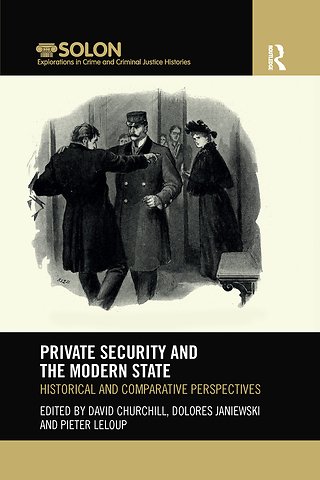
Private Security and the Modern State
Historical and Comparative Perspectives
Paperback Engels 2021 9781032173061Samenvatting
Based on extensive research in several international contexts, this volume provides a nuanced assessment of the historical evolution of private security and its fluid, contested and mutually constitutive relationship with state agencies, public policing and the criminal justice system.
This book provides an overview of the history of private security provision in its multiple forms including detective agencies, insurance companies, moral campaigners, employers’ associations, paramilitary organizations, self-protection and vigilantism. It also explores the historical evolution of private policing and security provision in a diverse set of temporal, national and international contexts and compares the interactions between public and private security bodies, structures, strategies and practices in different countries, cultures and settings. In doing so, the volume fills the existing gaps in historical knowledge about the emergence of private and public security organizations and provides a more robust understanding of changes in the division of responsibility for security provision, law enforcement and punishment between public and private institutions.
This wide-ranging volume will be of great interest to scholars and students of history, criminology, sociology, political science, international relations, security studies, surveillance studies, policing, criminal justice and law.
Specificaties
Lezersrecensies
Inhoudsopgave
Introduction. David Churchill, Dolores Janiewski & Pieter Leloup.
Part 1: Security Regimes in National Context
Chapter 1. Jacqueline E. Ross: Undercover Policing and State Power in the United States and France from the Nineteenth to the Early Twentieth Centuries.
Chapter 2. Wilbur Miller: The ‘Right to Bear Arms’ and Self-Defence in the United States: Individualized Private Policing.
Chapter 3. Pieter Leloup: Co-Operation or Competition? Discourses on the Role of the Private Security Sector in Belgium, 1934-1990.
Chapter 4. Adam White: Monopoly or Plurality? The Police and the Private Security Industry in Mid-Twentieth-Century Britain.
Part 2: Techniques & Cultures of Private Security
Chapter 5. David J. Cox & Yasmin Devi-McGleish: ‘Pardon Asked’: Printed Apologies as a Form of Private Security and Popular Justice in Nineteenth-Century Britain.
Chapter 6. Stephen Robertson: The Pinkertons and the Paperwork of Surveillance: Reporting Private Investigation in the United States, 1855-1940.
Chapter 7. Chad Pearson: ‘The law or popular justice’: Owen Wister and the Legitimation of Employer-Class Violence.
Chapter 8. Francis Dodsworth: Protection: Selling Self-Defence in Twentieth-Century Britain and the United States.
Part 3: Between Public & Private Security
Chapter 9. David Churchill: The Politics of Security in Liberal Society: Responsibility for Crime Prevention in Mid-Victorian Britain.
Chapter 10. Florian Altenhöner: No License to Know: Political Crisis and the Fragmentation and Privatisation of Surveillance in Germany, 1918-1920.
Chapter 11. Rhodri Jeffreys-Jones: What Burleson and Orwell Overlooked: Private Security Provision in the USA and the United Kingdom.
Chapter 12. Dolores Janiewski & Simon Judkins: Fluid Boundaries: The Evolution of a Private-Public Security Network in California, 1917-1952.
Conclusion. David Churchill, Dolores Janiewski & Pieter Leloup.
Rubrieken
- advisering
- algemeen management
- coaching en trainen
- communicatie en media
- economie
- financieel management
- inkoop en logistiek
- internet en social media
- it-management / ict
- juridisch
- leiderschap
- marketing
- mens en maatschappij
- non-profit
- ondernemen
- organisatiekunde
- personal finance
- personeelsmanagement
- persoonlijke effectiviteit
- projectmanagement
- psychologie
- reclame en verkoop
- strategisch management
- verandermanagement
- werk en loopbaan