Elisa Alòs,
Raul Merino,
Raúl Merino
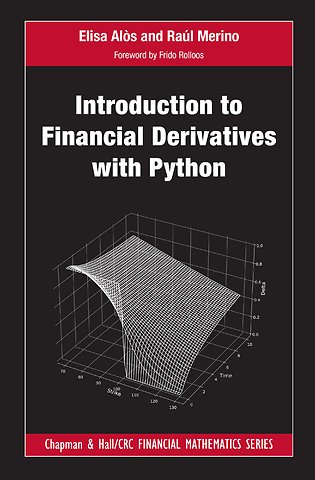
Introduction to Financial Derivatives with Python
Gebonden Engels 2022 9781032211039Levertijd ± 11 werkdagen
Gratis verzonden
Samenvatting
Introduction to Financial Derivatives with Python is an ideal textbook for an undergraduate course on derivatives, whether on a finance, economics, or financial mathematics programme. As well as covering all of the essential topics one would expect to be covered, the book also includes the basis of the numerical techniques most used in the financial industry, and their implementation in Python.
FeaturesConnected to a Github repository with the codes in the book. The repository can be accessed at https://bit.ly/3bllnufSuitable for undergraduate students, as well as anyone who wants a gentle introduction to the principles of quantitative financeNo pre-requisites required for programming or advanced mathematics beyond basic calculus
Specificaties
ISBN13:9781032211039
Taal:Engels
Bindwijze:Gebonden
Aantal pagina's:228
Uitgever:Taylor & Francis Ltd
Hoofdrubriek:Financieel management, Computer en informatica, Financieel management
Thema:
4TC Handboek, leswerk
Lezersrecensies
Wees de eerste die een lezersrecensie schrijft!
Inhoudsopgave
1. Introduction. 1.1. Financial Markets. 1.2. Derivatives. 1.3. Time has a Value. 1.4. No-Arbitrage Principle. 1.5. Chapter’s Digest. 1.6. Exercises. 2. Futures and Forwards. 2.1. Forward Contracts: Definitions. 2.2. Futures. 2.3. Why to use Forwards and Futures? 2.4. The Fair Delivery Price: The Forward Price. 2.5. Chapter’s Digest. 2.6. Exercises. 3. Options. 3.1. Call and Put Options. 3.2. The Intrinsic Value of an Option. 3.3. Some Properties of Option Prices. 3.4. Speculation with Options. 3.5. Some Classical Strategies. 3.6. Draw your Strategy with Python. 3.7. Chapter’s Digest. 3.8. Exercises. 4. Exotic Options. 4.1. Binary Options. 4.2. Forward Start Options. 4.3. Path-Dependent Options. 4.4. Spread and Basket Options. 4.5. Bermuda Options. 4.6. Chapter’s Digest. 4.7. Exercises. 5. The Binomial Model. 5.1. The Single-Period Binomial Model. 5.2. The Multi-Period Binomial Model. 5.3. The Greeks in the Binomial Model. 5.4. Coding the Binomial Model. 5.5. Chapter’s Digest. 5.6. Exercises. 6. A Continuous-Time Pricing Model. 6.1. Creating Some Intuition. 6.2. The Black-Scholes-Merton Framework. 6.3. THE BLACK-SCHOLES-MERTON EQUATION. 6.4. The Black-Scholes-Merton Formula. 6.5. The Black-Scholes-Merton Model from a Probabilistic Perspective. 6.6. The Black-Scholes-Merton Price and the Binomial Price. 6.7. The Greeks in the Black-Scholes-Merton Model. 6.8. Other Assets. 6.9. Drawbacks of the Black-Scholes-Merton Model. 6.10. Chapter’s Digest. 6.11. Exercises. 7. Monte Carlo Methods. 7.1. The Need of General Option Pricing Tools. 7.2. Mathematical Foundations of Monte Carlo Methods. 7.3. Option Pricing with Monte Carlo Methods. 7.4. European Options that Depend on the Final Price of Two Assets. 7.5. Chapter’s Digest. 7.6. Exercises. 8. The Volatility. 8.1. Historical Volatilities. 8.2. The Spot Volatility. 8.3. The Implied Volatility. 8.4. Chapter’s Digest. 8.5. Exercises. 9. Replicating Portfolios. 9.1. Replicating Portfolios for the Binomial Model. 9.2. Replicating Portfolios for the Black-Scholes-Merton Model. 9.3. Chapter’s Digest. 9.4. Exercises.
Rubrieken
- advisering
- algemeen management
- coaching en trainen
- communicatie en media
- economie
- financieel management
- inkoop en logistiek
- internet en social media
- it-management / ict
- juridisch
- leiderschap
- marketing
- mens en maatschappij
- non-profit
- ondernemen
- organisatiekunde
- personal finance
- personeelsmanagement
- persoonlijke effectiviteit
- projectmanagement
- psychologie
- reclame en verkoop
- strategisch management
- verandermanagement
- werk en loopbaan