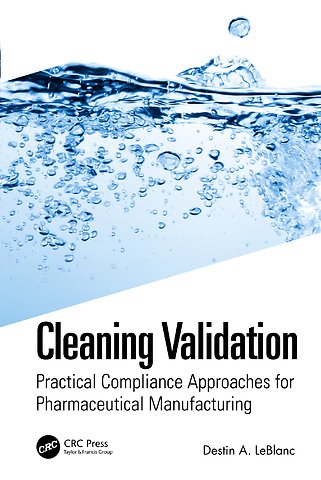
Cleaning Validation
Practical Compliance Approaches for Pharmaceutical Manufacturing
Gebonden Engels 2022 9781032430836Samenvatting
Pharmaceutical manufacturers and upper management are encouraged to meet the challenges of the science-based and risk-based approaches to cleaning validation. Using some of the principles and practices in this volume will help in designing a more effective and efficient cleaning validation program. Features
• Timely coverage of cleaning validation for the pharmaceutical industry, a dynamic area in terms of health-based limits.
• The author encourages pharmaceutical manufacturers, and particularly upper management, to meet the challenges of the science-based and riskbased approaches to cleaning validation.
• Draws on the author’s vast experience in the field of cleaning validation and hazardous materials.
• Discusses EMA vs. ISPE on Cleaning Limits and revised Risk-MaPP for highly hazardous products in shared facilities.
• A diverse list of topics from protocol limits for yeasts and molds to cleaning validation for homeopathic drug products.
Specificaties
Lezersrecensies
Inhoudsopgave
- Use of the Term "Product"
- Use of the Terms Grouping and Matrixing
- Deviations and Nonconformances
- Clarifying Terms: Blanks vs. Controls
- Meaning of "Dedicated"?
- Words (Again??)
-
Health-based Limits
- What's at Stake with HBELs
- A Look at the Revised Risk-MaPP
- EMA's Q&A Clarification: Part 1
- EMA's Q&A Clarification: Part 2
- The EMA Q&A "Clarification" on Limits
- The EMA Q&A on Routine Analytical Testing
- Other Issues in EMA's Q&A
- Highly Hazardous Products in Shared Facilities
-
Limits - General
- EMA vs. ISPE on Cleaning Limits?
- Does a High "Margin of Safety" Protect Patients?
- What If the Next Product is the Same Product?
- Limits for "Product A to Product A"
- Surfaces Areas in Carryover Calculations
- Carryover Calculation Errors to Avoid
- Protocol Limits for Yeasts/Molds?
- Cleaning Validation for Homeopathic Drug Products
- A Possible Approach for Biotech Limits
- Establishing Clearance for Degraded Protein Actives
-
Visually Clean
- Avoiding "Visually Dirty" Observations
- What's a Visual Limit?
- Visual Residue Limits – Part 1
- Visual Residue Limits – Part 2
-
Analytical and Sampling Methods
- Two More Nails in the Coffin?
- More Swab Sampling Issues
- Timing for Swab Sampling in a Protocol?
- Pass/Fail Analytical Test Methods
-
Product Grouping
- Issues in Product Grouping
- Toxicity as a Worst-Case Grouping Factor
- Another "Worst Case" Product Grouping Idea
-
Protocols and Procedures
- Issues in Rinsing - Part 1
- Issues in Rinsing - Part 2
- Routine Monitoring for Highly Hazardous Products
- "Concurrent Release" for Cleaning Validation
- Dirty and Clean Hold Time Protocols
-
API Manufacture
- A Critique of the APIC Guideline
- Another Issue for API Synthesis
- Contaminants in API Manufacture
- Miscellaneous
- Significant Figures: Back to Basics
- The Value of a Protocol Worksheet for Manual Cleaning
- Dealing with Used and New Equipment
- Solving Cleaning Validation Problems by Analogy
- Causing Cleaning Validation Problems by Analogy
Appendix A: Acronyms Used in this Volume
Appendix B: Shorthand Notations for Expressing Limits
Index
Rubrieken
- advisering
- algemeen management
- coaching en trainen
- communicatie en media
- economie
- financieel management
- inkoop en logistiek
- internet en social media
- it-management / ict
- juridisch
- leiderschap
- marketing
- mens en maatschappij
- non-profit
- ondernemen
- organisatiekunde
- personal finance
- personeelsmanagement
- persoonlijke effectiviteit
- projectmanagement
- psychologie
- reclame en verkoop
- strategisch management
- verandermanagement
- werk en loopbaan