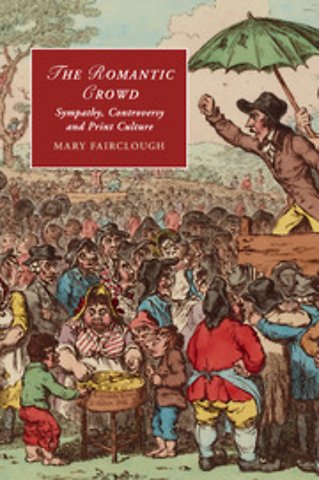
The Romantic Crowd
Sympathy, Controversy and Print Culture
Paperback Engels 2015 9781107566668Samenvatting
In the long eighteenth century, sympathy was understood not just as an emotional bond, but also as a physiological force, through which disruption in one part of the body produces instantaneous disruption in another. Building on this theory, Romantic writers explored sympathy as a disruptive social phenomenon, which functioned to spread disorder between individuals and even across nations like a 'contagion'. It thus accounted for the instinctive behaviour of people swept up in a crowd. During this era sympathy assumed a controversial political significance, as it came to be associated with both riotous political protest and the diffusion of information through the press. Mary Fairclough reads Edmund Burke, Mary Wollstonecraft, William Godwin, John Thelwall, William Hazlitt and Thomas De Quincey alongside contemporary political, medical and philosophical discourse. Many of their central questions about crowd behaviour still remain to be answered by the modern discourse of collective psychology.
Specificaties
Lezersrecensies
Inhoudsopgave
Rubrieken
- advisering
- algemeen management
- coaching en trainen
- communicatie en media
- economie
- financieel management
- inkoop en logistiek
- internet en social media
- it-management / ict
- juridisch
- leiderschap
- marketing
- mens en maatschappij
- non-profit
- ondernemen
- organisatiekunde
- personal finance
- personeelsmanagement
- persoonlijke effectiviteit
- projectmanagement
- psychologie
- reclame en verkoop
- strategisch management
- verandermanagement
- werk en loopbaan