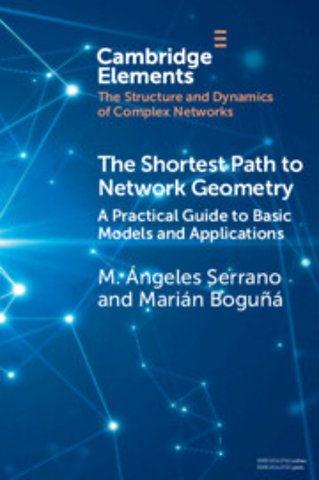
The Shortest Path to Network Geometry
A Practical Guide to Basic Models and Applications
Paperback Engels 2022 9781108791083Samenvatting
Real networks comprise from hundreds to millions of interacting elements and permeate all contexts, from technology to biology to society. All of them display non-trivial connectivity patterns, including the small-world phenomenon, making nodes to be separated by a small number of intermediate links. As a consequence, networks present an apparent lack of metric structure and are difficult to map. Yet, many networks have a hidden geometry that enables meaningful maps in the two-dimensional hyperbolic plane. The discovery of such hidden geometry and the understanding of its role have become fundamental questions in network science giving rise to the field of network geometry. This Element reviews fundamental models and methods for the geometric description of real networks with a focus on applications of real network maps, including decentralized routing protocols, geometric community detection, and the self-similar multiscale unfolding of networks by geometric renormalization.
Specificaties
Lezersrecensies
Inhoudsopgave
Rubrieken
- advisering
- algemeen management
- coaching en trainen
- communicatie en media
- economie
- financieel management
- inkoop en logistiek
- internet en social media
- it-management / ict
- juridisch
- leiderschap
- marketing
- mens en maatschappij
- non-profit
- ondernemen
- organisatiekunde
- personal finance
- personeelsmanagement
- persoonlijke effectiviteit
- projectmanagement
- psychologie
- reclame en verkoop
- strategisch management
- verandermanagement
- werk en loopbaan