
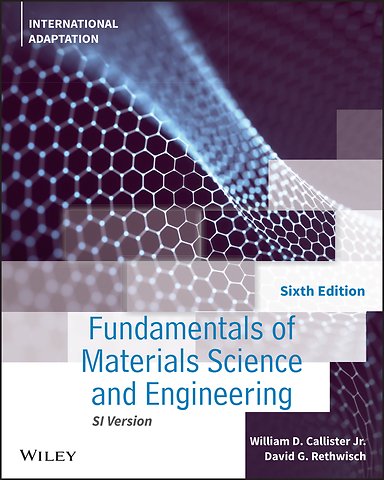
Fundamentals of Materials Science and Engineering
International Adaptation
Paperback Engels 2022 6e druk 9781119820543Samenvatting
Fundamentals of Materials Science and Engineering provides a comprehensive coverage of the three primary types of materials (metals, ceramics, and polymers) and composites. Adopting an integrated approach to the sequence of topics, the book focuses on the relationships that exist between the structural elements of materials and their properties. This presentation permits the early introduction of non-metals and supports the engineer's role in choosing materials based upon their characteristics.
Using clear, concise terminology that is familiar to students, the book presents material at an appropriate level for student comprehension. This International Adaptation has been thoroughly updated to use SI units. This edition enhances the coverage of failure mechanism by adding new sections on Griffith theory of brittle fracture, Goodman diagram, and fatigue crack propagation rate.
It further strengthens the coverage by including new sections on peritectoid and monotectic reactions, spinodal decomposition, and various hardening processes such as surface, and vacuum and plasma hardening. In addition, all homework problems requiring computations have been refreshed.
Trefwoorden
Specificaties
Lezersrecensies
Inhoudsopgave
1. Introduction 1
Learning Objectives 2
1.1 Historical Perspective 2
1.2 Materials Science and Engineering: Need of Its Study 3
Case Study 1.1—Cargo Ship Failures 6
1.3 Classification of Materials 7
Case Study 1.2—Carbonated Beverage Containers 12
1.4 Advanced Materials 14
1.5 Modern Materials’ Needs 17
Summary 18
References 18
Questions and Problems 19
2. Atomic Structure and Interatomic Bonding20
Learning Objectives 21
2.1 Introduction 21
Atomic Structure 21
2.2 Fundamental Concepts 21
2.3 Electrons in Atoms 24
2.4 The Periodic Table 30
Atomic Bonding in Solids 32
2.5 Bonding Forces and Energies 32
2.6 Primary Interatomic Bonds 34
2.7 Secondary Bonding or van der Waals Bonding 41
Materials of Importance 2.1—Water (Its Volume Expansion upon Freezing) 44
2.8 Mixed Bonding 45
2.9 Molecules 46
2.10 Bonding Type-Material Classification Correlations 46
Summary 47
Equation Summary 48
List of Symbols 48
Important Terms and Concepts 49
References 49
Questions and Problems 49
3. Structures of Metals and Ceramics 52
Learning Objectives 53
3.1 Introduction 53
Crystal Structures 54
3.2 Fundamental Concepts 54
3.3 Unit Cells 55
3.4 Metallic Crystal Structures 55
3.5 Density Computations—Metals 61
3.6 Ceramic Crystal Structures 62
3.7 Density Computations—Ceramics 69
3.8 Silicate Ceramics 70
3.9 Carbon 73
3.10 Polymorphism and Allotropy 78
3.11 Crystal Systems 78
Material of Importance 3.1—Tin (Its Allotropic Transformation) 80
Crystallographic Points, Directions, and Planes 81
3.12 Point Coordinates 81
3.13 Crystallographic Directions 83
3.14 Crystallographic Planes 90
3.15 Linear and Planar Densities 96
3.16 Close-Packed Crystal Structures 97
Crystalline and Noncrystalline Materials 100
3.17 Single Crystals 100
3.18 Polycrystalline Materials 101
3.20 X-Ray Diffraction: Determination of Crystal Structures 103
3.21 Noncrystalline Solids 108
Summary 110
Equation Summary 112
List of Symbols 113
Important Terms and Concepts 114
References 114
Questions and Problems 114
4. Polymer Structures 123
Learning Objectives 124
4.1 Introduction 124
4.2 Hydrocarbon Molecules 124
4.3 Polymer Molecules 127
4.4 The Chemistry of Polymer Molecules 127
4.5 Molecular Weight 131
4.6 Molecular Shape 135
4.7 Molecular Structure 137
4.8 Molecular Configurations 138
4.9 Thermoplastic and Thermosetting Polymers 141
4.10 Copolymers 142
4.11 Polymer Crystallinity 143
4.12 Polymer Crystals 147
Summary 149
Equation Summary 150
List of Symbols 151
Important Terms and Concepts 151
References 151
Questions and Problems 152
5. Composites 155
Learning Objectives 156
5.1 Introduction 156
Particle-Reinforced Composites 158
5.2 Large-Particle Composites 159
5.3 Dispersion-Strengthened Composites 162
Fiber-Reinforced Composites 163
5.4 Influence of Fiber Length 163
5.5 Influence of Fiber Orientation and Concentration 164
5.6 The Fiber Phase 173
5.7 The Matrix Phase 174
5.8 Polymer-Matrix Composites 175
5.9 Metal-Matrix Composites 180
5.10 Ceramic-Matrix Composites 182
5.11 Carbon–Carbon Composites 183
5.12 Hybrid Composites 184
5.13 Processing of Fiber-Reinforced Composites 184
Structural Composites 188
5.14 Laminar Composites 188
5.15 Sandwich Panels 190
Case Study 5.1—Use of Composites in the Boeing 787 Dreamliner 192
5.16 Nanocomposites 193
Summary 195
Equation Summary 198
List of Symbols 199
Important Terms and Concepts 199
References 199
Questions and Problems 200
6. Imperfections in Solids 204
Learning Objectives 205
6.1 Introduction 205
Point Defects 206
6.2 Point Defects in Metals 206
6.3 Point Defects in Ceramics 207
6.4 Impurities in Solids 210
6.5 Point Defects in Polymers 215
6.6 Specification of Composition 215
Miscellaneous Imperfections 219
6.7 Dislocations—Linear Defects 219
6.8 Interfacial Defects 222
Materials of Importance 6.1—Catalysts (and Surface Defects) 225
6.9 Bulk or Volume Defects 226
6.10 Atomic Vibrations 226
Microscopic Examination 227
6.11 Basic Concepts of Microscopy 227
6.12 Microscopic Techniques 228
6.13 Grain-Size Determination 232
Summary 235
Equation Summary 237
List of Symbols 237
Important Terms and Concepts 238
References 238
Questions and Problems 238
7. Diffusion 243
Learning Objectives 244
7.1 Introduction 244
7.2 Diffusion Mechanisms 245
7.3 Fick’s First Law 246
7.4 Fick’s Second Law—Nonsteady-State Diffusion 248
7.5 Factors that Influence Diffusion 252
7.6 Diffusion in Semiconducting Materials 258
Materials of Importance 7.1—Aluminum for Integrated Circuit Interconnects 261
7.7 Other Diffusion Paths 262
7.8 Diffusion in Ionic and Polymeric Materials 262
Summary 264
Equation Summary 266
List of Symbols 266
Important Terms and Concepts 266
References 267
Questions and Problems 267
8. Mechanical Properties 272
Learning Objectives 273
8.1 Introduction 273
8.2 Concepts of Stress and Strain 274
Elastic Deformation 278
8.3 Stress–Strain Behavior 278
8.4 Anelasticity 281
8.5 Elastic Properties of Materials 282
Mechanical Behavior—Metals 284
8.6 Tensile Properties 285
8.7 True Stress and Strain 292
8.8 Elastic Recovery after Plastic Deformation 295
8.9 Compressive, Shear, and Torsional Deformations 295
Mechanical Behavior—Ceramics 296
8.10 Flexural Strength 296
8.11 Elastic Behavior 297
8.12 Influence of Porosity on the Mechanical Properties of Ceramics 297
Mechanical Behavior—Polymers 299
8.13 Stress–Strain Behavior 299
8.14 Macroscopic Deformation 301
8.15 Viscoelastic Deformation 302
Hardness and Other Mechanical Property Considerations 306
8.16 Hardness 306
8.17 Hardness of Ceramic Materials 307
8.18 Tear Strength and Hardness of Polymers 312
8.19 Hardness at Elevated Temperature 313
Property Variability and Design/Safety Factors 313
8.20 Variability of Material Properties 313
8.21 Design/Safety Factors 315
Summary 319
Equation Summary 322
List of Symbols 323
Important Terms and Concepts 324
References 324
Questions and Problems 324
9. Dislocation, Deformation, and Strengthening Mechanisms 333
Learning Objectives 334
9.1 Introduction 334
Deformation Mechanisms for Metals 334
9.2 Historical 335
9.3 Basic Concepts of Dislocations 335
9.4 Characteristics of Dislocations 337
9.5 Slip Systems 338
9.6 Slip in Single Crystals 340
9.7 Plastic Deformation of Polycrystalline Metals 343
9.8 Deformation by Twinning 345
Mechanisms of Strengthening in Metals 346
9.9 Strengthening by Grain Size Reduction 346
9.10 Solid-Solution Strengthening 348
9.11 Strain Hardening 349
Recovery, Recrystallization, and Grain Growth 352
9.12 Recovery 352
9.13 Recrystallization 353
9.14 Grain Growth 357
Deformation Mechanisms for Ceramic Materials 359
9.15 Crystalline Ceramics 359
9.16 Noncrystalline Ceramics 359
Mechanisms of Deformation and for Strengthening of Polymers 360
9.17 Deformation of Semicrystalline Polymers 360
9.18 Factors that Influence the Mechanical Properties of Semicrystalline Polymers 362
Materials of Importance 9.1—Shrink-Wrap Polymer Films 365
9.19 Deformation of Elastomers 366
Summary 368
Equation Summary 371
List of Symbols 371
Important Terms and Concepts 371
References 372
Questions and Problems 372
10. Failure 378
Learning Objectives 379
10.1 Introduction 379
Fracture 380
10.2 Fundamentals of Fracture 380
10.3 Ductile Fracture 380
10.4 Brittle Fracture 382
10.5 Principles of Fracture Mechanics 384
10.6 Griffith Theory of Brittle Fracture 394
10.7 Brittle Fracture of Ceramics 395
10.8 Fracture of Polymers 399
10.9 Fracture Toughness Testing 401
Fatigue 405
10.10 Cyclic Stresses 406
10.11 The S–N Curve 407
10.12 Fatigue in Polymeric Materials 412
10.13 Crack Initiation and Propagation 413
10.14 Factors that Affect Fatigue Life 415
10.15 Thermal and Corrosion Fatigue 417
10.16 Goodman Diagram 418
10.17 Fatigue Crack Propagation Rate 420
Creep 423
10.18 Mechanical Behavior Dependent on Time 423
10.19 Stress and Temperature Effects 424
10.20 Data Extrapolation Methods 427
10.21 High-Temperature Material 428
10.22 Creep in Ceramic and Polymeric Materials 429
Summary 429
Equation Summary 432
List of Symbols 433
Important Terms and Concepts 434
References 434
Questions and Problems 434
11. Phase Diagrams 441
Learning Objectives 442
11.1 Introduction 442
Definitions and Basic Concepts 442
11.2 Solubility Limit 443
11.3 Phases 444
11.4 Microstructure 444
11.5 Phase Equilibria 444
11.6 One-Component (or Unary) Phase Diagrams 445
Binary Phase Diagrams 446
11.7 Binary Isomorphous Systems 447
11.8 Interpretation of Phase Diagrams 449
11.9 Development of Microstructure in Isomorphous Alloys 453
11.10 Mechanical Properties of Isomorphous Alloys 456
11.11 Binary Eutectic Systems 456
11.12 Development of Microstructure in Eutectic Alloys 462
Materials of Importance 11.1—Lead-Free Solders 463
11.13 Equilibrium Diagrams Having Intermediate Phases or Compounds 469
11.14 Eutectoid and Peritectic Reactions 472
11.15 Peritectoid and Monotectic Reactions 473
11.16 Congruent Phase Transformations 475
11.17 Ceramic Phase Diagrams 476
11.18 Ternary Phase Diagrams 479
11.19 The Gibbs Phase Rule 480
The Iron–Carbon System 482
11.20 The Iron–Iron Carbide (Fe–Fe 3 C) Phase Diagram 482
11.21 Development of Microstructure in Iron– Carbon Alloys 485
11.22 The Influence of Other Alloying Elements 492
11.23 Spinodal Decomposition 493
Summary 496
Equation Summary 498
List of Symbols 499
Important Terms and Concepts 499
References 500
Questions and Problems 500
12. Phase Transformations 507
Learning Objectives 508
12.1 Introduction 508
Phase Transformations in Metals 508
12.2 Basic Concepts 509
12.3 The Thermodynamics and Kinetics of Phase Transformations 509
12.4 Metastable Versus Equilibrium States 520
Microstructural and Property Changes in Iron–Carbon Alloys 521
12.5 Isothermal Transformation Diagrams 521
12.6 Continuous-Cooling Transformation Diagrams 531
12.7 Mechanical Behavior of Iron–Carbon Alloys 534
12.8 Tempered Martensite 539
12.9 Review of Phase Transformations and Mechanical Properties for Iron–Carbon Alloys 541
Materials of Importance 12.1—Shape- Memory Alloys 544
Precipitation Hardening 547
12.10 Heat Treatments 547
12.11 Mechanism of Hardening 549
12.12 Martempering and Austempering 551
12.13 Surface Hardening (Case-Hardening Process) 552
12.14 Vacuum and Plasma Hardening 554
Crystallization, Melting, and Glass Transition Phenomena in Polymers 554
12.15 Crystallization 555
12.16 Melting 556
12.17 The Glass Transition 556
12.18 Melting and Glass Transition Temperatures 556
12.19 Factors that Influence Melting and Glass Transition Temperatures 557
Summary 560
Equation Summary 562
List of Symbols 563
Important Terms and Concepts 563
References 563
Questions and Problems 564
13. Electrical Properties of Materials 571
Learning Objectives 572
13.1 Introduction 572
Electrical Conduction 573
13.2 Ohm’s Law 573
13.3 Electrical Conductivity 573
13.4 Electronic and Ionic Conduction 574
13.5 Energy Band Structures in Solids 574
13.6 Conduction in Terms of Band and Atomic Bonding Models 577
13.7 Electron Mobility 579
13.8 Electrical Resistivity of Metals 580
13.9 Electrical Characteristics of Commercial Alloys 583
Semiconductivity 583
13.10 Intrinsic Semiconduction 583
13.11 Extrinsic Semiconduction 586
13.12 The Temperature Dependence of Carrier Concentration 589
13.13 Factors that Affect Carrier Mobility 591
13.14 The Hall Effect 595
13.15 Semiconductor Devices 597
Electrical Conduction in Ionic Ceramics and in Polymers 603
13.16 Conduction in Ionic Materials 603
13.17 Electrical Properties of Polymers 604
Dielectric Behavior 605
13.18 Capacitance 605
13.19 Field Vectors and Polarization 607
13.20 Types of Polarization 610
13.21 Frequency Dependence of the Dielectric Constant 611
13.22 Dielectric Strength 612
13.23 Dielectric Materials 612
Other Electrical Characteristics of Materials 613
13.24 Ferroelectricity 613
13.25 Piezoelectricity 614
Materials of Importance 13.1— Piezoelectric Ceramic Ink-Jet Printer Heads 615
13.26 Electrostriction 616
Summary 617
Equation Summary 619
List of Symbols 620
Important Terms and Concepts 621
References 621
Questions and Problems 622
14. Types and Applications of Materials628
Learning Objectives 629
14.1 Introduction 629
Types of Metal Alloys 629
14.2 Ferrous Alloys 629
14.3 Nonferrous Alloys 642
Materials of Importance 14.1—Metal Alloys Used for Euro Coins 652
Types of Ceramics 653
14.4 Glasses 654
14.5 Glass-Ceramics 654
14.6 Clay Products 656
14.7 Refractories 656
14.8 Abrasives 659
14.9 Cements 661
14.10 Ceramic Biomaterials 662
14.11 Carbons 663
14.12 Advanced Ceramics 666
Types of Polymers 668
14.13 Plastics 668
Materials of Importance 14.2—Phenolic Billiard Balls 670
14.14 Elastomers 671
14.15 Fibers 673
14.16 Miscellaneous Applications 673
14.17 Polymeric Biomaterials 675
14.18 Advanced Polymeric Materials 677
Summary 680
Important Terms and Concepts 683
References 683
Questions and Problems 683
15. Processing of Engineering Materials686
Learning Objectives 687
15.1 Introduction 687
Fabrication of Metals 687
15.2 Forming Operations 688
15.3 Casting 689
15.4 Miscellaneous Techniques 691
15.5 3D Printing (Additive Manufacturing) 692
Thermal Processing of Metals 696
15.6 Annealing Processes 697
15.7 Heat Treatment of Steels 699
Fabrication of Ceramic Materials 711
15.8 Fabrication and Processing of Glasses and Glass-Ceramics 711
15.9 Fabrication and Processing of Clay Products 716
15.10 Powder Pressing 721
15.11 Tape Casting 723
15.12 3D Printing of Ceramic Materials 723
Synthesis and Fabrication of Polymers 725
15.13 Polymerization 725
15.14 Polymer Additives 728
15.15 Forming Techniques for Plastics 729
15.16 Fabrication of Elastomers 732
15.17 Fabrication of Fibers and Films 732
15.18 3D Printing of Polymers 733
Summary 736
Important Terms and Concepts 739
References 739
Questions and Problems 740
16. Corrosion and Degradation 743
Learning Objectives 744
16.1 Introduction 744
Corrosion of Metals 745
16.2 Electrochemical Considerations 745
16.3 Corrosion Kinetics 751
16.4 Prediction of Corrosion Rates 753
16.5 Passivity 759
16.6 Environmental Effects 760
16.7 Forms of Corrosion 761
16.8 Corrosion Environments 768
16.9 Corrosion Prevention 769
16.10 Oxidation 771
Corrosion of Ceramic Materials 775
Degradation of Polymers 775
16.11 Swelling and Dissolution 775
16.12 Bond Rupture 777
16.13 Weathering 779
Summary 779
Equation Summary 781
List of Symbols 782
Important Terms and Concepts 783
References 783
Questions and Problems 783
17. Thermal Properties 787
Learning Objectives 788
17.1 Introduction 788
17.2 Heat Capacity 788
17.3 Thermal Expansion 792
Materials of Importance 17.1—Invar and Other Low-Expansion Alloys 794
17.4 Thermal Conductivity 795
17.5 Thermal Stresses 798
Summary 800
Equation Summary 801
List of Symbols 802
Important Terms and Concepts 802
References 802
Questions and Problems 802
18. Magnetic Properties 805
Learning Objectives 806
18.1 Introduction 806
18.2 Basic Concepts 806
18.3 Diamagnetism and Paramagnetism 810
18.4 Ferromagnetism 812
18.5 Antiferromagnetism and Ferrimagnetism 813
18.6 The Influence of Temperature on Magnetic Behavior 817
18.7 Domains and Hysteresis 818
18.8 Magnetic Anisotropy 821
18.9 Soft Magnetic Materials 823
Materials of Importance 18.1—An Iron–Silicon Alloy That Is Used in Transformer Cores 823
18.10 Hard Magnetic Materials 825
18.11 Magnetic Storage 828
18.12 Superconductivity 831
Summary 834
Equation Summary 836
List of Symbols 836
Important Terms and Concepts 837
References 837
Questions and Problems 837
19. Optical Properties 840
Learning Objectives 841
19.1 Introduction 841
Basic Concepts 841
19.2 Electromagnetic Radiation 841
19.3 Light Interactions with Solids 843
19.4 Atomic and Electronic Interactions 844
Optical Properties of Metals 845
Optical Properties of Nonmetals 846
19.5 Refraction 846
19.6 Reflection 848
19.7 Absorption 849
19.8 Transmission 852
19.9 Color 852
19.10 Opacity and Translucency in Insulators 854
Applications of Optical Phenomena 855
19.11 Luminescence 855
19.12 Photoconductivity 855
Materials of Importance 19.1—Light-Emitting Diodes 856
19.13 Lasers 858
19.14 Optical Fibers in Communications 862
Summary 864
Equation Summary 866
List of Symbols 867
Important Terms and Concepts 867
References 867
Questions and Problems 868
20. Economic, Environmental, and Societal Issues in Materials Science and Engineering 870
Learning Objectives 871
20.1 Introduction 871
Economic Considerations 871
20.2 Component Design 872
20.3 Materials 872
20.4 Manufacturing Techniques 873
Environmental and Societal Considerations 873
20.5 Recycling Issues in Materials Science and Engineering 876
Materials of Importance 20.1—Biodegradable and Biorenewable Polymers/Plastics 880
Summary 882
References 883
Questions and Problems 883
Appendix A The International System of Units (SI) A-1
A.1: The SI Base Units A-1
A.2: Some SI Derived Units A-2
A.3: SI Multiple and Submultiple Prefixes A-2
A.4: Unit Abbreviations A-3
A.5: Unit Conversion Factors A-3
Appendix B Properties of Selected Engineering Materials A-5
B.1: Density A-5
B.2: Modulus of Elasticity A-9
B.3: Poisson’s Ratio A-12
B.4: Strength and Ductility A-14
B.5: Plane Strain Fracture Toughness A-19
B.6: Linear Coefficient of Thermal Expansion A-20
B.7: Thermal Conductivity A-24
B.8: Specific Heat A-27
B.9: Electrical Resistivity A-30
B.10: Metal Alloy Compositions A-33
Appendix C Costs and Relative Costs for Selected Engineering Materials A-35
Appendix D Repeat Unit Structures for Common Polymers A-40
Appendix E Glass Transition and Melting Temperatures for Common Polymeric Materials A-45
Appendix F Characteristics of Selected Elements A-46
Appendix G Values of Selected Physical Constants A-47
Appendix H Periodic Table of the ElementsA-48
Glossary G-1
Answers to Selected Problems (available online)
Index I-1
Anderen kochten ook
 Russell Hibbeler€ 76,99
 Frank Mill€ 162,45
 James Shackelford€ 99,87
 Russell Hibbeler€ 101,31
 Michael Ashby€ 74,14
 Jaap Oosterhoff€ 59,50
Rubrieken
- advisering
- algemeen management
- coaching en trainen
- communicatie en media
- economie
- financieel management
- inkoop en logistiek
- internet en social media
- it-management / ict
- juridisch
- leiderschap
- marketing
- mens en maatschappij
- non-profit
- ondernemen
- organisatiekunde
- personal finance
- personeelsmanagement
- persoonlijke effectiviteit
- projectmanagement
- psychologie
- reclame en verkoop
- strategisch management
- verandermanagement
- werk en loopbaan
