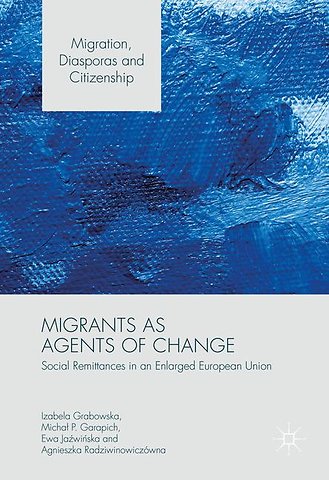
Migrants as Agents of Change
Social Remittances in an Enlarged European Union
Gebonden Engels 2016 9781137590657Samenvatting
This book offers a unique and innovative way of looking at the paradoxical consequences of human mobility. Based on a three-year transnational multi-sited longitudinal research project, it demonstrates that not all migrants acquire, transfer and implement social remittances in the same way. Whilst the circulation of ideas, norms and practices is an important aspect of modernity, acts of resistance, imitation and innovation mean that whilst some migrants become ordinary agents of social change in their local microcosms, others may contest that change. By putting this individual agency centre stage, the authors trace how social remittances are evolving, and the ambiguous impact that they have on society. This thought-provoking work will appeal to students and scholars of sociology, geography and anthropology.
Specificaties
Lezersrecensies
Inhoudsopgave
Rubrieken
- advisering
- algemeen management
- coaching en trainen
- communicatie en media
- economie
- financieel management
- inkoop en logistiek
- internet en social media
- it-management / ict
- juridisch
- leiderschap
- marketing
- mens en maatschappij
- non-profit
- ondernemen
- organisatiekunde
- personal finance
- personeelsmanagement
- persoonlijke effectiviteit
- projectmanagement
- psychologie
- reclame en verkoop
- strategisch management
- verandermanagement
- werk en loopbaan