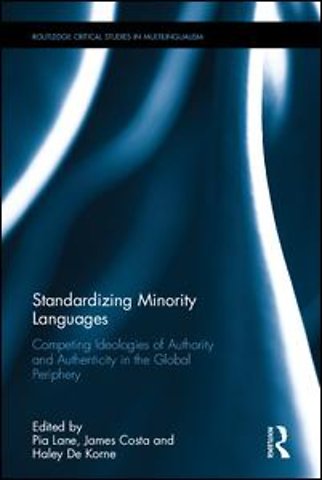
Standardizing Minority Languages
Competing Ideologies of Authority and Authenticity in the Global Periphery
Gebonden Engels 2017 1e druk 9781138125124Samenvatting
The Open Access version of this book, available at https://www.taylorfrancis.com/books/9781138125124, has been made available under a Creative Commons Attribution-Non Commercial-No Derivatives 4.0 license.
This volume addresses a crucial, yet largely unaddressed dimension of minority language standardization, namely how social actors engage with, support, negotiate, resist and even reject such processes. The focus is on social actors rather than language as a means for analysing the complexity and tensions inherent in contemporary standardization processes. By considering the perspectives and actions of people who participate in or are affected by minority language politics, the contributors aim to provide a comparative and nuanced analysis of the complexity and tensions inherent in minority language standardisation processes. Echoing Fasold (1984), this involves a shift in focus from a sociolinguistics of language to a sociolinguistics of people.
The book addresses tensions that are born of the renewed or continued need to standardize ‘language’ in the early 21st century across the world. It proposes to go beyond the traditional macro/micro dichotomy by foregrounding the role of actors as they position themselves as users of standard forms of language, oral or written, across sociolinguistic scales. Language policy processes can be seen as practices and ideologies in action and this volume therefore investigates how social actors in a wide range of geographical settings embrace, contribute to, resist and also reject (aspects of) minority language standardization.
Specificaties
Lezersrecensies
Inhoudsopgave
- Introduction: Standardising Minority Languages: Reinventing peripheral languages in the 21st century? James Costa, Haley De Korne, and Pia Lane
- Basque Standardization and the New Speaker: Political Praxis and the Shifting Dynamics of Authority and Value Jacqueline Urla, Estibaliz Amorrortu, Ane Ortega, and Jone Goirigolzarri
- On the pros and cons of standardizing Scots: Notes from the North of a small island James Costa
- Legitimating Limburgish: The reproduction of heritage Diana Camps
- Negotiating the standard in contemporary Galicia Bernadette O’Rourke
- Language standardisation as frozen mediated actions – the materiality of language standardization Pia Lane
- Language standardization in the aftermath of the Soviet Language Empire Lenore Grenoble and Nadezhd Ja. Bulatova
- Standardization of Inuit languages in Canada Donna Patrick, Kumiko Murasugi, and Jeela Palluq-Cloutier
- "That's too much to learn": Writing, longevity, and urgency in the Isthmus Zapotec speech community Haley De Korne
- Orthography, Standardization, and Register: The Case of Manding Coleman Donaldson
- Beyond Colonial Linguistics: The Dialectic of Control and Resistance in the Standardization of isiXhosa Ana Deumert and Nkululeko Mabandla
- Visions and revisions of minority languages: Standardization and its dilemmas
Susan Gal
Rubrieken
- advisering
- algemeen management
- coaching en trainen
- communicatie en media
- economie
- financieel management
- inkoop en logistiek
- internet en social media
- it-management / ict
- juridisch
- leiderschap
- marketing
- mens en maatschappij
- non-profit
- ondernemen
- organisatiekunde
- personal finance
- personeelsmanagement
- persoonlijke effectiviteit
- projectmanagement
- psychologie
- reclame en verkoop
- strategisch management
- verandermanagement
- werk en loopbaan