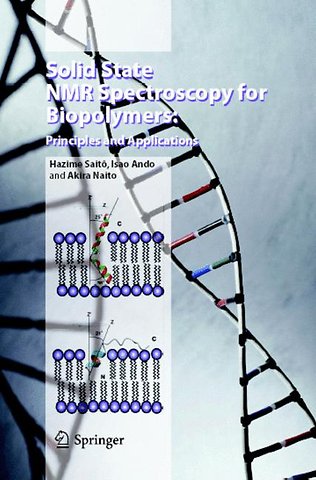
Solid State NMR Spectroscopy for Biopolymers
Principles and Applications
Gebonden Engels 2006 9781402043024Samenvatting
‘‘Biopolymers’’ are polymeric materials of biological origin, including globular, membrane, and fibrous proteins, polypeptides, nucleic acids, po- saccharides, lipids, etc. and their assembly, although preference to respe- ive subjects may be different among readers who are more interested in their biological significance or industrial and/or medical applications. Nevert- less, characterizing or revealing their secondary structure and dynamics may be an equally very important and useful issue for both kinds of readers. Special interest in revealing the 3D structure of globular proteins, nucleic acids, and peptides was aroused in relation to the currently active Structural Biology. X-ray crystallography and multidimensional solution NMR sp- troscopy have proved to be the standard and indispensable means for this purpose. There remain, however, several limitations to this end, if one intends to expand its scope further. This is because these approaches are not always straightforward to characterize fibrous or membrane proteins owing to extreme difficulty in crystallization in the former, and insufficient spectral resolution due to sparing solubility or increased effective molecular mass in the presence of surrounding lipid bilayers in the latter.
Specificaties
Lezersrecensies
Inhoudsopgave
1. Introduction
2. Solid state NMR approach
2.1. CP-MAS and DD-MAS NMR
2.2. Quadrupolar nuclei
3. Brief outline of NMR parameters
3.1. Chemical shifts
3.2. Relaxation parameters
3.3. Dynamics-dependent suppression of peaks
4. Multinuclear approaches
4.1. 31P NMR
4.2. 2H NMR
4.3. 17O NMR
5. Experimental strategies
5.1. Isotope enrichment (labeling)
5.2. Assignment of peaks
5.3. Ultra high-field and ultra high-speed MAS NMR spectroscopy
6. NMR constraints for structural determination
6.1. Orientational constraint
6.2. Interatomic distance
6.3. Torsion angles
6.4. Conformation-dependent 13C chemical shifts
7. Dynamics
7.1. Fast motions with motional frequency >106 Hz
7.2. Intermediate or slow motions with frequency between 106 and 103 Hz
7.3. Very slow motions with frequency < 103 Hz
Part II Applications
8. Hydrogen bonded systems
8.1. Hydrogen bond shifts
8.2. 2H quadrupolar coupling constant
9. Fibrous proteins
9.1. Collagen fibrils
9.2. Elastin
9.3. Cerial proteins
9.4. Silk fibroin
9.5. Keratin
9.6. Bacteriophage coat protein
10. Polysaccharides
10.1. Distinction of polymorphs
10.2. Network structure, dynamics and gelation mechanism
11. Polypeptides as new materials
11.1. Liquid crystalline polypeptides
11.2. Blend system
12. Globular proteins
12.1. (Almost) complete assignment of 13C NMR spectra of globular proteins
12.2. 3D structure: ?-spectrin SH3 domain
12.3. Ligand-binding to globular protein
13. Membrane protein I: dynamic picture
13.1. Bacteriorhodopsin
13.2. Phoborhodopsin and its cognitive transducer
13.3. Diacylgycerol kinase
14. Membrane proteins II: 3D structure
14.1. 3D structure of mechanically aligned membrane proteins
14.2. Secondary structure based on distance constraints
15. Biologically active membrane-associated peptides
15.1. Channel-forrming peptides
15.2. Antimicrobial peptides
15.3. Opioid peptides
15.4. Fusion peptides
15.5. Membrane model system
17. Amyloid and related biomolecules
17.1. Amyloid ?-peptide
17.2. Calcitonin (CT)
Rubrieken
- advisering
- algemeen management
- coaching en trainen
- communicatie en media
- economie
- financieel management
- inkoop en logistiek
- internet en social media
- it-management / ict
- juridisch
- leiderschap
- marketing
- mens en maatschappij
- non-profit
- ondernemen
- organisatiekunde
- personal finance
- personeelsmanagement
- persoonlijke effectiviteit
- projectmanagement
- psychologie
- reclame en verkoop
- strategisch management
- verandermanagement
- werk en loopbaan