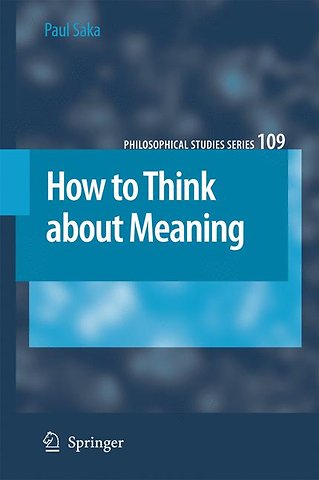
How to Think about Meaning
Gebonden Engels 2007 9781402058561Samenvatting
According to the dominant theory of meaning, truth-conditional semantics, to explain the meaning of a statement is to specify the conditions necessary and sufficient for its truth. Classical truth-conditional semantics is coming under increasing attack, however, from contextualists and inferentialists, who agree that meaning is located in the mind.
How to Think about Meaning develops an even more radical mentalist semantics, which it does by shifting the object of semantic inquiry. Whereas for classical semantics the object of analysis is an abstract sentence or utterance such as “Grass is green”, for attitudinal semantics the object of inquiry is a propositional attitude such as “Speaker so-and-so thinks grass is green”. Explicit relativization to some speaker S allows for semantic theory then to make contact with psychology, sociology, historical linguistics, and other empirical disciplines.
Specificaties
Lezersrecensies
Inhoudsopgave
Rubrieken
- advisering
- algemeen management
- coaching en trainen
- communicatie en media
- economie
- financieel management
- inkoop en logistiek
- internet en social media
- it-management / ict
- juridisch
- leiderschap
- marketing
- mens en maatschappij
- non-profit
- ondernemen
- organisatiekunde
- personal finance
- personeelsmanagement
- persoonlijke effectiviteit
- projectmanagement
- psychologie
- reclame en verkoop
- strategisch management
- verandermanagement
- werk en loopbaan