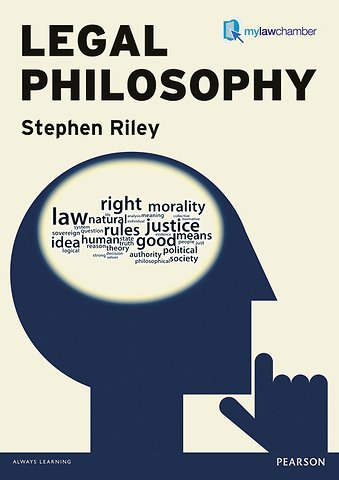
Legal Philosophy
Paperback Engels 2012 9781408277348Samenvatting
“I consider this to be a well-written and engaging text. The analysis is detailed, appropriate and clear, and reflects a more innovative sense of the jurisprudential issues and problems that are important to undergraduate study.”
Dr. Alun Gibbs, University of Southampton
In some respects, the law can be viewed simply as a system of rules which govern our actions. Yet at the very heart of law lie numerous philosophical questions - questions about how people live their lives, about what it means to be “just,” or about how we should organise ourselves as a society.
In Legal Philosophy, Dr. Stephen Riley offers an accessible introduction to the most important themes shared by law and philosophy. He examines the key concepts that characterise what law tries, or ought to try to do, providing analysis of what leading thinkers and theorists from varying, often conflicting, schools of thought have contributed to our understanding of them. He questions what we mean, what we have meant and what we should mean when we talk about ideas central to law, such as “person,” “good,” “right,” “rules,” and “justice” and, by taking this approach, aims to develop your own skill around questioning and reasoning, providing a springboard to further study.
He also uses a number of innovative devices to help develop your understanding, such as extracted materials which demonstrate where a given concept is evident in “real” law; or the “concept and method” sections at the end of each chapter which help you apply the themes presented.
Clear, lively and engaging Legal Philosophy is the ideal companion for anyone enrolled on legal philosophy, legal theory or jurisprudence courses.
Dr. Stephen Riley is Senior Lecturer in Law at Sheffield Hallam University where he teaches and writes on the philosophy of law, particularly in the areas of human dignity, critical theory and law, and general jurisprudence.
Specificaties
Lezersrecensies
Inhoudsopgave
Chapter 1 Justice
1 Ends
a. Judgment
b. Desert
c. Truth
2 Means
a. Adjudication
b. Impartiality
c. Equality
3 Individuals
a. The individual’s good
b. Rights
c. Status
4 Collectives
a. The common good
b. The rule of law
c. Authority
5 Philosophy and justice
a. Meta-theory
b. Scepticism
c. Pragmatism
Questions
Concepts and methods
§ Theorising
Further reading
Chapter 2 Person
1 Facts and values
a. Humans and persons
b. Science and facts
c. Humanity and human nature
2 Aristotle
a. The human species
b. Political animals
c. The situated person
3 Humanism
a. Humanity and persons
b. Liberty
c. Fraternity and equality
4 Feminism
a. The second sex
b. Nature as ideology
c. Identity politics
5 Freedom
a. Freedom as liberty
b. Freedom as rationality
c. Freedom as autonomy
Questions
Concepts and methods
§ Ideas and ideology
Further reading
Chapter 3 Good
1 The good
a. The human good
b. A good life and justice
c. Happiness and harmony
2 Plato
a. The good and the individual
b. The good and the state
c. Contemporary Platonism
3 Natural law
a. Early natural law
b. Natural law and religion
c. Modern natural law
4 Utilitarianism
a. Hedonism
b. Utilitarianism
c. Variants of utilitarianism
5 Place and property
a. Property
b. Environment
c. Capability
Questions
Concepts and methods
§ Values
Further reading
Chapter 4 Right
1 Right
a. Right and truth
b. Right answers
c. Right as justice
2 Right as correspondence
a. Kant: right as duty
b. Hegel: right made social
c. Marx: right made material
3 Right as coherence
a. Hobbes: right as contract
b. Mill: right as liberty
c. Rawls: right as fairness
4 Rights
a. Hohfeld: distinguishing rights
b. Dworkin: rights as trumps
c. Nozick: rights as constraints
5 Human rights
a. From natural rights to human rights
b. Particularity versus universality
c. Human rights and liberalism
Questions
Concepts and methods
§ Logic
Further reading
Chapter 5 Rule
1 Rules
a. Rules as commands
b. Forms and functions of rules
c. Formalism and anti-formalism
2 Positivism
a. Origins of positivism
b. Logical posit
Rubrieken
- advisering
- algemeen management
- coaching en trainen
- communicatie en media
- economie
- financieel management
- inkoop en logistiek
- internet en social media
- it-management / ict
- juridisch
- leiderschap
- marketing
- mens en maatschappij
- non-profit
- ondernemen
- organisatiekunde
- personal finance
- personeelsmanagement
- persoonlijke effectiviteit
- projectmanagement
- psychologie
- reclame en verkoop
- strategisch management
- verandermanagement
- werk en loopbaan