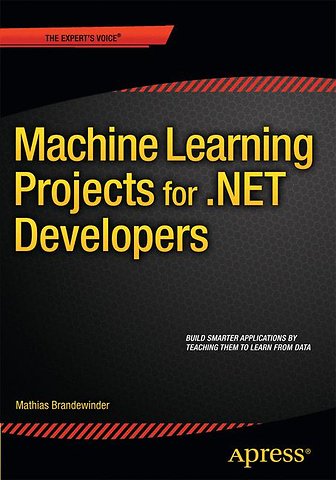
Machine Learning Projects for .NET Developers
Paperback Engels 2015 2014e druk 9781430267676Samenvatting
Machine Learning Projects for .NET Developers shows you how to build smarter .NET applications that learn from data, using simple algorithms and techniques that can be applied to a wide range of real-world problems. You’ll code each project in the familiar setting of Visual Studio, while the machine learning logic uses F#, a language ideally suited to machine learning applications in .NET. If you’re new to F#, this book will give you everything you need to get started. If you’re already familiar with F#, this is your chance to put the language into action in an exciting new context.
In a series of fascinating projects, you’ll learn how to:Build an optical character recognition (OCR) system from scratchCode a spam filter that learns by exampleUse F#’s powerful type providers to interface with external resources (in this case, data analysis tools from the R programming language)Transform your data into informative features, and use them to make accurate predictionsFind patterns in data when you don’t know what you’re looking forPredict numerical values using regression modelsImplement an intelligent game that learns how to play from experience
Along the way, you’ll learn fundamental ideas that can be applied in all kinds of real-world contexts and industries, from advertising to finance, medicine, and scientific research. While some machine learning algorithms use fairly advanced mathematics, this book focuses on simple but effective approaches. If you enjoy hacking code and data, this book is for you.
Specificaties
Lezersrecensies
Inhoudsopgave
Chapter 2: Spam or Ham? Detecting Spam in Text Using Bayes' Theorem
Chapter 3: The Joy of Type Providers: Finding and Preparing Data, From Anywhere
Chapter 4: Of Bikes and Men: Fitting a Regression Model to Data with Gradient Descent
Chapter 5: You Are Not An Unique Snowflake: Detecting Patterns with Clustering and Principle Component Analysis
Chapter 6: Trees and Forests: Making Predictions from Incomplete Data
Chapter 7: A Strange Game: Learning From Experience with Reinforcement Learning
Chapter 8: Digits, Revisited: Optimizing and Scaling Your Algorithm Code
Chapter 9: Conclusion
Rubrieken
- advisering
- algemeen management
- coaching en trainen
- communicatie en media
- economie
- financieel management
- inkoop en logistiek
- internet en social media
- it-management / ict
- juridisch
- leiderschap
- marketing
- mens en maatschappij
- non-profit
- ondernemen
- organisatiekunde
- personal finance
- personeelsmanagement
- persoonlijke effectiviteit
- projectmanagement
- psychologie
- reclame en verkoop
- strategisch management
- verandermanagement
- werk en loopbaan