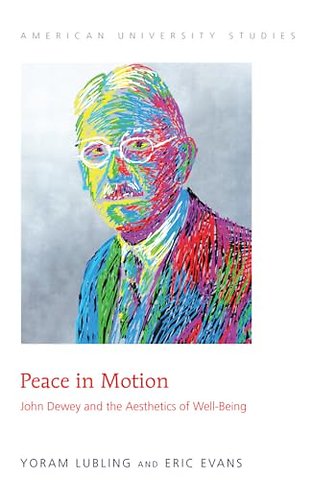
Peace in Motion
John Dewey and the Aesthetics of Well-Being
Gebonden EN 2016 9781433121234Samenvatting
In this book Yoram Lubling and Eric Evans offer a Deweyan reconstruction of our philosophical understanding of well-being. They begin with Dewey’s critique of the «philosophical fallacy» to examine the legitimacy and value of theories of well-being offered by traditional philosophy. However, such theories fail to provide an authentic account of well-being due to a false understanding of experience as either epistemic or cognitive. Next, using Dewey’s theory of experience, they reconstruct «happiness» as the target for evaluation of well-being. This leads them to reject the traditional view of a private encapsulated self, and to offer in its place a transactionally situated self which is an embodied, enculturated agent. Through their emphasis on the importance of the qualitative aspects of Dewey’s understanding of a situation, the pervasive quality of the situation emerges as the most plausible criterion for the evaluation of well-being. The authors use Dewey’s theories of inquiry, ethics, value and art to establish the naturalistic conditions under which such pervasive quality enters into a situation as either settled or unsettled, in other words, as peace in motion. Consequently, a problematic situation becomes the primary condition under which all inquiry initiates whether it is in the context of science, ethics, values, art or ordinary living. Lubling and Evans conclude that a Deweyan account of well-being involves embodied knowing instead of the traditional view of cognitive knowledge. By using such an account, it is possible to explain the conditions and mechanisms under which well-being contributes to the enlargement and enrichment of individual and collective human experience.
Specificaties
Lezersrecensies
Rubrieken
- advisering
- algemeen management
- coaching en trainen
- communicatie en media
- economie
- financieel management
- inkoop en logistiek
- internet en social media
- it-management / ict
- juridisch
- leiderschap
- marketing
- mens en maatschappij
- non-profit
- ondernemen
- organisatiekunde
- personal finance
- personeelsmanagement
- persoonlijke effectiviteit
- projectmanagement
- psychologie
- reclame en verkoop
- strategisch management
- verandermanagement
- werk en loopbaan